nebula
Rosette Nebula
The Rosette Nebula is a vast cloud of glowing hydrogen in Monoceros, the Unicorn, shaped like an open flower with a hollow heart. Gaia measurements of its stars place it about 1,490 parsecs away, while agency pages give 4,700 to 5,200 light-years. ESO puts it at over 100 light-years across, and on the sky it covers more than six times the area of the full Moon.12345
At its centre sits the young star cluster NGC 2244, about two million years old. Ultraviolet light from its hottest stars, among them the O-type stars HD 46150 and HD 46223, makes the gas glow, and their radiation and winds have cleared the central cavity. Around the bubble, dark pillars, globules and newborn stars show that star formation is still going on.1356789
Shape and size in space
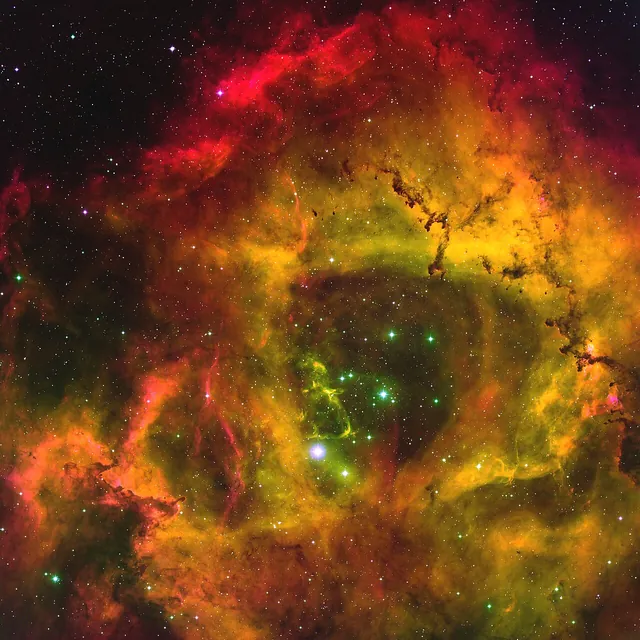
A 2022 study using Gaia EDR3 parallaxes found an average distance of 1,489 ± 37 parsecs for the whole region, 1,440 ± 32 parsecs for NGC 2244 and 1,525 ± 36 parsecs for NGC 2237. Earlier estimates for the cluster ranged from 1,400 to 1,700 parsecs, and agency pages quote 4,700, 5,000 or 5,200 light-years. ESO describes the nebula as over 100 light-years across.1234
The Rosette is the most prominent and active star-forming region in the Mon OB2 association. Its central cluster has blown a roughly circular cavity into the Rosette molecular cloud, and the expanding H II region now presses against that cloud. A 2025 survey with SDSS-V’s Local Volume Mapper supports the idea that the nebula grew from an uneven molecular cloud with a thin, sheet-like structure.11214
Beyond the glowing bubble, molecular gas is being pushed outwards. A survey of carbon monoxide found about 2,000 compact clumps and a molecular ring of radius 11 parsecs expanding at 30 km/s, with a dynamical lifetime of about a million years. In the north, the shells, elephant trunks and tiny globulettes are all moving outwards at nearly the same speed, about 22 km/s.1516
- Distance of the whole region
- 1,489 ± 37 pc1Gaia EDR3
- Distance of NGC 2237
- 1,525 ± 36 pc1
- Diameter
- over 100 light-years2
- Apparent size of NGC 2237
- 80′ × 50′10
- Mass of the nebula
- about 10,000 solar masses2
- Expanding molecular ring
- radius 11 pc, expanding at 30 km/s15
- Compact molecular clumps
- about 2,00015
- Expansion of the northern shells and globulettes
- about 22 km/s16
What makes it shine
The Rosette is an H II region: its hydrogen is ionised by ultraviolet light from the young, hot, blue stars of NGC 2244, which sets the gas glowing. ESO describes the whole region glowing red in hydrogen light. Emission-line images separate the light of hydrogen, doubly ionised oxygen and ionised sulphur, and a 2025 spectroscopic survey mapped how their ratios change across the nebula.2512
The nebula also holds gas far hotter than the glowing hydrogen. Chandra found soft, diffuse X-rays spread over parsec scales, from plasma at about 0.7 and 9 million kelvin. It most likely comes from the fast winds of the O stars, heated where winds collide or strike surrounding gas; most of the wind energy seems to flow out into interstellar space without cooling.13
In infrared light the picture changes. Spitzer shows how the O stars’ radiation and winds have cleared dust away, revealing a cavity of cooler dust. Herschel’s far-infrared maps of the neighbouring Rosette molecular cloud show the dust growing colder, and the gas denser, with distance from NGC 2244, a sign that the cluster’s radiation reaches deep into the cloud.414
The stars inside
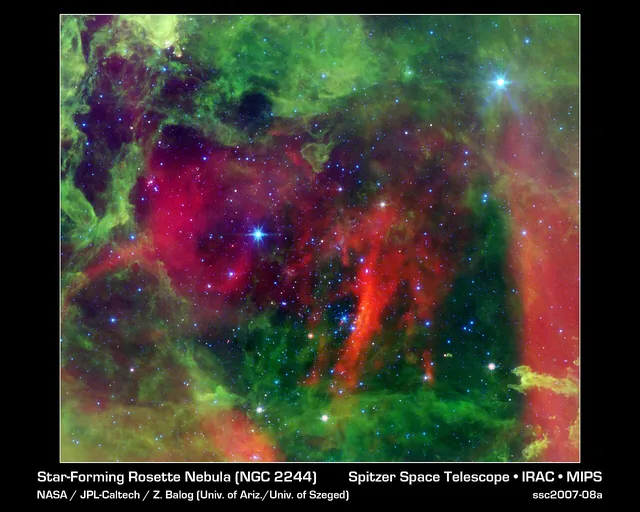
NGC 2244 lies at the heart of the cavity. A Chandra survey detected more than 900 X-ray sources there and estimated a total population of about 2,000 stars, strongly concentrated around the central O5 star HD 46150; the other early O star, HD 46223, of type O4, has few companions. A 2022 census found almost 3,000 probable members across the wider region.1678
The cluster is about 2 million years old and appears to be flying apart. Its stars show a clear expansion pattern, faster farther out, and they move too fast for its total mass of about 1,000 Suns to hold them, so NGC 2244 may be unbound. Deep Gemini imaging traced its population down to brown dwarfs of about 0.02 solar masses.1617
Other groups of young stars surround it. Chandra raised the count in the smaller cluster NGC 2237 from 36 to about 160 stars. Spitzer, studying about 1,000 stars, found that within about 1.6 light-years of an O star only 27 per cent of young stars keep planet-forming discs, against about 45 per cent farther away.318
- HD 46150
- spectral type O5V((f))z; magnitude 6.737
- HD 46223
- spectral type O4V((f)); magnitude 7.288
- X-ray sources in NGC 2244
- more than 9006
- Estimated stars in NGC 2244
- about 2,0006
- Mass of NGC 2244
- 1,000 ± 70 solar masses1
- Half-mass radius of NGC 2244
- 3.4 ± 0.2 pc1
- Stars in NGC 2237
- about 160336 known before Chandra
- Stars with discs
- 27 per cent within about 1.6 light-years of an O star; about 45 per cent beyond18
Notable features
NGC 2244
The open cluster at the centre of the Rosette, of magnitude 4.8 and 24′ across. Its massive stars are thought to have cleared much of the gas from the centre of the bubble. The cluster is expanding, faster with distance from its centre, and may not be held together by gravity.111
NGC 2237
The western part of the nebula, listed under its own NGC number, and a smaller satellite cluster of young stars. Chandra’s census of about 160 stars there, together with an outflow from a dark cloud, showed that star formation continues, and suggested that this cluster formed after the central one.310
Globulettes and elephant trunks
Dark specks and trunks of dense gas lie where the H II region meets the molecular shell. Radio observations of globulettes gave masses of about 50 to 500 times Jupiter’s. Several contain dense cores, strengthening the idea that some might collapse to form brown dwarfs or planetary-mass objects.16
North-western globules
Small globules protruding from the shell in the nebula’s north-west. Near-infrared imaging with ESO’s New Technology Telescope measured mean densities of about 46,000 particles per cubic centimetre and found an outflow from a Class I protostar embedded deep inside one of them.19
The Rosette molecular cloud
The large molecular cloud beside the nebula, where star formation is most active today. Spitzer data reveal 1,528 young stellar objects across the Rosette; in a ring 11–16 parsecs from the centre about 30 per cent are very young Class I sources, while the central clusters have almost none.914
Discovery and history
According to ESO, the English astronomer John Flamsteed discovered the Rosette around 1690. Catalogues give the nebula several numbers: the Revised New General Catalogue lists NGC 2237 as its western part and NGC 2244 as the cluster inside it, and astronomers refer to the whole glowing cloud as NGC 2237–2246.2101113
Modern studies have used the Rosette to test whether massive stars trigger the birth of new ones. Herschel found an age sequence of dense cores, from more evolved to younger, with increasing distance from NGC 2244, and Chandra results suggested the central cluster formed first. A 2021 kinematic study argued that some outer groups instead formed spontaneously in filaments of a turbulent cloud.31420
- Discovered
- around 16902by John Flamsteed
Seeing it for yourself
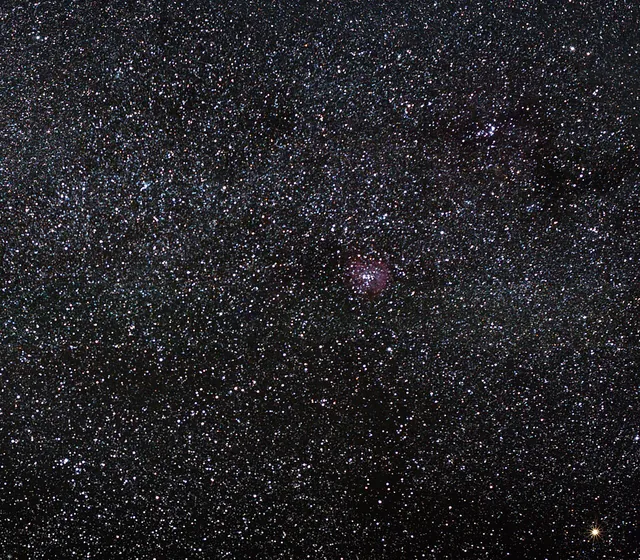
The Rosette lies in Monoceros, the Unicorn, a constellation visible from both hemispheres. Its central cluster, NGC 2244, shines at magnitude 4.8 and is easily seen even with small telescopes, but the nebula itself is harder to spot and needs a larger telescope. It is enormously large on the sky, covering more than six times the area of the full Moon.23511
Telescopes on the Rosette
Chandra observed the Rosette in January 2001, resolving more than 300 stars and the hot diffuse gas between them; with later pointings in 2004 and 2007 it gathered 50 hours of data. Spitzer surveyed about 1,000 stars for planet-forming discs in a study published in 2007, and Herschel mapped the molecular cloud’s cold dust during its science demonstration phase.3131418
Surveys continue. A 2019 study with the Gemini-South telescope counted the cluster’s brown dwarfs, Gaia measured the motions of its stars, and in October 2023 SDSS-V’s Local Volume Mapper collected 33,326 spectra over a radius of about a degree. A 2026 analysis of stacked Spitzer images catalogued about 20,000 sources and picked out 1,528 young stellar objects.191217
Quick answers
- What kind of object is the Rosette Nebula?
- The Rosette Nebula is an H II region (emission nebula) around a young open cluster.101112
- Which constellation is the Rosette Nebula in?
- The Rosette Nebula lies in the constellation Monoceros.310
- How far away is the Rosette Nebula?
- The Rosette Nebula is about 1,490 parsecs from Earth (Gaia average for the region, 1,489 ± 37 pc; agency pages give 4,700–5,200 light-years).124
- How big is the Rosette Nebula?
- The Rosette Nebula is over 100 light-years across.2
- How big does the Rosette Nebula look in the sky?
- The Rosette Nebula covers 80′ × 50′ of sky (NGC 2237 in the Revised NGC; more than six times the area of the full Moon).510
- How bright is the Rosette Nebula in the night sky?
- The Rosette Nebula has an apparent magnitude of 4.8 (the central cluster NGC 2244).11
- How old is the Rosette Nebula?
- The Rosette Nebula is about 2 million years old (the cluster NGC 2244).16
- How massive is the Rosette Nebula?
- The Rosette Nebula has a mass of about 10,000 solar masses (estimated mass of the nebula).2
Sources
- Stellar population of the Rosette Nebula and NGC 2244: application of the probabilistic random forest (Mužić et al.) — Astronomy & Astrophysics 668, A19 (arXiv:2209.13302), 2022
- The Rosette Nebula: a cosmic rose (image b12) — European Southern Observatory, 2009
- Rosette Nebula: The Heart of a Rose (Chandra Photo Album, 8 September 2010) — Chandra X-ray Center, Harvard-Smithsonian Center for Astrophysics, 2010
- Heart of the Rosette Nebula (ssc2007-08a) — NASA Jet Propulsion Laboratory, Caltech (Spitzer), 2007
- Rosette emission-line image (noao0403a) — NSF NOIRLab, 2004
- A Chandra Study of the Rosette Star-Forming Complex. I. The Stellar Population and Structure of the Young Open Cluster NGC 2244 (Wang et al.) — Astrophysical Journal (arXiv:0711.2024), 2008
- SIMBAD astronomical database: HD 46150 — Centre de Données astronomiques de Strasbourg (CDS)
- SIMBAD astronomical database: HD 46223 — Centre de Données astronomiques de Strasbourg (CDS)
- Tracing star formation across the Rosette nebula using deep Spitzer imaging (Capela et al.) — Monthly Notices of the Royal Astronomical Society (arXiv:2609.40021), 2026
- Revised NGC Data for NGC 2237 (from W. Steinicke’s Revised NGC and IC Catalog) — SEDS Interactive NGC Catalog
- Revised NGC Data for NGC 2244 (from W. Steinicke’s Revised NGC and IC Catalog) — SEDS Interactive NGC Catalog
- SDSS-V Local Volume Mapper (LVM): Revealing the Structure of the Rosette Nebula (Villa-Durango et al.) — Monthly Notices of the Royal Astronomical Society (arXiv:2509.10665), 2025
- Ten Million Degree Gas in M 17 and the Rosette Nebula: X-ray Flows in Galactic H II Regions (Townsley et al.) — Astrophysical Journal 593, 874 (arXiv:astro-ph/0305133), 2003
- The Herschel view of star formation in the Rosette molecular cloud under the influence of NGC 2244 (Schneider et al.) — Astronomy & Astrophysics (arXiv:1005.3924), 2010
- A large-scale CO survey of the Rosette Molecular Cloud: assessing the effects of O stars on surrounding molecular gas (Dent et al.) — Monthly Notices of the Royal Astronomical Society (arXiv:0902.4138), 2009
- Mass and motion of globulettes in the Rosette Nebula (Gahm et al.) — Astronomy & Astrophysics (arXiv:1305.2485), 2013
- Looking deep into the Rosette Nebula’s heart: the (sub)stellar content of the massive young cluster NGC 2244 (Mužić et al.) — Astrophysical Journal (arXiv:1907.00617), 2019
- Astronomers Map Out Planetary Danger Zone (ssc2007-08) — NASA Jet Propulsion Laboratory, Caltech (Spitzer), 2007
- Rosette nebula globules: Seahorse giving birth to a star (Mäkelä et al.) — Astronomy & Astrophysics 605, A82 (arXiv:1707.05074), 2017
- A kinematic perspective on the formation process of the stellar groups in the Rosette Nebula (Lim et al.) — Astronomical Journal (arXiv:2105.03698), 2021
- SIMBAD astronomical database: NGC 2244 — Centre de Données astronomiques de Strasbourg (CDS)
Figures checked against these sources in November 2026. Where a quantity is not known, it is left out rather than estimated.

