nebula
IC 1396
IC 1396 is a vast cloud of glowing hydrogen in Cepheus, more than 3° across on the sky. At its centre lies the young star cluster Trumpler 37, and the cloud is lit and ionised by the cluster’s central star, HD 206267, a hot multiple star of spectral type O6. Gaia measurements of the cluster’s stars put it about 925 parsecs away.1234
Round its edge stand more than 20 dark globules of gas and dust with bright rims, the remains of the cloud that formed the cluster, slowly being eaten away by its light. The largest is the Elephant’s Trunk. The light that erodes these globules also squeezes them, and new stars are forming inside many of them while the cluster itself is only about 4 million years old.135
Shape and size in space
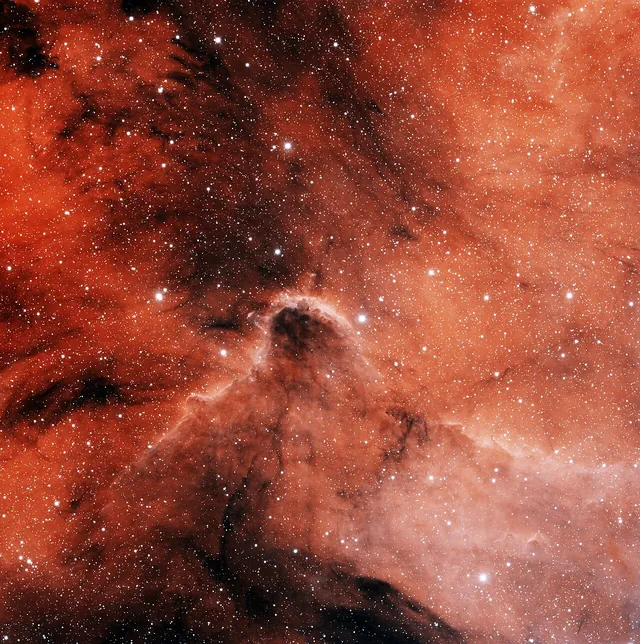
IC 1396 is a ring-shaped H II region, a bubble of ionised gas some 3° across on the sky, with a hollow interior that shows little nebulosity. Its shell is about 12 parsecs in radius. As the H II region expanded it swept the surrounding cold gas into a ring of molecular clouds: one study finds the ring expanding at about 5 km per second for some 2.5 million years, and another gives an expansion age of about 3 million years.159
Its distance has been measured many ways. A 2002 study of the cluster gave 870 parsecs, and parallaxes from the Gaia spacecraft give 945 parsecs (2019) and, with newer data, 925 ± 73 parsecs (2023). Hipparcos parallaxes of the wider Cep OB2 association gave a smaller 615 ± 35 parsecs. NASA pages round the distance to nearly 3,000 light-years.13578
IC 1396 belongs to Cep OB2, a group of young massive stars discovered by Viktor Ambartsumian in 1949. The cluster Trumpler 37 forms its younger subgroup, Cep OB2b. The older subgroup, Cep OB2a, about 7 to 8 million years old, is spread across a much larger area of sky and lies inside the Cepheus Bubble, a ring of infrared emission 9° across.1
What makes it shine
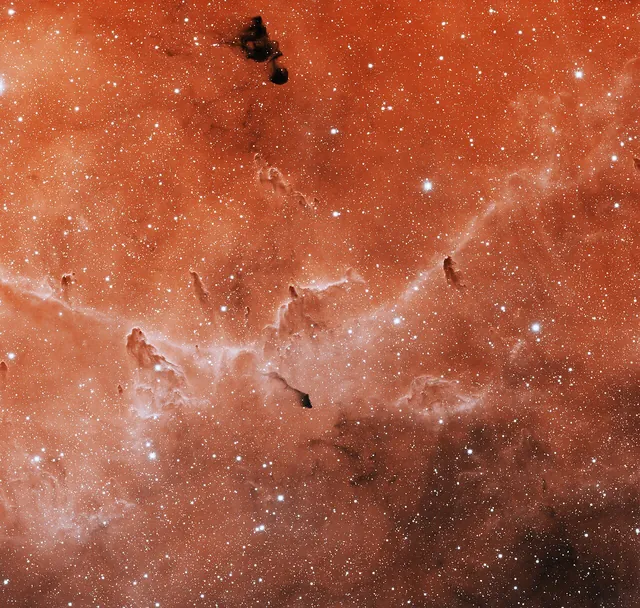
IC 1396 is an emission nebula: its gas shines with its own light. HD 206267 is the main source of the photo-ionisation that energises it, and photographs of the nebula record the red light of hydrogen alongside the glow of sulphur.1257
The ionised gas also shines at radio wavelengths, and a 1980 radio map was used to build a three-dimensional model of it. Outside the ionised zone lies cold gas that does not glow: radio surveys of atomic hydrogen found about 20,000 solar masses of it wrapped round the H II region, and dark dust clouds crowd its edge, seen in silhouette against the bright gas behind.15
- Atomic hydrogen round the nebula
- about 2 × 10⁴ solar masses1
The stars inside
Trumpler 37 is one of the youngest known open clusters. Age estimates cluster around 4 million years: 3.7 million in a 1990 study, about 4 million in studies of its young stars published in 2005 and 2023, and 2 to 4 million in a 2025 survey with the Subaru telescope. It has become a benchmark for how the discs of dust and gas round young stars evolve: about two in five of its discs show signs of having evolved.131214
Its brightest star, HD 206267, is a Trapezium-like multiple system at the centre of the nebula. SIMBAD lists the main pair as types O6 and O9, and it shines at magnitude 5.6. Studies of the region also describe its main star as O6.5. It was the star Barnard picked out in 1894 as the brightest of the group, then catalogued as DM +56° 2617. The red supergiant mu Cephei may also belong to the cluster, as suggested in 1976.14513
The cluster’s population keeps growing as surveys improve. A 1987 study found 427 probable members from their motions. In 2005 about 40 per cent of its young stars were found to be still feeding from their discs. Gaia data analysed in 2023 added 334 new members and revealed four subclusters at the same distance but moving differently, a sign of several bursts of star formation. In 2025 the Subaru telescope identified 2,425 likely low-mass members, 1,331 of them new. The youngest stars lie mostly west of HD 206267.1314
Notable features
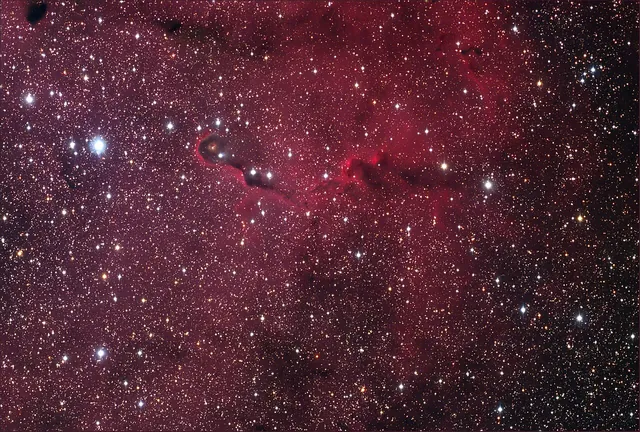
Elephant’s Trunk (IC 1396A)
The bright-rimmed cloud closest on the sky to HD 206267, about 15′ to its west, and the largest of the globules. Its rim is the brightest of all, so it is probably also the nearest to the star in space. It has formed several generations of stars, some apparently triggered by the star’s light.158
Bright-rimmed globules
More than 20 bright-rimmed and comet-shaped globules surround the nebula, most prominently on its western and northern sides. Pottasch lettered the main ones A to H in 1956 in order of distance from the star, and eleven appear in a 1991 catalogue of bright-rimmed clouds as BRC 32 to 42. The farther a globule lies from HD 206267, the more massive it tends to be, as expected if the star’s light is evaporating them.15
IC 1396N
A bright-rimmed cloud on the northern edge, also catalogued as BRC 38, and one of the main sites of new star formation in the region. Many Herbig–Haro objects, among the main signs of newborn stars, are catalogued in it, including HH 589 to 595 and HH 777 to 780.15
IC 1396 W
A small dark cloud about 1.75° west-north-west of HD 206267. It hides a very young Class 0 protostar that should grow into a star of about one solar mass, and three molecular outflows whose axes are parallel to within 3°.1
Hydrogen tails
Radio maps of atomic hydrogen show tail-like streams behind the globules IC 1396A, B and F, reaching up to 6.5 parsecs away from the central star. They may be gas stripped from the globules and swept downstream into their shadows.1
Barnard’s dark nebulae
Six dark clouds in the region are in E. E. Barnard’s catalogue of dark nebulae. In order of decreasing size they are B160, B161, B365, B163, B162 and B367.9
Discovery and history
E. E. Barnard found IC 1396 on photographs of the Milky Way taken at Lick Observatory with the Willard lens, 6 inches across. Writing in February 1894, he described a plate of Cepheus exposed for seven hours that showed “a mixture of bright stars and nebulosity”, which he called the great nebula and cluster in Cepheus. J. L. E. Dreyer’s Index Catalogue lists it with a reference to Barnard and the brief description “neb part of Milky Way”.1113
The first study of its molecular gas was made in 1975. In 1956 Pottasch lettered its bright-rimmed globules, and the globules were catalogued again in later surveys: as radial systems of globules in 1985, as bright-rimmed clouds in 1991, and from infrared extinction maps in 2005.1
Seeing it for yourself
IC 1396 is large but faint. It spans about 3° and Astronomy magazine recommends it to observers under exceptionally dark skies; some report glimpsing it with the naked eye, using averted vision, as a grey patch of magnitude 5.6. Its overall surface brightness is only about magnitude 14 per square arcminute.9
A good guide is mu Cephei, Herschel’s Garnet Star, which lies on the nebula’s northern edge and varies between magnitude 3.4 and 5.1 over two to two and a half years. Barnard first recorded the nebula on a seven-hour photographic exposure, and the NOIRLab image of the Elephant’s Trunk on this page was taken by visitors through the Advanced Observing Program at the Kitt Peak Visitor Center.91315
Telescopes on IC 1396
NASA’s Spitzer Space Telescope chose the Elephant’s Trunk for one of its first public images in December 2003, finding half a dozen protostars hidden in the dark globule. NASA’s Chandra X-ray Observatory has since picked out young stars in and around it by their X-rays, and a 2012 study combining those data with optical and infrared surveys estimated that triggered star formation accounts for more than 14 to 25 per cent of the region’s stars today.516
The Gaia spacecraft of the European Space Agency has measured the distances and motions of hundreds of the cluster’s stars, and in 2025 the Hyper Suprime-Cam on the Subaru telescope surveyed the whole complex. Visible-light mosaics with the Mayall 4-metre telescope at Kitt Peak have mapped parts of the nebula in detail, each covering only about 5 per cent of it.23814
Quick answers
- What kind of object is IC 1396?
- IC 1396 is an emission nebula (H II region) round the young star cluster Trumpler 37.15
- How far away is IC 1396?
- IC 1396 is about 925 parsecs from Earth (Gaia parallaxes of the cluster’s stars, ± 73 pc; earlier estimates range from about 615 to 945 pc, and NASA quotes nearly 3,000 light-years).1378
- How big does IC 1396 look in the sky?
- IC 1396 covers about 3° of sky (170′ × 140′ in the Revised IC).1910
- How bright is IC 1396 in the night sky?
- IC 1396 has an apparent magnitude of 3.5 (SEDS; observers report a magnitude 5.6 glow to the naked eye).911
- When was IC 1396 discovered?
- IC 1396 was discovered by 1894, photographically, by E. E. Barnard at Lick Observatory.13
Sources
- Star Forming Regions in Cepheus (M. Kun, Z. T. Kiss & Z. Balog) — Handbook of Star Forming Regions, Vol. I (Astronomical Society of the Pacific), 2008
- IC 1396 Northeast (noao-ic1396b) — NOIRLab
- Star formation in IC 1396: kinematics and subcluster structure revealed by Gaia (Pelayo-Baldárrago et al.) — Astronomy & Astrophysics, 2023
- SIMBAD astronomical database: HD 206267 — Centre de Données astronomiques de Strasbourg (CDS)
- The Elephant Trunk Nebula and the Trumpler 37 cluster: contribution of triggered star formation to the total population of an H II region (Getman et al.) — Monthly Notices of the Royal Astronomical Society, 2012
- SIMBAD astronomical database: IC 1396 — Centre de Données astronomiques de Strasbourg (CDS)
- APOD: IC 1396: Emission Nebula in Cepheus (5 August 2012) — NASA Science, 2012
- IRAM and Gaia views of multi-episodic star formation in IC 1396A (Sicilia-Aguilar et al.) — Astronomy & Astrophysics, 2019
- 101 must-see cosmic objects: IC 1396 (A. Goldstein) — Astronomy magazine, 2022
- Revised IC data for IC 1396 (from W. Steinicke’s Revised NGC and IC Catalog) — SEDS Interactive NGC Catalog
- IC 1396 (H. Frommert) — SEDS NGC/IC database
- The low-mass stellar population in the young cluster Tr 37: disk evolution, accretion, and environment (Sicilia-Aguilar et al.) — Astronomy & Astrophysics, 2013
- Photographic nebulosities and star clusters connected with the Milky Way (E. E. Barnard) — Astronomy and Astro-Physics, vol. 13, pp. 177–182, 1894
- Subaru Hyper Suprime-Cam observations of IC 1396: source catalogue, member population, and sub-clusters of the complex (Das et al.) — Astronomy & Astrophysics, 2025
- Van den Bergh 142 and IC 1396 (noao-vdb142block) — NOIRLab
- Dark Globule in IC 1396 (ssc2003-06b) — NASA/JPL-Caltech, Spitzer Space Telescope, 2003
Figures checked against these sources in November 2026. Where a quantity is not known, it is left out rather than estimated.

