nebula
Elephant’s Trunk Nebula (IC 1396A)
The Elephant’s Trunk Nebula, IC 1396A, is a long, curling cloud of cold gas and dust standing inside the glowing nebula IC 1396 in Cepheus. NASA describes it as more than 20 light-years long. Dark in visible light, it is outlined by a bright rim where the ionising radiation of the hot star HD 206267, about 15′ to its east, is eating into it.1234
It is a showcase of star birth apparently set off by a massive star. Infrared telescopes found protostars hidden inside it, and X-ray, optical and infrared surveys have counted more than 250 young stars in and around it, the youngest lying deepest in the cloud.256
Shape and size in space
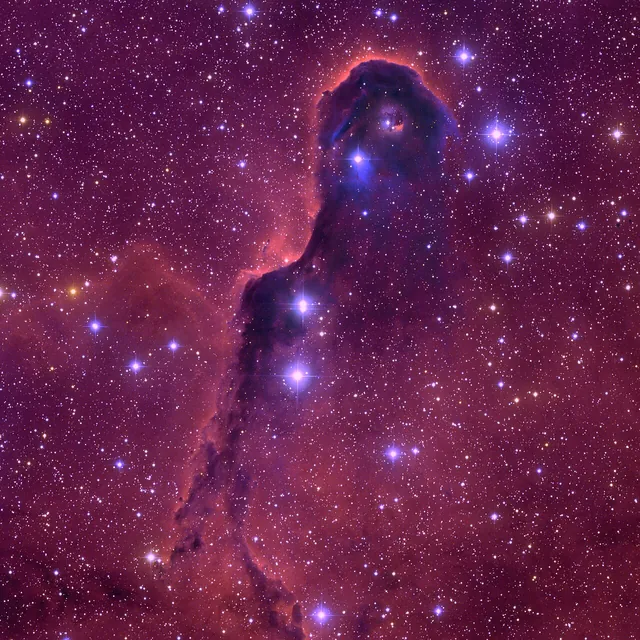
The Elephant’s Trunk is a cometary globule: a round head more than a parsec across with a long, swept-back tail. NASA describes the trunk as more than 20 light-years long, and on the sky it measures about 14′ by 2′. Its head faces HD 206267, about 15′ away, a projected distance of about 3.7 parsecs. Two bright rims mark the front: Rim A before the head, and Rim Aa further west at the trunk’s shoulder, where the cloud behind is catalogued separately as SFO 36.12379
The cloud holds about 200 solar masses of molecular gas and is thick with dust: away from its central hole, dust dims the starlight passing through by about 10 magnitudes, and up to 16 magnitudes in places. Its rim is the brightest of all the rims round IC 1396, which suggests that it is also the globule physically closest to HD 206267.211
Gaia measurements show the globule moving across the sky at about 4 km per second relative to the cluster Trumpler 37, about 8 km per second in total, too slow for the star’s radiation to have accelerated it much. Radio maps of atomic hydrogen reveal tails streaming away behind it, up to 6.5 parsecs from the central star.712
What makes it shine
Most of the Elephant’s Trunk does not shine at all. It is a cold, dense cloud seen as a dark silhouette against the glowing gas of IC 1396, and it is opaque to visible light. Only its edges glow: the strong ionising radiation of a nearby massive star lights the bright rim round the head and shoulders, while the surrounding ionised gas compresses the globule.236
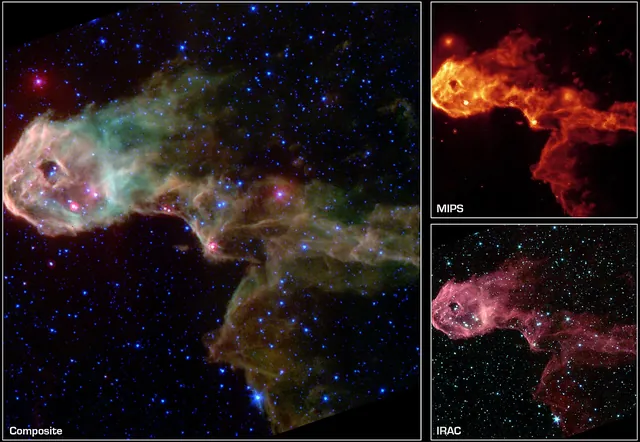
In infrared light the picture reverses. Spitzer showed the dark globule to be infrared-bright, its glow coming from molecular hydrogen and from polycyclic aromatic hydrocarbons. Radio maps made in 1976 at 6 and 11 cm suggested there is ionised gas inside the globule too.5612
The stars inside
Before Spitzer, only two young stars were known in the globule: LkHα 349, a star of about 3 solar masses and spectral type F9, and LkHα 349c, a T Tauri star of type K7. Together they have cleared a cavity about 0.3 parsecs across in the globule’s head. In infrared light they look alike, a sign that LkHα 349c is surrounded by a thick, dusty disc, while LkHα 349 has none.23512
Spitzer then revealed several very young protostars of Class 0 or Class I and about a dozen Class II stars, young stars with warm discs. Three of the new sources lie within about 0.02 parsecs of the ionisation front. About 5 per cent of the globule’s mass is in protostars between 100,000 and 1 million years old, a high rate of star formation that was probably triggered by the nearby O star.5611
Adding Chandra’s X-ray images to earlier surveys doubled the known population to more than 250 young stars. They are lined up by age, from the youngest inside the cloud to older ones towards HD 206267, as expected if the star’s radiation has been compressing the cloud and driving its collapse for several million years. More than 140 stars, down to a tenth of the Sun’s mass, seem to have formed this way. Spectra suggest two phases: one about 4 million years ago that also formed the central O star, and another within the last million years inside the globule.211
Notable features
The cavity in the head
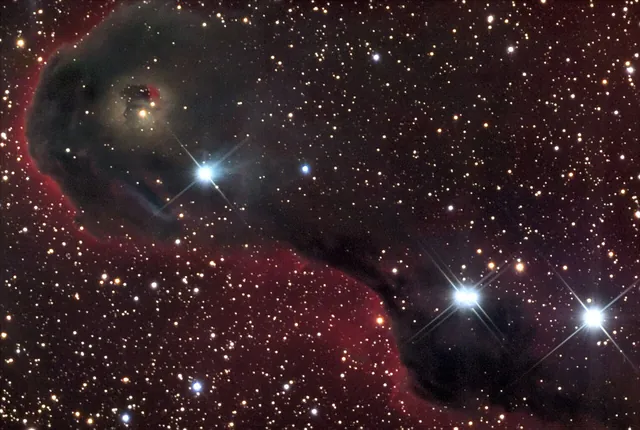
The bright hole in the elephant’s head is a cavity about 0.3 parsecs across, cleared by the young star LkHα 349 and its companion. Dust dims light by only 2.8 magnitudes inside it, against about 6 magnitudes on the head’s northern side and 10 on its southern side.2311
IC 1396A-PACS-1
A Class 0 protostar at the edge of the H II region, among the youngest protostars known from its chemistry. Its molecular emission resembles a ‘hot corino’ with warm carbon-chain chemistry, and it is probably the last intermediate-mass star that will form in the globule.7
A cold core
Around IC 1396A-PACS-1 the dust is only 14 to 18 degrees above absolute zero, and it is densest there. Maps made with the IRAM 30-metre telescope’s NIKA camera show a second cold clump to the south, slightly warmer and two to six times less dense, with no sign yet of stars forming.7
V390 Cephei
An A-type young star in the eye-shaped hole of the head. Signs of interaction with the surrounding gas show that it really belongs to the globule, and it is one of the young stars whose radiation and outflows reshape the cloud at close range.7
Several generations
Three stellar populations lie within the globule. Stars less than 0.5 parsecs apart formed in different episodes over about 1 to 2 million years, so neighbours may have begun life, and built their planet-forming discs, in very different conditions.7
A record-faint water maser
Only one water maser has been found in the globule. Its infrared source shines with less than a tenth of the Sun’s luminosity, the first such maser seen from so faint an object.11
Unusual ices
The protostars’ envelopes hold exceptionally little ice compared with their silicate dust, unlike protostars in nearby star-forming regions. The radiation field or the pressure on the globule may have altered their chemistry.11
Discovery and history
The trunk stands inside IC 1396, which E. E. Barnard described from long-exposure photographs in 1894. In 1956 Pottasch lettered the brightest globules of IC 1396 from A to H in order of distance from the central star, and the Elephant’s Trunk became globule A, IC 1396A. It is also listed as vdB 142 and LBN 452.1891213
The young stars LkHα 349 and LkHα 349c were catalogued in the 1970s, but no others were known in the globule until Spitzer. The trunk was one of Spitzer’s first public images in December 2003, its winding, filamentary shape likened by NASA to a flying dragon.2612
Seeing it for yourself
The trunk lies about 15′ west of HD 206267, the central star of IC 1396 in Cepheus, and is about 14′ long by 2′ wide on the sky. Astronomy magazine notes that some observers find it easier to spot than the Horsehead Nebula, but like the rest of IC 1396 it is a target for exceptionally dark skies. The close-up of its head on this page was taken by visitors to the Advanced Observing Program at the Kitt Peak Visitor Center.291415
- Position
- about 15′ west of HD 2062672
Telescopes on the Elephant’s Trunk
Spitzer imaged the globule at wavelengths from 3.6 to 24 microns in 2003, then took infrared spectra of its protostars from 5.5 to 38 microns. Follow-up work searched it for water masers with the Green Bank Telescope and took optical spectra at Palomar. NASA’s Chandra X-ray Observatory found many of its young stars by their X-rays.2511
The European Space Agency’s Herschel Space Observatory and the IRAM 30-metre radio telescope mapped the temperature and density of its cold dust and gas, and Gaia measured the motions of its stars. On the ground, Kitt Peak’s Mayall and WIYN telescopes have made detailed visible-light portraits of the trunk.4716
Quick answers
- What kind of object is the Elephant’s Trunk Nebula (IC 1396A)?
- The Elephant’s Trunk Nebula (IC 1396A) is a bright-rimmed globule of gas and dust in the nebula IC 1396.278
- Which constellation is the Elephant’s Trunk Nebula (IC 1396A) in?
- The Elephant’s Trunk Nebula (IC 1396A) lies in the constellation Cepheus.13
- How far away is the Elephant’s Trunk Nebula (IC 1396A)?
- The Elephant’s Trunk Nebula (IC 1396A) is about 925 parsecs from Earth (Gaia distance of the cluster Trumpler 37 that lights it; NASA pages give 2,450 to nearly 3,000 light-years).1310
- How big does the Elephant’s Trunk Nebula (IC 1396A) look in the sky?
- The Elephant’s Trunk Nebula (IC 1396A) covers 14′ × 2′ of sky.9
- How massive is the Elephant’s Trunk Nebula (IC 1396A)?
- The Elephant’s Trunk Nebula (IC 1396A) has a mass of about 200 solar masses (of molecular gas).2
Sources
- APOD: The Elephant’s Trunk Nebula in Cepheus (19 January 2017) — NASA Science, 2017
- The Elephant Trunk Nebula and the Trumpler 37 cluster: contribution of triggered star formation to the total population of an H II region (Getman et al.) — Monthly Notices of the Royal Astronomical Society, 2012
- Spitzer/IRAC composite image of a dark globule in IC 1396 (ssc2003-06a1) — NASA/JPL-Caltech, Spitzer Space Telescope, 2003
- IC 1396A Elephant Trunk Nebula (noao1507a) — NOIRLab
- Protostars in the Elephant Trunk Nebula (Reach et al.) — Astrophysical Journal Supplement Series, 2004
- Dark Globule in IC 1396 (ssc2003-06b) — NASA/JPL-Caltech, Spitzer Space Telescope, 2003
- IRAM and Gaia views of multi-episodic star formation in IC 1396A: the origin and dynamics of the Class 0 protostar at the edge of an H II region (Sicilia-Aguilar et al.) — Astronomy & Astrophysics, 2019
- SIMBAD astronomical database: Elephant Trunk Nebula (IC 1396A) — Centre de Données astronomiques de Strasbourg (CDS)
- Revised IC data for IC 1396 and IC 1396A (from W. Steinicke’s Revised NGC and IC Catalog) — SEDS Interactive NGC Catalog
- Star formation in IC 1396: kinematics and subcluster structure revealed by Gaia (Pelayo-Baldárrago et al.) — Astronomy & Astrophysics, 2023
- Properties of protostars in the Elephant Trunk globule IC 1396A (Reach et al.) — Astrophysical Journal, 2009
- Star Forming Regions in Cepheus (M. Kun, Z. T. Kiss & Z. Balog) — Handbook of Star Forming Regions, Vol. I (Astronomical Society of the Pacific), 2008
- Photographic nebulosities and star clusters connected with the Milky Way (E. E. Barnard) — Astronomy and Astro-Physics, vol. 13, pp. 177–182, 1894
- 101 must-see cosmic objects: IC 1396 (A. Goldstein) — Astronomy magazine, 2022
- Vdb142 in IC1396: The Elephant Trunk Nebula (noao-ic1396hapeman) — NOIRLab
- IC1396, The Elephant Trunk Nebula (noao-ic1396) — NOIRLab
Figures checked against these sources in November 2026. Where a quantity is not known, it is left out rather than estimated.

