nebula
Fish Head Nebula (IC 1795)
The Fish Head Nebula, IC 1795, is a glowing cloud in Cassiopeia on the north-western edge of the Heart Nebula. It is the visible part of W3, a giant molecular cloud of about 400,000 solar masses in the Perseus spiral arm, where many massive stars are forming. Gaia places its central cluster about 2.17 kiloparsecs away; NASA gives about 6,000 light-years.12345
At its centre lies a young cluster, also called IC 1795, 3 to 5 million years old and lit by the O-type star BD +61 411. The Heart’s expanding bubble seems to have set off this cluster’s birth, and the cluster in turn is thought to have triggered the even younger, still-embedded star clusters of W3 Main, W3 North and W3(OH): one of the first convincing cases of three generations of stars each triggering the next.2456
Shape and size in space
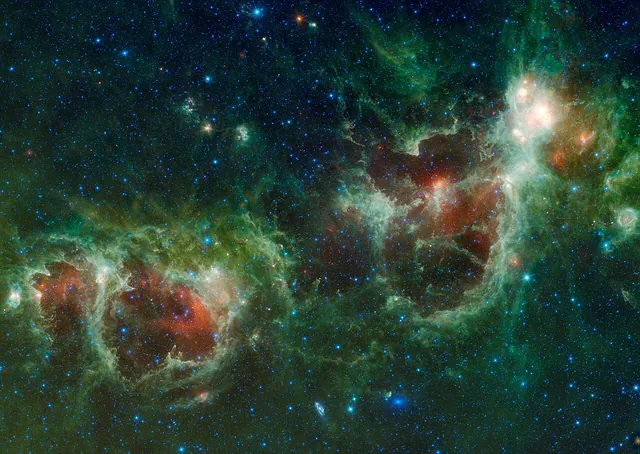
W3 is a smaller H II region, about 30′ or 20 parsecs across, on the north-western edge of the W4 shell that forms the Heart. It forms the central part of a dense ridge, the high-density layer, thought to have been swept up as the Heart’s bubble expanded into the W3 giant molecular cloud. The layer holds H II regions at many stages of growth, and 105 OB stars there have been confirmed by spectroscopy.24
The middle of this layer splits into three parts: the IC 1795 cluster at the centre, W3 Main on one side and W3(OH) on the other. The cluster sits inside an expanding bubble about 9′ in radius, and the embedded star-forming knots lie in a shell of molecular gas around it. NGC 896, a young cluster that shines in radio waves, is seen against the western edge of that shell.24
Gaia parallaxes hint that the complex is tilted in depth, though the result is tentative. W3(OH) appears nearest at about 2.00 kiloparsecs, the IC 1795 cluster in the middle at 2.17, and W3 Main farthest at 2.30, so the complex, which runs from south-east to north-west on the sky, may also be tilted, with W3(OH) on the near side and W3 Main on the far side.4
W3 settled an old puzzle about distances in the Milky Way. Distances worked out from the speed of its gas, 3.9 to 4.2 kiloparsecs, were about twice those from its stars. In 2006 the Very Long Baseline Array measured the parallax of masers in W3(OH) directly, giving 1.95 and 2.04 kiloparsecs, and showed that this stretch of the Perseus arm moves unusually. Gaia parallaxes of its stars later gave 2.14 kiloparsecs for the whole complex.4910
What makes it shine
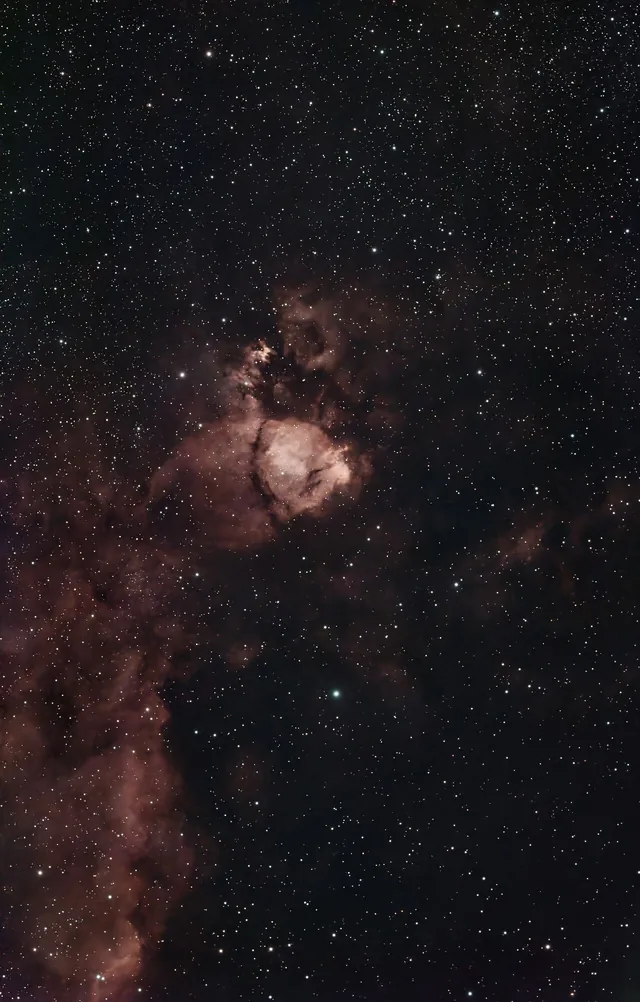
In NGC 896, the Fish Head’s western knot, newly forming stars energise the gas, but dark lanes of dust that stretch across the nebula hide most of that star formation from view. Narrow-band images pick out its hydrogen, oxygen and sulphur light separately.12
At longer wavelengths the hidden activity shows. Chandra picked out about 1,300 faint X-ray sources across W3, most of them young stars still contracting in the cloud. Herschel’s far-infrared maps found that W3 East, W3 West and W3(OH) are the most massive and luminous of the cloud’s compact clumps, with the most gas packed along the line of sight.313
- X-ray sources in W3
- about 1,30013Chandra mosaic of about 800 square arcminutes
The stars inside
The cluster IC 1795 is the most prominent part of W3 in visible light, with about 2,000 stars. Its dominant star, BD +61 411, is of spectral type O6.5 V((f)). Combining Spitzer and Chandra data, astronomers confirmed 289 members and 340 more candidates, complete down to about one solar mass.246
Photometry and spectra of its stars, and the colours of stars that have lost their discs, both give an age of 3 to 5 million years. About half of its stars between 0.8 and 2 solar masses still have dusty discs, against about a fifth of those above 2 solar masses, so discs around heavier stars seem to clear faster; being close to one of the two O stars makes no difference within 0.6 parsecs.26
Not every study agrees on the cluster’s history. A 2024 analysis of carbon monoxide found three clouds of 2,000 to 8,000 solar masses moving at different speeds, and proposed that collisions between them triggered the massive stars of IC 1795 about 2 million years ago, and more recently those of W3 Main and W3(OH).14
The embedded clusters around IC 1795 each seem to have formed differently. In W3 Main the widely spread young low-mass stars are older than the central OB stars, suggesting the whole cluster collapsed first and its massive stars formed late. W3(OH) looks like a case of collect-and-collapse, with gas swept up by a shock, and W3 North holds one isolated massive star. Herschel data suggest a convergent constructive feedback, in which feedback from massive stars keeps material available to a growing cluster, producing stars that are younger and more massive towards its centre.313
Notable features
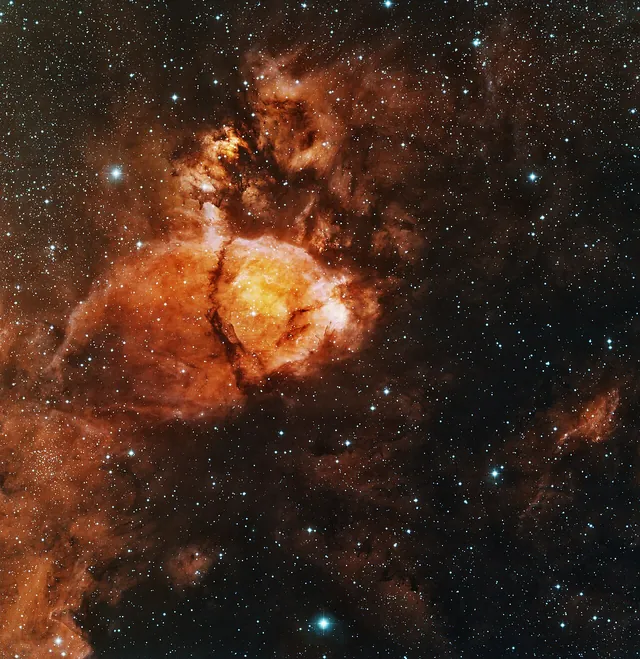
NGC 896
The western knot of the Fish Head, 10′ across, which William Herschel found in 1787 and which has its own NGC number. It holds a young cluster that shines in radio waves.2811
W3 Main
The dominant star-forming region of W3. Chandra found a nearly spherical cluster about 7 parsecs across with about 900 X-ray stars. Near-infrared spectra identify 15 OB stars from O5 V to B4 V and an age spread of at least 2 to 3 million years: its most massive star, IRS2, has already evolved, while another, IRS N1, is still deeply embedded in an ultracompact H II region. Its stars add up to about 4,000 Suns.51315
W3(OH)
The prototypical ultracompact H II region, with a small, clumpy cluster of about 50 young stars no more than 0.6 parsecs across. Parallaxes of its masers gave a distance of 1.95 ± 0.04 kiloparsecs to this part of the Perseus arm. Nearby, a young object driving a water-maser outflow moves at more than 7 km/s relative to the ultracompact H II region.91013
W3 North
An H II region lit by a single massive star with no cluster of young stars around it, perhaps a runaway O star or a massive star that formed alone.13
The dark lane
A narrow lane of dust running north to south across the nebula, noted in the Revised Index Catalogue, which with the other dust lanes hides most of the star formation inside.712
Discovery and history
William Herschel found the western knot, NGC 896, on 3 November 1787 with his 18.7-inch reflector, and listed it as number 695 of his third class. The wider nebula, IC 1795, was later credited to E. E. Barnard, observing with a refractor; Dreyer’s Index Catalogue described it simply as a patch of nebulosity. The Villafranca catalogue calls it the Fishhead, alongside the Heart and Soul.111
Until 2005 the only published studies of the cluster’s stars used photographic plates and photoelectric photometry. That year, new CCD photometry and spectra dated the cluster between the 6 to 20 million-year-old giant shells around W4 and the 10,000 to 100,000-year-old knots of W3, confirming an age sequence across all three generations and giving some of the first convincing evidence that superbubbles can trigger star formation.2
Seeing it for yourself
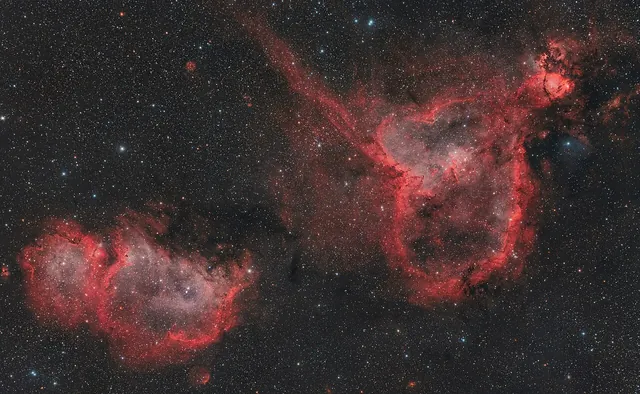
The Fish Head lies in Cassiopeia on the north-western edge of the Heart, on the opposite side from the Soul. William Herschel saw its knot NGC 896 by eye through an 18.7-inch reflector in 1787, and Barnard later saw the larger nebula through a refractor.1211
Telescopes on the Fish Head
Chandra observed W3 Main for 22 hours in 2000 and 2005, revealing several hundred young stars there, many missed by earlier infrared surveys. Deep Spitzer images surveyed the discs around IC 1795’s stars, Herschel mapped the cold dust of the whole W3 cloud, and the Large Binocular Telescope took near-infrared spectra of W3 Main’s massive stars.35615
Radio astronomers used the Very Long Baseline Array to measure the parallax of masers in W3(OH), Gaia measured the parallaxes of its stars, and the 0.9-metre telescope at Kitt Peak imaged the nebula in narrow-band visible light.491012
- Stars in the W3 Main X-ray cluster
- about 90013
Quick answers
- What kind of object is the Fish Head Nebula (IC 1795)?
- The Fish Head Nebula (IC 1795) is an H II region (emission nebula) around a young cluster.27
- Which constellation is the Fish Head Nebula (IC 1795) in?
- The Fish Head Nebula (IC 1795) lies in the constellation Cassiopeia.7
- How far away is the Fish Head Nebula (IC 1795)?
- The Fish Head Nebula (IC 1795) is about 2.2 kiloparsecs from Earth (Gaia DR2: 2.17 kpc for the cluster; masers in nearby W3(OH) give 1.95 and 2.04 kpc; NASA says about 6,000 light-years).45910
- How big is the Fish Head Nebula (IC 1795)?
- The Fish Head Nebula (IC 1795) is about 20 pc across (the W3 H II region, 30′ across).2
- How big does the Fish Head Nebula (IC 1795) look in the sky?
- The Fish Head Nebula (IC 1795) covers 40′ × 20′ of sky.7
- How old is the Fish Head Nebula (IC 1795)?
- The Fish Head Nebula (IC 1795) is 3 to 5 million years old (the central cluster).26
- When was the Fish Head Nebula (IC 1795) discovered?
- The Fish Head Nebula (IC 1795) was discovered 3 November 1787 (NGC 896, William Herschel), IC 1795 as a whole credited to E. E. Barnard.11
Sources
- The Villafranca catalog of Galactic OB groups. II. From Gaia DR2 to EDR3 and ten new systems with O stars (Maíz Apellániz et al.) — Astronomy & Astrophysics 657, A131 (arXiv:2110.01464), 2022
- Hierarchical Triggering of Star Formation by Superbubbles in W3/W4 (Oey et al.) — Astronomical Journal 129, 393 (arXiv:astro-ph/0501136), 2005
- Herschel Observations of the W3 GMC: Clues to the Formation of Clusters of High-Mass Stars (Rivera-Ingraham et al.) — Astrophysical Journal 766, 85 (arXiv:1301.3805), 2013
- Gaia-DR2 distance to the W3 Complex in the Perseus Arm (Navarete, Galli & Damineli) — Monthly Notices of the Royal Astronomical Society 487, 2771 (arXiv:1905.08593), 2019
- W3 Main: A Productive Star Formation Factory (Chandra Photo Album, 18 December 2006) — Chandra X-ray Center, Harvard-Smithsonian Center for Astrophysics, 2006
- Disk Evolution in OB Associations: Deep Spitzer/IRAC Observations of IC 1795 (Roccatagliata et al.) — Astrophysical Journal 733, 113 (arXiv:1103.5770), 2011
- Revised IC Data for IC 1795 (from W. Steinicke’s Revised NGC and IC Catalog) — SEDS Interactive NGC Catalog
- Revised NGC Data for NGC 896 (from W. Steinicke’s Revised NGC and IC Catalog) — SEDS Interactive NGC Catalog
- The Distance to the Perseus Spiral Arm in the Milky Way (Xu et al.) — Science 311, 54 (arXiv:astro-ph/0512223), 2006
- Water maser motions in W3(OH) and a determination of its distance (Hachisuka et al.) — Astrophysical Journal 645, 337 (arXiv:astro-ph/0512226), 2006
- Historic NGC/IC: discoverers and discovery dates of the NGC and IC objects (W. Steinicke) — Wolfgang Steinicke, NGC/IC research pages (archived copy), 2026
- NGC 896 (noaoann14005a) — NSF NOIRLab, 2014
- The Diverse Stellar Populations of the W3 Star Forming Complex (Feigelson & Townsley) — Astrophysical Journal 673, 354 (arXiv:0710.0090), 2008
- A Kinematic Analysis of the Giant Molecular Complex W3; Possible Evidence for Cloud-Cloud Collisions that Triggered OB Star Clusters in W3 Main and W3(OH) (Yamada et al.) — Publications of the Astronomical Society of Japan (arXiv:2106.02217), 2024
- Age spread in W3 Main: LBT/LUCI near-infrared spectroscopy of the massive stellar content (Bik et al.) — Astrophysical Journal (arXiv:1109.3467), 2012
Figures checked against these sources in November 2026. Where a quantity is not known, it is left out rather than estimated.

