nebula
Soul Nebula (IC 1848)
The Soul Nebula, also called the Embryo Nebula, is a great cloud of glowing hydrogen in Cassiopeia, next to the Heart Nebula. It is listed as IC 1848, Sh 2-199 and the radio source W5, and covers 120′ of sky. A Gaia study puts its central cluster 2,004 parsecs away; NASA gives about 6,500 light-years, and other estimates run from 1.9 to 2.2 kiloparsecs.1234
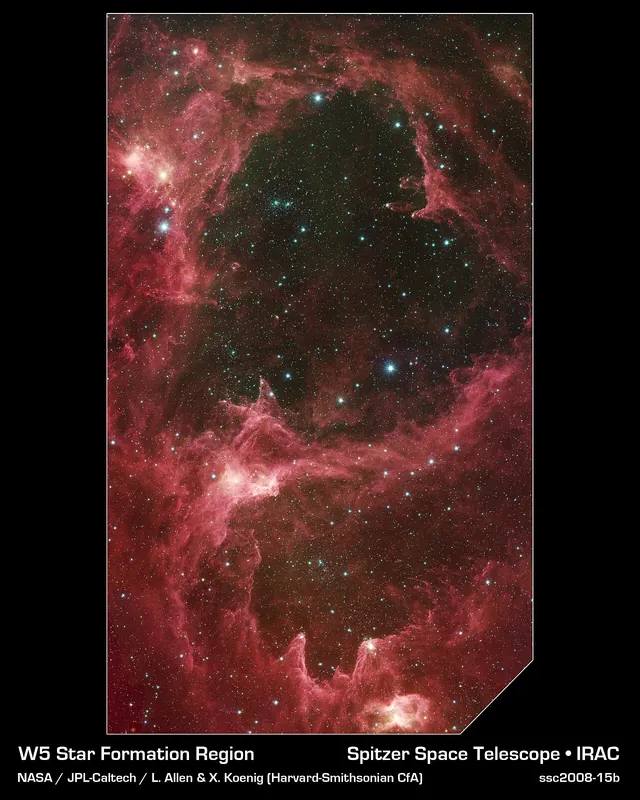
Hot young stars have blown two adjoining cavities in its cloud. Its brightest star, HD 17505, is a system of at least four O-type stars at the heart of the cluster IC 1848. Pillars of cold gas on the cavity walls point back at these stars, and new stars are forming in their tips. Spitzer images of the Soul give some of the best evidence that one generation of stars can trigger the next.15678
Shape and size in space
Estimates of the Soul’s distance from its stars range from 1.9 to 2.2 kiloparsecs, while distances worked out from the motion of its gas come out about 1.5 times larger, near 3 kiloparsecs. A 2025 study using Gaia DR3 parallaxes found 2,004 ± 9 parsecs for the cluster IC 1848. NASA quotes about 6,500 light-years, and Astronomy magazine 7,500.34810
The Soul is the eastern member of the chain of clouds W3, W4 and W5 in the Perseus arm. In visible light it splits into two roughly circular, adjoining H II regions, W5 West with four O stars and W5 East with one, and maps of carbon monoxide show the molecular gas around them as two broken rings. In Spitzer’s images it covers as much sky as four full Moons.56813
Little cloud is left around the bubbles. Herschel found about 8,000 solar masses of neutral gas around W5 East, little for so large an H II region, and suggested that the stars lighting W5 East, W5 West, Sh 201 and two other nearby H II regions formed along a dense filament or sheet rather than inside a round cloud.13
Carbon monoxide maps name the molecular clouds that wrap the cavities: W5 NW to the north-west of HD 17505, W5 NE between HD 18326 and BD +60 586, and W5 A east of HD 18326. Following the orbits of the Soul’s clusters back in time, a 2025 study found that the W3, W4 and W5 complex formed some 20 to 30 million years ago, and that the shape of IC 1848 may be inherited from its parent gas rather than shaped by its present motions.35
What makes it shine
The Soul glows because its O stars ionise the surrounding hydrogen. Their winds and ultraviolet light are carving the cavities; denser knots of gas erode more slowly and are left standing as pillars, each about 10 light-years tall.16
In infrared light, dust takes over. Spitzer saw extended emission at 24 microns, probably from heated dust grains that survive even in this strongly ionising environment, and in its camera images red marks the glow of organic molecules called polycyclic aromatic hydrocarbons, warmed by the young stars.515
Herschel’s far-infrared maps measured the dust temperature around W5 East: 17.5 to 20 kelvin in the dense condensations and filaments, 21 to 22 kelvin in the photodissociation regions, and 24 to 31 kelvin towards the ionised regions themselves.13
The stars inside
The cluster IC 1848 sits at the centre of W5 West and is dominated by HD 17505. This system contains at least four O-type stars, with a combined mass approaching 100 Suns: an inner pair of O7.5 V stars that orbit each other every 8.57 days, and a third star of type O6.5 III that circles them in less than 61 years. Seven more visual companions lie between 2.1 and 124 arcseconds away, though they have not been shown to be bound to it.6716
A survey of the cluster selected 105 early-type members and found 196 young stars glowing in hydrogen-alpha and 368 Class II young stars, which still have dusty discs. The evolved stars give an age of 5 million years and the young low-mass stars about 3 million; among stars above 3 solar masses, heavy stars are slightly rarer, in proportion, than usual. Gaia shows it is expanding.36
Many of the young stars in IC 1848 are still feeding. Those of 0.5 to 2 solar masses with excess ultraviolet light accrete about 1.4 × 10⁻⁸ solar masses a year on average, while stars of 2.5 solar masses and more take in more than 10⁻⁶ solar masses a year. Across the wider Cas OB6 association, 7 of 14 O-type systems studied are probably binaries.616
Across the whole of W5, Spitzer measured more than 18,000 sources and found 2,064 young stars, 40 to 70 per cent of them in clusters of ten or more. Dense clusters are centred on the O stars HD 18326, BD +60 586, HD 17505 and HD 17520. A 2024 study found that only about 27 and 17 per cent of the low-mass stars in the clusters of W5 East and West still have planet-forming discs, fewer than in other nearby young clusters, a deficit linked to intense feedback from the massive stars.517
- HD 17505
- at least four O stars; total mass approaching 100 solar masses7
- Early-type members of IC 1848
- 1056
- Hydrogen-alpha emission stars
- 1966
- Age of IC 1848
- 5 million years (evolved stars); 3 million (young low-mass stars)6
- Slope of the initial mass function
- Γ = −1.6 ± 0.26slightly steeper than Salpeter
- Disc fraction
- about 27 per cent (East), 17 per cent (West)17down to 0.1 solar masses
Notable features
HD 17505
The brightest star of IC 1848 and the main power source of W5 West, a multiple system of at least four O stars. Its inner pair shows no sign yet of interaction between the two stars.67
The two cavities
W5 West, round IC 1848, and W5 East, round the O star HD 18326. Spitzer found stars growing progressively younger with distance from their centres. Inside the cavities the ratio of older (Class II) to younger (Class I) young stars is about seven times higher than in the surrounding molecular gas, a sign of at least two generations of stars.568
The Mountains of Creation
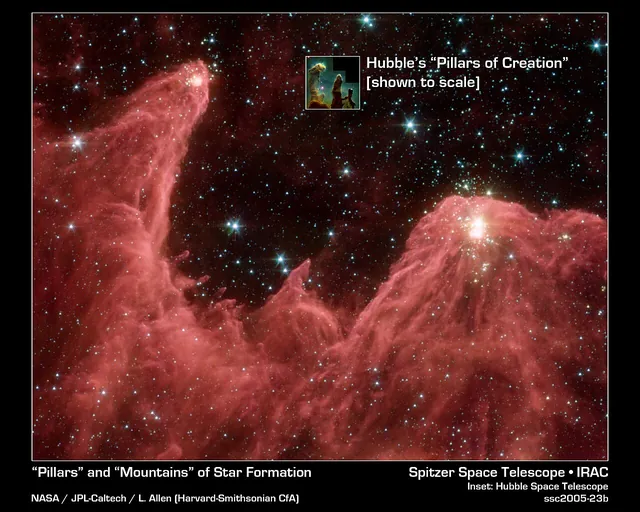
Towering pillars of cool gas and dust in W5, named by Spitzer scientists in 2005. They are more than ten times the size of the Eagle Nebula’s famous pillars, and Spitzer revealed hundreds of forming stars inside the central pillar. They point towards an initiator star of more than ten solar masses, outside the picture, whose radiation and winds are thought to have triggered those stars. Slightly older blue stars fill the cleared spaces between the clouds, born around the same time as the initiator star.15
Bright-rimmed clouds
Clouds with bright rims face the O stars: BRC 10 to 12 in W5 West and BRC 13 and 14 in W5 East. In W5 East, young stars near BRC 13 and 14 are about 1 million years old, against about 4 million near the central O7 V star, suggesting star formation has moved from the centre out to the eastern rim. Herschel found very young Class 0 and Class I protostars enclosed by BRC 14.31318
Sh 201
A small bipolar H II region on the edge of W5 East. Herschel found massive condensations at its waist with very young Class 0 and Class I protostars, some of which may become massive stars, since they have both massive envelopes and high accretion rates.13
W5-NW
A cloud complex on the north-western side where two molecular clouds appear to have collided. One cloud has a key-like shape that fits a U-shaped hollow in the other, and young stars cluster where they meet, probably formed by the collision.519
Discovery and history
Wolfgang Steinicke’s historical catalogue credits E. E. Barnard with discovering IC 1848, observing with a refractor, but gives no date. Dreyer’s Index Catalogue described a cluster of faint stars extending towards an 8th-magnitude star, in faint nebulosity. It is also called the Soul or Embryo Nebula. W5 is its number as a radio source, from Westerhout (1958), and Sharpless listed it as Sh 2-199 in 1959.12451112
The Soul became famous for triggered star formation. In 2005 Spitzer scientists released their “Mountains of Creation”, and in 2008 a 24-hour Spitzer portrait of W5 showed stars growing younger with distance from the centres of the cavities, which NASA called some of the best evidence yet that the carving of these bubbles sets off new generations of stars.815
Seeing it for yourself
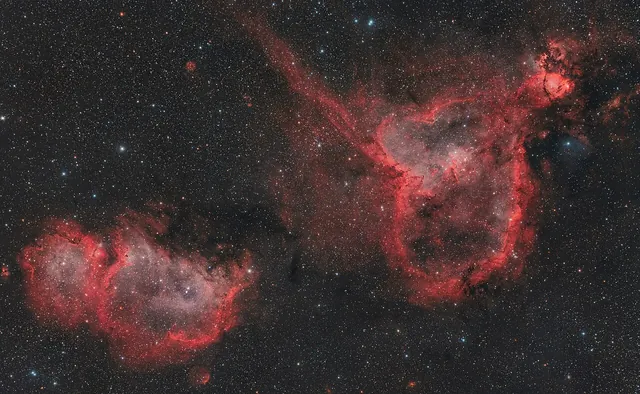
The Soul lies in Cassiopeia, beside the Heart Nebula. The nebula glows with the light of a magnitude 6.5 star, but spread over 120′ of sky it is faint to the eye, and small parts of it look dim. Like the Heart, it makes a far better target for long-exposure photography than for visual observing.21014
Telescopes on the Soul
Spitzer surveyed W5 with its Infrared Array Camera and its Multiband Imaging Photometer, cataloguing young stars across the region. NASA’s WISE mission imaged the Soul in 2010, and the Herschel space observatory mapped the cold dust and embedded protostars of W5 East, finding 50 point sources at 100 microns, most of them very young Class 0 and Class I objects.1513
From the ground, optical spectroscopy found 139 young stars glowing in hydrogen-alpha in W5 East, and radio maps of carbon monoxide from the James Clerk Maxwell Telescope traced the colliding clouds of W5-NW. Most recently Gaia has measured the distances and motions of the Soul’s clusters.31819
Quick answers
- What kind of object is the Soul Nebula (IC 1848)?
- The Soul Nebula (IC 1848) is an H II region (emission nebula) around young open clusters.69
- Which constellation is the Soul Nebula (IC 1848) in?
- The Soul Nebula (IC 1848) lies in the constellation Cassiopeia.9
- How far away is the Soul Nebula (IC 1848)?
- The Soul Nebula (IC 1848) is about 2,000 parsecs from Earth (Gaia DR3: 2,004 ± 9 pc; photometry gives 2.2 ± 0.2 kpc; NASA says about 6,500 light-years).136
- How big is the Soul Nebula (IC 1848)?
- The Soul Nebula (IC 1848) is about 300 light-years across (Astronomy magazine).10
- How big does the Soul Nebula (IC 1848) look in the sky?
- The Soul Nebula (IC 1848) covers 120′ of sky (Sharpless catalogue; about four full Moons of sky).28
- How bright is the Soul Nebula (IC 1848) in the night sky?
- The Soul Nebula (IC 1848) has an apparent magnitude of 6.5 (the cluster IC 1848).9
Sources
- Soul Nebula (PIA13014) — NASA Jet Propulsion Laboratory, Caltech (WISE), 2010
- Catalogue of H II regions (Sharpless 1959): entry Sh 2-199 — CDS VizieR, catalogue VII/20, 1959
- Tracing the W3/W4/W5 and Perseus complex dynamical evolution with star clusters (Della Croce et al.) — Astronomy & Astrophysics (arXiv:2504.16159), 2025
- Gaia-DR2 distance to the W3 Complex in the Perseus Arm (Navarete, Galli & Damineli) — Monthly Notices of the Royal Astronomical Society 487, 2771 (arXiv:1905.08593), 2019
- Clustered and Triggered Star Formation in W5: Observations with Spitzer (Koenig et al.) — Astrophysical Journal 688, 1142 (arXiv:0808.3284), 2008
- Sejong Open Cluster Survey (SOS). II. IC 1848 Cluster in the H II Region W5 West (Lim et al.) — Monthly Notices of the Royal Astronomical Society (arXiv:1311.6553), 2014
- Fundamental parameters of massive stars in multiple systems: The cases of HD 17505A and HD 206267A (Raucq et al.) — Astronomy & Astrophysics 614, A60 (arXiv:1803.00243), 2018
- W5 Star Formation Region (ssc2008-15b) — NASA Jet Propulsion Laboratory, Caltech (Spitzer), 2008
- Revised IC Data for IC 1848 (from W. Steinicke’s Revised NGC and IC Catalog) — SEDS Interactive NGC Catalog
- Deep-Sky Dreams: The Soul Nebula (David J. Eicher) — Astronomy magazine, 2025
- Historic NGC/IC: discoverers and discovery dates of the NGC and IC objects (W. Steinicke) — Wolfgang Steinicke, NGC/IC research pages (archived copy), 2026
- IC 1848 — SEDS Interactive NGC Catalog
- Interstellar matter and star formation in W5-E: A Herschel view (Deharveng et al.) — Astronomy & Astrophysics (arXiv:1209.2907), 2012
- Heart and Soul (PIA13112) — NASA Jet Propulsion Laboratory, Caltech (WISE), 2010
- Towering Infernos (ssc2005-23b) — NASA Jet Propulsion Laboratory, Caltech (Spitzer), 2005
- Binary and Multiple O-Type Stars in the Cas OB6 Association (Hillwig et al.) — Astrophysical Journal 639, 1069 (arXiv:astro-ph/0512407), 2006
- Twins in Diversity: Understanding circumstellar disk evolution in the twin clusters of W5 complex (Damian et al.) — Monthly Notices of the Royal Astronomical Society (arXiv:2410.18920), 2024
- Clustering of Emission-line Stars in the W5E HII region (Nakano et al.) — Publications of the Astronomical Society of Japan (arXiv:0802.2624), 2008
- Cloud-cloud collision and cluster formation in the W5-NW complex (Issac et al.) — arXiv preprint 2402.07394, 2024
Figures checked against these sources in November 2026. Where a quantity is not known, it is left out rather than estimated.

