nebula
Heart Nebula (IC 1805)
The Heart Nebula is a giant cloud of glowing hydrogen in Cassiopeia, listed as IC 1805, Sh 2-190 and the radio source W4. It is about 150′ across, more than two degrees of sky. Gaia measurements of its central stars place it 1,982 to 2,075 parsecs away, and NASA gives about 6,000 light-years, but published distances have ranged from 1.45 to 3.79 kiloparsecs.12345
The heart shape is a cavity blown by the young star cluster at its centre, also called IC 1805 or Melotte 15, which holds nine known O-type stars. Their light makes the gas shine, and their energy has helped inflate a superbubble that rises hundreds of parsecs out of the Milky Way’s disc. On the nebula’s western edge, the Fish Head Nebula marks where the expanding bubble meets a dense cloud and new stars are forming.16789
Shape and size in space
Distances to the Heart have long disagreed. In the last two decades alone, published values have run from 1.45 to 3.79 kiloparsecs. Photometry of its stars gave 2.4 kiloparsecs in 2017, while Gaia parallaxes of the cluster gave 2,075 parsecs in 2022 and 1,982 parsecs in 2025. Radio parallaxes of masers in W3(OH), in the neighbouring cloud, give 1.95 and 2.04 kiloparsecs, and NASA quotes about 6,000 light-years.145101314
The Heart, the Soul and the Fish Head form the most prominent complex of glowing hydrogen in the second Galactic quadrant, and together they make up the Cas OB6 association in the Perseus spiral arm. The Heart itself is a cavity cleared by the stars at its centre. Its glowing shell is roughly a degree across, and Chandra scientists describe W4 as an inflating bubble of gas over 100 light-years wide.18910
Above the nebula, radio maps of hydrogen first revealed an empty, cone-shaped region, proposed in 1996 as a chimney: an opening through which hot gas could escape from the Milky Way’s disc into its halo. Hydrogen-alpha images later showed a closed shell about 230 parsecs high, aged 6.4 to 9.6 million years, and a much larger loop reaching about 1.3 kiloparsecs above the plane.7810
Radio observations published in 2007 found that the structure is not yet an open chimney but a superbubble that is breaking apart and may become one. Assuming a distance of 2.35 kiloparsecs, its egg-shaped shell is 164 parsecs wide and reaches 246 parsecs above the Galactic mid-plane, with a break at its top and another on one side.7
The Heart is not an obvious place for so many massive stars. Its molecular clouds are relatively small, and the region’s lower metallicity, warmer gas and thinner gas cover are all thought to be unfavourable for star formation. A 2025 Gaia study traced the orbits of its clusters and found that the W3, W4 and W5 complex formed some 20 to 30 million years ago, just a few hundred parsecs from LISCA I, a neighbouring aggregate of star clusters in the same Perseus complex.410
What makes it shine
The Heart is an H II region, a cloud of hydrogen ionised by its hot young stars. Radio emission from the superbubble’s walls is thermal, coming from the same ionised gas as the hydrogen-alpha light, and the open cluster OCl 352, another name for the central cluster, appears to ionise it all.167
Hollowed-out nebulae like the Heart and the Rosette represent a later stage than nebulae that are still filled with gas, such as the Lagoon Nebula, as the stars’ radiation and winds blow the gas outwards. In the Heart, one O star, KM Cas, sits close to the western edge of that cavity, well away from the cluster.15
Inside the cavity, the winds of the O stars fill the bubble with hot plasma that Chandra has detected as diffuse X-rays. Radio polarisation measurements show a magnetic field of 3 to 5 microgauss along the line of sight in the walls of the superbubble.715
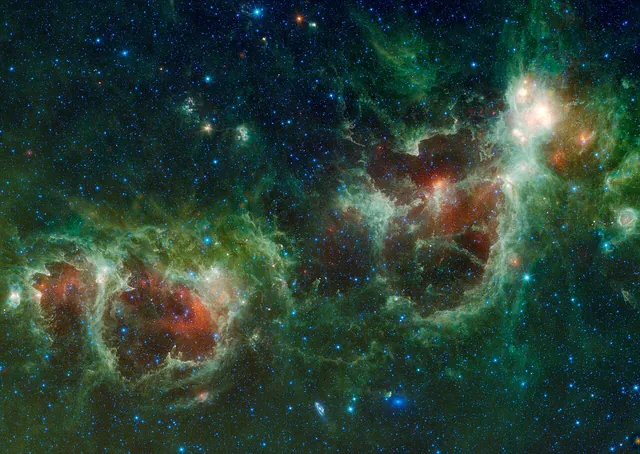
In infrared light the Heart becomes a ring of warm dust. NASA’s WISE mission imaged it beside the Soul Nebula in 2010, covering 5.5 by 3.9 degrees of sky; together the two nebulae stretch nearly 580 light-years, and both are bubbles blown into the surrounding dust by the radiation and winds of their stars.5
The stars inside
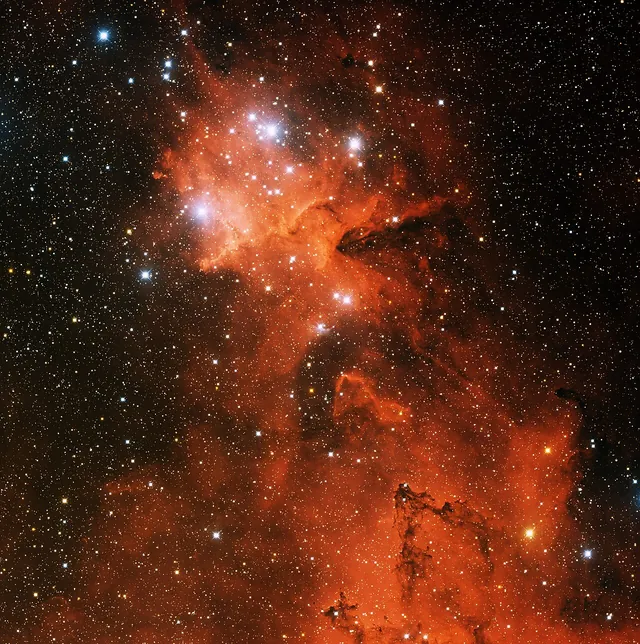
The central cluster is sparse for its wealth of massive stars, so it is sometimes called an aggregate or OB association. It holds nine known O-type stars, among them HD 15570, one of the standard stars for spectral type O4 If, and HD 15629, a standard for O4.5 V((fc)). A 2017 study counted eight, the most of any young open cluster in the northern sky, and about 40 early-type stars lie within 12′ of its centre.11015
Photometry of about 100,000 stars over a 41′ by 45′ field gives the cluster a main-sequence age of 3.5 million years and a total mass of about 2,700 Suns, with a normal, Salpeter-like proportion of heavy to light stars. Its low-mass stars, still contracting, have a median age of 2.48 million years, and the massive stars show no age spread larger than about 1.5 million years. A 2025 Gaia study put the age at about 5 million years.410
The cluster is coming apart. Stars in its core move at random with a velocity dispersion of 0.9 km/s, but a halo of stars spread over 20 parsecs is expanding radially. A computer model reproduces this if the cluster collapsed for its first 2 million years, after which members began to escape; among the clusters of W3, W4 and W5, its expansion is the strongest and most orderly. Six stars may be runaways from it.1416
Not all the stars are young. Two evolved stars in the field, BD +60 493 and BD +60 498, fit an age of 7.3 million years, close to the superbubble’s expansion age, and are thought to belong to the wider Cas OB6 association. Star formation here has come in several episodes over 10 to 20 million years and still continues among low-mass stars. At least 20 per cent of the cluster’s O stars are binaries, well below the 80 per cent once claimed.101517
- Earliest spectral types
- O4 If (HD 15570); O4.5 V((fc)) (HD 15629)1
- Total mass of the cluster
- 2,700 ± 200 solar masses10
- Main-sequence turn-off age
- 3.5 million years10
- Slope of the initial mass function
- Γ = −1.3 ± 0.210Salpeter-type
- Velocity dispersion in the core
- 0.9 ± 0.3 km/s16
- Extent of the expanding halo
- over 20 pc16
- Potential runaway stars
- six1
Notable features
Melotte 15 (the cluster IC 1805)
The young open cluster at the heart of the nebula, of magnitude 6.5 and 20′ across. Strictly, IC 1805 is the cluster’s own number; it is also listed as Melotte 15 and OCL 352. It has a weak core surrounded by a rich halo that blends into the Cas OB6 association.16
HD 15570
One of the three brightest early-type stars in the cluster and a standard for spectral type O4 If. Astronomers think it is in a stage between a normal O star and a Wolf–Rayet star.11517
HD 15558
A massive binary near the cluster’s centre, with an orbit of about 442 to 447 days. A 2006 analysis gave astonishing minimum masses of 150 and 50 Suns and suggested it might really be a triple star; a 2016 solution found a lower mass function, so the masses remain uncertain.1517
The W4 superbubble
The vast shell above the nebula, catalogued as G134.4+3.85. Once described as a chimney venting gas into the Galactic halo, it now appears to be a superbubble that is fragmenting and may become a chimney. Its builders are debated: the winds of the cluster’s nine O stars, or an earlier generation of stars and supernovae.710
Bright-rimmed clouds BRC 5 and BRC 7
Dense clouds with bright rims around W4, whose likely ionising sources include the cluster’s O stars HD 15558, HD 15570 and HD 15629. Astronomers have studied them as places where these hot stars may have triggered small bursts of star formation.410
The Fish Head Nebula
The bright knot of nebula on the Heart’s north-western edge, IC 1795 in the W3 cloud. It is the youngest of the three great nebulae in the complex, and the expansion of W4 may have triggered the birth of its stars.189
Discovery and history
Wolfgang Steinicke’s historical catalogue credits the American astronomer E. E. Barnard with discovering IC 1805, observing with a refractor, though it gives no date. Dreyer’s Index Catalogue described it as a compressed cluster in extremely large nebulosity. A knot of the neighbouring Fish Head, NGC 896, had been found much earlier: William Herschel recorded it on 3 November 1787.1112
The nebula is also known as W4, and it appears as Sh 2-190 in Sharpless’s 1959 catalogue of H II regions, 150′ across. In 1996 hydrogen maps showed the cone-shaped void above it, and in 2022 the Villafranca catalogue of O-star groups named the cluster Villafranca O-017, noting that the Heart, like the Rosette, is a nebula hollowed out by its central cluster.1210
Seeing it for yourself
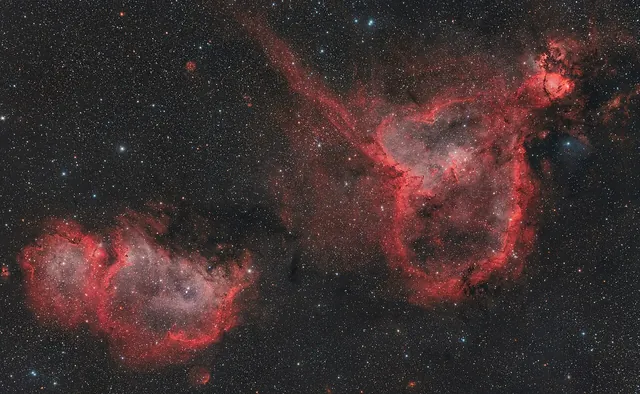
The Heart lies in Cassiopeia, next to the Soul Nebula. Its central cluster shines at magnitude 6.5, but the nebula is more than two degrees across and has a low surface brightness. It needs a wide field and a very dark sky, and a telescope of 8 inches or more helps; it is much easier to photograph with long exposures than to see by eye.356
Telescopes on the Heart
Radio telescopes mapped the hydrogen around W4 and the polarised emission of its superbubble, and wide-field hydrogen-alpha cameras traced the shell high above the Galactic plane. Chandra detected the hot gas filling the cavity, and in a study published in 2016 XMM-Newton measured X-rays from the cluster’s O stars, finding that colliding winds play little part in them.71015
NASA’s WISE mission photographed the Heart and Soul in infrared in 2010. Since then Gaia has measured the distances and motions of the cluster’s stars, revealing its expanding halo, and the 4-metre Mayall telescope at Kitt Peak has imaged its centre in detail.451618
Quick answers
- What kind of object is the Heart Nebula (IC 1805)?
- The Heart Nebula (IC 1805) is an H II region (emission nebula) around a young open cluster.16
- Which constellation is the Heart Nebula (IC 1805) in?
- The Heart Nebula (IC 1805) lies in the constellation Cassiopeia.6
- How far away is the Heart Nebula (IC 1805)?
- The Heart Nebula (IC 1805) is about 2,000 parsecs from Earth (Gaia: 2,075 pc (2022) and 1,982 pc (2025); photometry gives 2.4 kpc; NASA says about 6,000 light-years).14510
- How big is the Heart Nebula (IC 1805)?
- The Heart Nebula (IC 1805) is over 100 light-years across (the W4 bubble).9
- How big does the Heart Nebula (IC 1805) look in the sky?
- The Heart Nebula (IC 1805) covers 150′ of sky (Sharpless catalogue; the central cluster spans 20′).26
- How bright is the Heart Nebula (IC 1805) in the night sky?
- The Heart Nebula (IC 1805) has an apparent magnitude of 6.5 (the central cluster).6
- How old is the Heart Nebula (IC 1805)?
- The Heart Nebula (IC 1805) is about 3.5 to 5 million years old (the central cluster).410
- When was the Heart Nebula (IC 1805) discovered?
- The Heart Nebula (IC 1805) was discovered by E. E. Barnard.1112
- How massive is the Heart Nebula (IC 1805)?
- The Heart Nebula (IC 1805) has a mass of about 2,700 solar masses (stars of the central cluster).10
Sources
- The Villafranca catalog of Galactic OB groups. II. From Gaia DR2 to EDR3 and ten new systems with O stars (Maíz Apellániz et al.) — Astronomy & Astrophysics 657, A131 (arXiv:2110.01464), 2022
- Catalogue of H II regions (Sharpless 1959): entry Sh 2-190 — CDS VizieR, catalogue VII/20, 1959
- Deep-Sky Dreams: The Heart Nebula (David J. Eicher) — Astronomy magazine, 2025
- Tracing the W3/W4/W5 and Perseus complex dynamical evolution with star clusters (Della Croce et al.) — Astronomy & Astrophysics (arXiv:2504.16159), 2025
- Heart and Soul (PIA13112) — NASA Jet Propulsion Laboratory, Caltech (WISE), 2010
- Revised IC Data for IC 1805 (from W. Steinicke’s Revised NGC and IC Catalog) — SEDS Interactive NGC Catalog
- The Fragmenting Superbubble Associated with the H II Region W4 (West et al.) — Astrophysical Journal 656, 914 (arXiv:astro-ph/0611226), 2007
- Hierarchical Triggering of Star Formation by Superbubbles in W3/W4 (Oey et al.) — Astronomical Journal 129, 393 (arXiv:astro-ph/0501136), 2005
- W3 Main: A Productive Star Formation Factory (Chandra Photo Album, 18 December 2006) — Chandra X-ray Center, Harvard-Smithsonian Center for Astrophysics, 2006
- An Optical and Infrared Photometric Study of the Young Open Cluster IC 1805 in the Giant H II Region W4 (Sung et al.) — Astrophysical Journal Supplement Series 230, 3 (arXiv:1704.04592), 2017
- Historic NGC/IC: discoverers and discovery dates of the NGC and IC objects (W. Steinicke) — Wolfgang Steinicke, NGC/IC research pages (archived copy), 2026
- IC 1805 — SEDS Interactive NGC Catalog
- The Distance to the Perseus Spiral Arm in the Milky Way (Xu et al.) — Science 311, 54 (arXiv:astro-ph/0512223), 2006
- Water maser motions in W3(OH) and a determination of its distance (Hachisuka et al.) — Astrophysical Journal 645, 337 (arXiv:astro-ph/0512226), 2006
- X-ray and optical spectroscopy of the massive young open cluster IC 1805 (Rauw & Nazé) — Astronomy & Astrophysics 594, A82 (arXiv:1608.04499), 2016
- The origin of a distributed stellar population in the star-forming region W4 (Lim et al.) — Astrophysical Journal 899, 121 (arXiv:2006.15262), 2020
- The multiplicity of the three brightest early-type stars of IC 1805: HD 15570, HD 15629 and HD 15558 (De Becker et al.) — Astronomy & Astrophysics 456, 1121 (arXiv:astro-ph/0606379), 2006
- Open Cluster IC 1805 (noao-ic1805) — NSF NOIRLab, 2020
Figures checked against these sources in November 2026. Where a quantity is not known, it is left out rather than estimated.

