nebula
Lagoon Nebula (M8)
The Lagoon Nebula is one of the brightest star-forming clouds in the sky, faintly visible to the unaided eye against the rich Milky Way in Sagittarius. It lies roughly 4,350 light-years away, and ESO describes the glowing cloud as about 100 light-years across. Its name comes from a broad, lagoon-shaped lane of dark dust that winds through the middle and splits the glow into two halves.12345
Hot, massive young stars light it from within. Their ultraviolet radiation ionises the hydrogen gas and sets it glowing red, while their winds carve the clouds into ridges, globules and twisting funnels. Beside the brightest patch, the Hourglass, lies Herschel 36, a triple system of massive stars, and nearby shines 9 Sagittarii, a pair of O-type stars. Thousands of stars have formed here within the last few million years.3678910
Shape and size in space
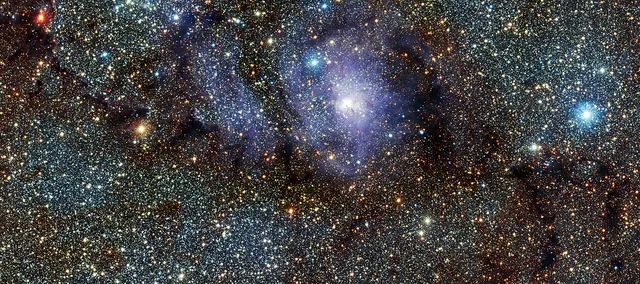
Distances to the Lagoon were long uncertain. Older references ranged from about 4,850 to 6,500 light-years, and NASA’s Hubble guide still quotes 5,200. Parallaxes from the Gaia spacecraft now place its cluster, NGC 6530, at 1,325 parsecs in one study and 1,336 parsecs in another, and ESA/Hubble gives about 4,350 light-years. ESO’s own releases say 4,000–5,000 light-years.123681213
On the sky the nebula spans about 90′ × 40′, roughly three times the width of the full Moon. ESO describes a giant cloud about 100 light-years across, while ESA/Hubble gives 55 light-years wide and 20 tall. A broad dark dust lane crosses the middle and divides the glow into two sections, and a faint extension to the east carries a catalogue number of its own, IC 4678.4578
The young cluster NGC 6530 is centred in the eastern half of the nebula. Its starlight is reddened by dust, but only a little, which suggests the cluster lies just in front of the glowing gas. Gaia’s measurements of stellar motions indicate that the cluster’s parent cloud crossed the plane of the Milky Way about four million years ago, an encounter that may have triggered most of its star formation.358
What makes it shine
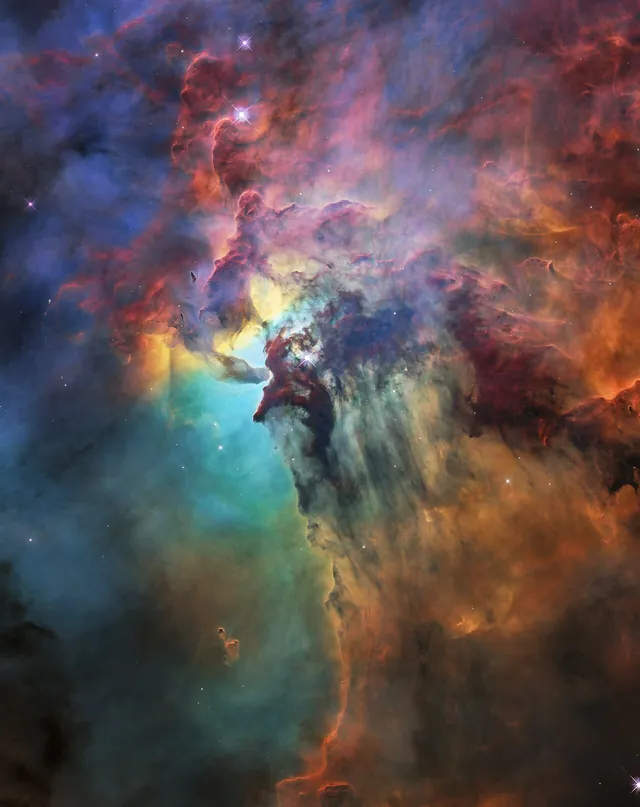
The Lagoon is an emission nebula. Massive stars embedded in it give off enormous amounts of ultraviolet radiation, which ionises the surrounding hydrogen and makes it glow in a distinctive shade of red. Two stars stand out near the bright centre: 9 Sagittarii, at magnitude 5.97 the brightest star associated with the nebula, and Herschel 36, the main source of light for the Hourglass.1681516
Radiation from Herschel 36 heats the surfaces of nearby clouds and blows some of their gas away, leaving denser and thinner regions. Hubble has watched this in visible light, which shows the glowing gas in detail, and in infrared light, which cuts through the dust to reveal structures and young stars hidden behind it. Narrow-band images map individual elements such as hydrogen, nitrogen, oxygen and sulphur.17
The stars inside
NGC 6530 is the cluster born from the Lagoon’s gas. A 2019 study combining X-ray, infrared, ultraviolet and Gaia data listed nearly 3,700 candidate members, of which about 2,700 are thought to be genuine. Their ages run from under half a million to about five million years in a pattern of sequential star formation, and part of the population is still hidden behind thick dust.3
The cluster is coming apart. Gaia proper motions show NGC 6530 expanding at about 1 km/s, and a study of some 900 members using Gaia-ESO Survey spectra found a three-dimensional velocity dispersion of 5.35 km/s, high enough to suggest the group is not gravitationally bound. Oddly, the expansion runs mainly north–south, with very little sign of it east–west.1218
The brightest stars are multiple. 9 Sagittarii is a pair of O-type stars, classed O3.5 V and O5–5.5 V, that circle each other every 8.6 years on a highly eccentric orbit. Herschel 36 is a triple: a close binary with a period of 1.54 days and a wider companion. Interferometry with ESO’s Very Large Telescope gave its three stars masses of 22.3, 20.5 and 12.5 Suns.91017
- Candidate members of NGC 6530
- nearly 3,7003about 2,700 estimated genuine
- Ages
- under 0.5 to about 5 million years3
- Expansion speed
- about 1 km/s12
- 3D velocity dispersion
- 5.35 km/s (+0.39/−0.34)18
- Orbit of 9 Sagittarii
- 8.6 years; eccentricity 0.710
- Inner binary of Herschel 36
- period 1.5415 ± 0.0006 days17
- Masses of the Herschel 36 A stars
- 22.3, 20.5 and 12.5 solar masses9
Notable features
The Hourglass
The brightest part of the Lagoon Nebula, named for its shape and discovered by John Herschel. It lies in a region of vigorous star formation and is lit mainly by the hot young star Herschel 36, with the bright O-type star 9 Sagittarii close by.816
The interstellar twisters
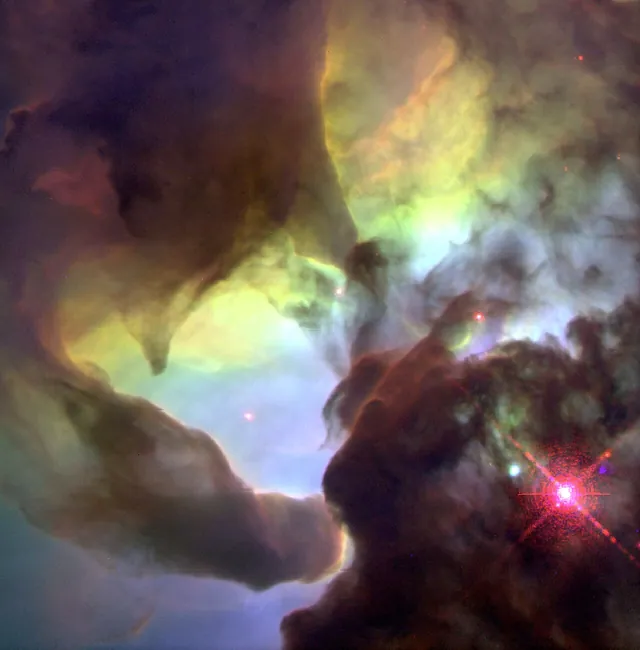
Hubble images released in 1997 revealed a pair of funnels and twisted-rope structures near Herschel 36, each about half a light-year long. They are thought to be wound into shape by the temperature difference between the clouds’ hot surfaces and cold interiors, and may one day collapse to form new stars.716
Bok globules
Dark, compact clouds scattered across the glow, so dense that they block background starlight even in the infrared. The most conspicuous are in E. E. Barnard’s catalogue of dark nebulae: the comet-shaped Barnard 88, small Barnard 89 near the cluster, and the long, narrow Barnard 296 at the southern edge.5813
Herbig–Haro objects
Newborn stars still wrapped in accretion discs fire jets from their poles, and short-lived bright streaks appear where the jets plough into surrounding gas. Several of these Herbig–Haro objects were found in the Lagoon in the years before 2010, clear evidence that star formation is still going on.613
Discovery and history
Giovanni Battista Hodierna recorded the nebula before 1654 as number II.6 in his list, and John Flamsteed noted it as a nebula around 1680. Philippe Loys de Chéseaux saw it in 1746 and, resolving some stars, called it a cluster. Guillaume Le Gentil found the nebula and the cluster together in 1747, and Nicolas Louis de Lacaille listed it as III.14 in his catalogue of 1751–52.8
Charles Messier catalogued it on 23 May 1764, describing mainly the cluster and mentioning the nebula separately around the star 9 Sagittarii. William Herschel gave two parts of the nebula their own numbers, later NGC 6526 and NGC 6533, and John Herschel listed the cluster separately. In the New General Catalogue the nebula became NGC 6523 and the cluster NGC 6530.8
Seeing it for yourself
The Lagoon sits in a conspicuous field of the Sagittarius Milky Way. At magnitude 6 it is faintly visible to the unaided eye under dark skies and easy to see in binoculars or a small telescope. Without optical aid it looks like a small grey patch, because human eyes cannot tell colours apart in dim light. NASA’s Hubble observing guide names August as the best month to look.168
Telescopes on the Lagoon
Hubble has returned to the Lagoon many times. Images released in January 1997 revealed the twisters beside Herschel 36; the Advanced Camera for Surveys imaged the heart of the nebula in 2010; and for Hubble’s 28th anniversary in April 2018 it observed a region about four light-years across in visible and infrared light. Hubble has also searched the cluster NGC 6530 for proplyds, glowing discs around newborn stars.26716
From the ground, ESO’s Wide Field Imager at La Silla produced a 370-million-pixel view covering more than one and a half square degrees in 2009. In 2011 the VISTA telescope mapped the nebula in infrared light for the VVV survey of the Milky Way’s central regions, and in 2014 the VLT Survey Telescope caught it in a 16,000-pixel-wide image for the VPHAS+ survey.4513
Quick answers
- What kind of object is the Lagoon Nebula (M8)?
- The Lagoon Nebula (M8) is an emission nebula (H II region) with the young open cluster NGC 6530.158
- Which constellation is the Lagoon Nebula (M8) in?
- The Lagoon Nebula (M8) lies in the constellation Sagittarius.1
- How far away is the Lagoon Nebula (M8)?
- The Lagoon Nebula (M8) is about 4,350 light-years from Earth (Gaia parallaxes of its cluster give 1,325–1,336 parsecs).2312
- How big is the Lagoon Nebula (M8)?
- The Lagoon Nebula (M8) is about 100 light-years across (ESA/Hubble gives 55 × 20 light-years).457
- How bright is the Lagoon Nebula (M8) in the night sky?
- The Lagoon Nebula (M8) has an apparent magnitude of 6.0 (faintly visible to the unaided eye under dark skies).18
- How big does the Lagoon Nebula (M8) look in the sky?
- The Lagoon Nebula (M8) covers 90′ × 40′ of sky (about three times the width of the full Moon).8
Sources
- Messier 8 (The Lagoon Nebula) — NASA Science, Hubble’s Messier Catalog
- Cosmic Smokescreen (Picture of the Week potw2250a) — ESA/Hubble, 2022
- A wide-area photometric and astrometric (Gaia DR2) study of the young cluster NGC 6530 (Damiani et al.) — Astronomy & Astrophysics 623, A25 (arXiv:1812.11402), 2019
- Sneak Preview of Survey Telescope Treasure Trove (eso1403) — European Southern Observatory, 2014
- The Trilogy is Complete (eso0936) — European Southern Observatory, 2009
- Breaking waves in the stellar Lagoon (heic1015) — ESA/Hubble, 2010
- Hubble celebrates 28th anniversary with a trip through the Lagoon Nebula (heic1808) — ESA/Hubble, 2018
- Messier 8 (H. Frommert & C. Kronberg) — SEDS Messier Database (Observatoire de Paris mirror), 2007
- The outer orbit of the high-mass stellar triple system Herschel 36 determined with the VLTI (Sanchez-Bermudez et al.) — Monthly Notices of the Royal Astronomical Society (arXiv:2204.13075), 2022
- 9 Sgr: uncovering an O-type spectroscopic binary with an 8.6 year period (Rauw et al.) — Astronomy & Astrophysics (arXiv:1205.3314), 2012
- SIMBAD astronomical database: M 8 — Centre de Données astronomiques de Strasbourg (CDS)
- Kinematics in Young Star Clusters and Associations with Gaia DR2 (Kuhn et al.) — Astrophysical Journal 870, 32 (arXiv:1807.02115), 2019
- VISTA Stares Deeply into the Blue Lagoon (eso1101) — European Southern Observatory, 2011
- Revised NGC Data for NGC 6523 (from W. Steinicke’s Revised NGC and IC Catalog) — SEDS Interactive NGC Catalog
- SIMBAD astronomical database: * 9 Sgr — Centre de Données astronomiques de Strasbourg (CDS)
- Giant “Twisters” and Star Wisps in the Lagoon Nebula — NASA Science (Hubble news release), 1997
- On the multiplicity of the zero-age main-sequence O star Herschel 36 (Arias et al.) — Astrophysical Journal Letters 710, L30 (arXiv:1001.3892), 2010
- The Gaia-ESO Survey: Asymmetric expansion of the Lagoon Nebula cluster NGC 6530 from GES and Gaia DR2 (Wright et al.) — Monthly Notices of the Royal Astronomical Society (arXiv:1903.12176), 2019
Figures checked against these sources in November 2026. Where a quantity is not known, it is left out rather than estimated.

