nebula
Trifid Nebula (M20)
The Trifid Nebula is a star-forming cloud in Sagittarius, named by John Herschel for the three dark lanes of dust that divide its glowing heart. It joins a red emission nebula, lit by young stars at its centre, to a blue reflection nebula that is most conspicuous to the north. Gaia measurements place it about 1,260 parsecs away, roughly half the distance of some earlier estimates.123
At its centre shines a hot O-type star, HD 164492, whose light illuminates the surrounding cloud. Massive stars there have shaped the region for at least 300,000 years, their winds blowing an enormous bubble into the gas and dust. Around it new stars are still forming: Spitzer found about 160 young stellar objects, and Hubble has watched jets from protostars change over 29 years.45678
Shape and size in space
The Trifid’s distance has been unusually disputed. Older estimates ranged from about 2,200 to 7,600 light-years, and a 2004 Hubble release gave 9,000 light-years (2,700 parsecs). Gaia parallaxes have narrowed this down: one study found 1,260 ± 70 parsecs, about half the 2,700 parsecs of an earlier estimate, and another about 1,250 parsecs. NASA’s current Hubble guide gives 5,000 light-years.1231011
On the sky the Trifid spans about 28′ and lies just north-west of the larger Lagoon Nebula, which Gaia shows to be at a similar distance. The red emission nebula at the centre, with its young cluster, is surrounded by a blue reflection nebula that is most conspicuous to the north. Three intersecting lanes of dark dust trisect the bright core.123
Millimetre maps show the cloud around the Trifid broken into dense filaments 1 to 10 parsecs long, which existed before the nebula formed. One massive filament with the properties of an infrared dark cloud connects M20 to the supernova remnant W28. A 2021 study proposed that the present generation of stars formed after two clouds collided about a million years ago.1113
What makes it shine
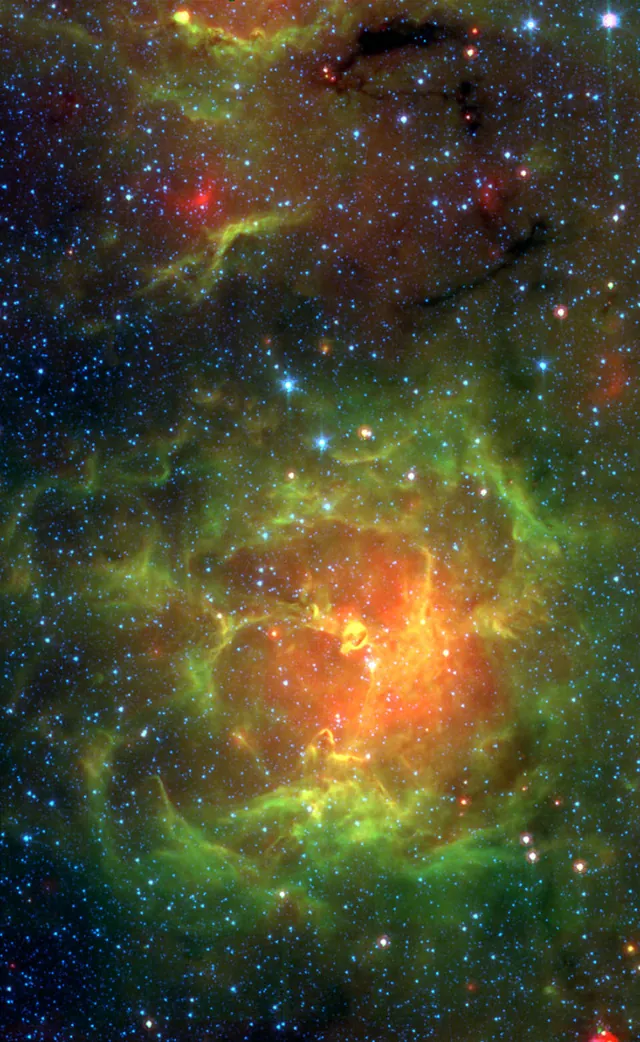
The Trifid is both an emission and a reflection nebula. Its red heart is gas ionised by the flood of ultraviolet light from the young, massive stars at its centre; around it, dust reflects starlight and appears blue. The main ionising star, HD 164492, has a brightest component classed O7.5 Vz, and an A-type supergiant, HD 164514, sits on the nebula’s northern edge.14510
In infrared light the picture changes. Where dark lanes trisect the nebula in visible light, the Spitzer Space Telescope saw bright regions of star formation, along with large filamentary dark clouds and warm dust glowing in shells, arcs and bow shocks. The colours in such images are false: Spitzer’s combined IRAC and MIPS view shows 4.5, 8.0 and 24 microns as blue, green and red.56
Hubble’s 2026 visible-light view reads like a density map. The bright blue upper left holds the least dust: there ultraviolet light has stripped electrons from the gas, and winds have cleared a bubble. Bright yellow gas streams away where clouds are being destroyed, thicker dust shows dark brown, and in the densest corner the view is nearly black.7814
The stars inside
A 2021 study combining optical imaging with Gaia and infrared data identified 15 flat-spectrum or Class I young stellar objects, 46 Class II objects and 41 accreting pre-main-sequence stars. The visible young stars, about 1.5 million years old, are spread towards the edges of the molecular clouds, the youngest objects are more tightly grouped, and a cavity empty of young stars lies where two clouds overlap.11
Infrared surveys found many more. Spitzer uncovered 30 massive embryonic stars and 120 smaller newborn stars, ten of the massive ones inside four dark cores that radio astronomers had thought were not yet ripe for star formation. A detailed analysis identified about 160 young stellar objects and found several protostars together inside some of the coldest cores, evidence that stars cluster from the earliest stage.56
Millimetre surveys counted 33 dense cores around the nebula, 16 of them forming stars, most with masses of only a few Suns. The fragments that became the cometary globules at the edge of the glowing region held 100 solar masses or more. Photoionisation seems to play only a minor role in forming the cores, and the nearby supernova remnant W28 may have triggered some of the clusters.13
Notable features
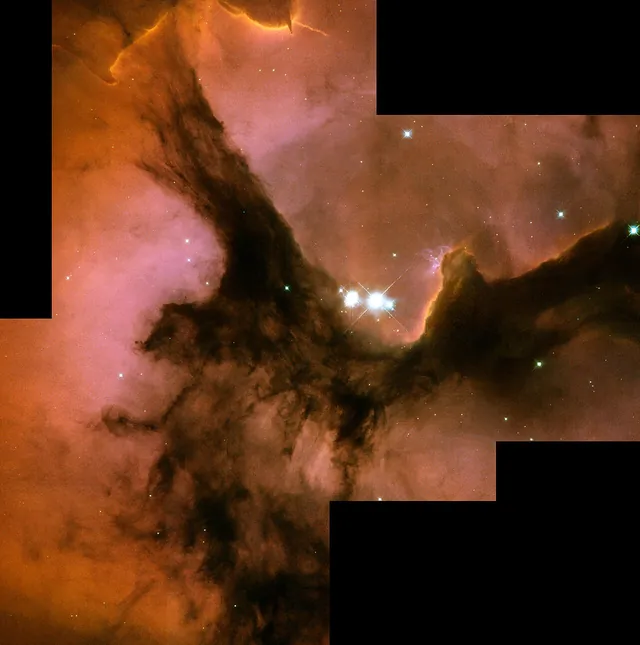
The three dark lanes
The dust lanes that give the Trifid its name, silhouetted against the glowing gas and meeting near the bright young stars at its heart. E. E. Barnard catalogued this dark nebula as Barnard 85, and John Herschel coined the name Trifid for the nebula’s three-lobed appearance.13
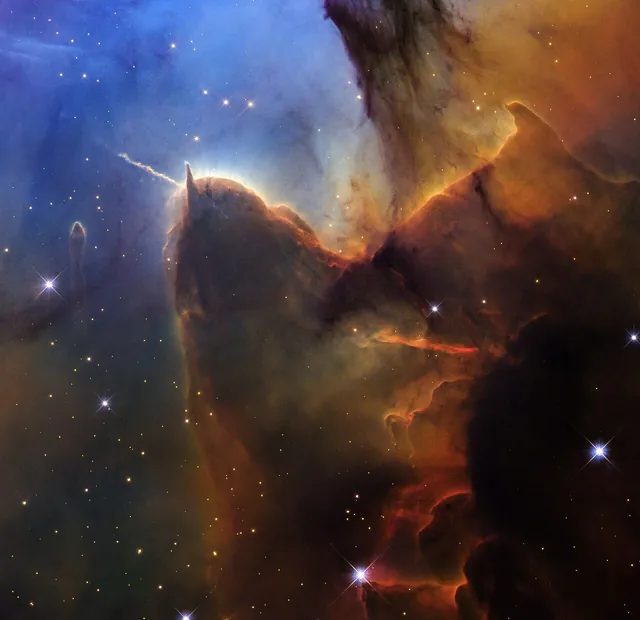
The Cosmic Sea Lemon and Herbig–Haro 399
A rust-coloured cloud shaped like a sea lemon, imaged by Hubble in 1997 and 2026. Its left horn is part of Herbig–Haro 399, a jet of plasma ejected over centuries by a protostar in the cloud’s head. Comparing the two images shows the jet expanding, so astronomers can measure its speed and energy.78
A nursery torn apart
Hubble’s 1997 view showed a star-forming cloud being torn apart by radiation from a massive star just beyond the frame. Finger-like jets, each about three-quarters of a light-year long, protrude from the cloud’s head and may mark stars forming at their tips, while the radiation erodes them.1015
The cold cores TC1 to TC4
Dense, cold cores around the Trifid, once classed as very young Class 0 objects and expected to be starless. Spitzer detected mid-infrared light from protostars inside them: one each in TC1 and TC2 and several in TC3 and TC4. In TC3 the most massive star sits at the centre of its small cluster.56
Discovery and history
Charles Messier discovered the Trifid on 5 June 1764 and described it as a cluster of 8th- to 9th-magnitude stars enveloped in nebulosity, a remark that also took in nearby M21. William Herschel, who usually avoided giving Messier’s objects numbers of his own, assigned four to parts of this nebula, perhaps because Messier had called it merely a cluster of stars.1
John Herschel gave the whole object a single entry and first used the name “Trifid”; that entry became NGC 6514 in J. L. E. Dreyer’s New General Catalogue. E. E. Barnard later catalogued the dark nebula responsible for its three-lobed look as Barnard 85.1
Seeing it for yourself
The Trifid lies in Sagittarius just north-west of the Lagoon Nebula, close enough for the two to make a fine pair in wide-field photographs, and even closer to the open cluster M21. NASA’s Hubble guide gives its magnitude as 6.3, says it can be spotted with a small telescope, and names August as the best month to look.110
Its brightness is hard to pin down. Visual estimates range from magnitude 6.8 to 9.0, partly because the bright multiple star within it, of about 7th magnitude overall, and a supergiant of magnitude 7.4 on its northern edge make it difficult to separate the nebula’s own light from theirs.1
Telescopes on the Trifid
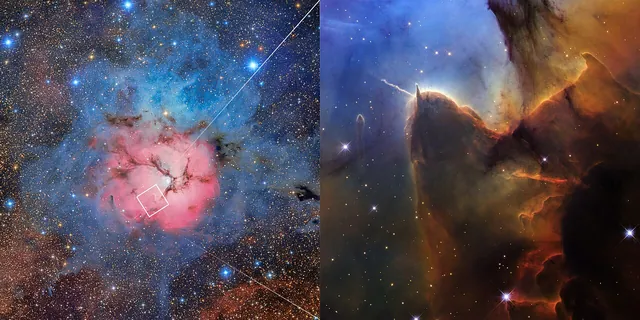
Hubble first studied the Trifid with its Wide Field and Planetary Camera 2: a 1997 image of a star-forming cloud torn apart by radiation was released in November 1999, and a view of the nebula’s heart near the meeting point of the dust lanes followed in June 2004. For its 36th anniversary, on 20 April 2026, Hubble released a new Wide Field Camera 3 view of the 1997 scene.3781015
Infrared and radio telescopes see through the dust. Spitzer’s images, released in 2005, revealed embryonic stars throughout the nebula, and millimetre telescopes including the IRAM 30-metre dish mapped its cold dust and molecular gas. NASA notes that the camera of the Nancy Grace Roman Space Telescope can cover the entire Trifid, showing the full bubble, in a single pointing.6713
Quick answers
- What kind of object is the Trifid Nebula (M20)?
- The Trifid Nebula (M20) is an emission and reflection nebula (H II region) with a young open cluster.19
- Which constellation is the Trifid Nebula (M20) in?
- The Trifid Nebula (M20) lies in the constellation Sagittarius.10
- How far away is the Trifid Nebula (M20)?
- The Trifid Nebula (M20) is about 1,260 parsecs from Earth (Gaia parallaxes; NASA quotes 5,000 light-years, older sources up to 9,000).231011
- How bright is the Trifid Nebula (M20) in the night sky?
- The Trifid Nebula (M20) has an apparent magnitude of 6.3 (estimates range from 6.3 to 9.0).11012
- How big does the Trifid Nebula (M20) look in the sky?
- The Trifid Nebula (M20) covers 28′ of sky (the Revised NGC gives 20′ × 20′).112
- When was the Trifid Nebula (M20) discovered?
- The Trifid Nebula (M20) was discovered on 5 June 1764, by Charles Messier.1
Sources
- Messier 20 (H. Frommert & C. Kronberg) — SEDS Messier Database (Observatoire de Paris mirror), 2007
- Kinematics in Young Star Clusters and Associations with Gaia DR2 (Kuhn et al.) — Astrophysical Journal 870, 32 (arXiv:1807.02115), 2019
- New Hubble Image Reveals Details in the Heart of the Trifid Nebula — NASA Science (Hubble news release), 2004
- SIMBAD astronomical database: HD 164492 — Centre de Données astronomiques de Strasbourg (CDS)
- Spectacular Spitzer images of the Trifid Nebula: Protostars in a young, massive-star-forming region (Rho et al.) — Astrophysical Journal 643, 965 (arXiv:astro-ph/0601633), 2006
- Spitzer/IRAC+MIPS View of the Trifid Nebula (ssc2005-02a2) — NASA Spitzer Space Telescope, Caltech, 2005
- NASA’s Hubble Dazzles With Young Stars in Trifid Nebula — NASA Science (Hubble news release), 2026
- Hubble dazzles with young stars in Trifid Nebula for 36th anniversary (heic2608) — ESA/Hubble, 2026
- SIMBAD astronomical database: M 20 — Centre de Données astronomiques de Strasbourg (CDS)
- Messier 20 (The Trifid Nebula) — NASA Science, Hubble’s Messier Catalog
- The Young Stellar Population, Distance, and Cloud–Cloud Collision Induced Star Formation Scenario of the Trifid Nebula (Kalari et al.) — Astrophysical Journal 921, 81 (arXiv:2111.01902), 2021
- Revised NGC Data for NGC 6514 (from W. Steinicke’s Revised NGC and IC Catalog) — SEDS Interactive NGC Catalog
- Star Formation in the Trifid Nebula (Lefloch et al.) — Astronomy & Astrophysics (arXiv:0809.2023), 2008
- Trifid Nebula (Wide Field Camera 3 image) (heic2608a) — ESA/Hubble, 2026
- The Trifid Nebula: Stellar Sibling Rivalry — NASA Science (Hubble news release), 1999
- Full Trifid Nebula (Rubin image with Hubble close-up) (heic2608b) — ESA/Hubble, 2026
Figures checked against these sources in November 2026. Where a quantity is not known, it is left out rather than estimated.

