nebula
North America Nebula (NGC 7000)
The North America Nebula is a huge cloud of glowing hydrogen in Cygnus whose outline, complete with a dark Gulf of Mexico and a bright Atlantic coast, mimics the continent. It lies about 3° east of the bright star Deneb and covers several times the area of the full Moon, yet its light is spread so thinly that binoculars show it only as a subtle brightening of the Milky Way.12
It is one half of a single star-forming complex, the H II region W80, which it shares with the Pelican Nebula; a lane of dark dust called L935 divides the two. Most of the ultraviolet light that makes the gas shine comes from one hidden star, the Bajamar star, an O-type binary buried behind that dust. Gaia measurements place the complex about 2,600 light-years away, and its clouds hold one of the largest concentrations of young stars near the Sun.34567
Shape and size in space
The North America and Pelican nebulae are two parts of one H II region about 3° across, known to radio astronomers as W80. Between them lies the dark cloud L935, catalogued by Beverly Lynds in 1962: its opaque southern part forms the ‘Gulf of Mexico’ and its thinner centre the ‘Atlantic Ocean’. The famous shapes come only from where clouds of dust in front of the glowing gas block its light.1345
Its distance was long uncertain. Estimates ranged from 500 parsecs to more than 1,000, and studies before Gaia adopted 520, 550 or 600 parsecs. In 2020 Gaia parallaxes of the complex’s young stars gave 795 ± 25 parsecs, about 2,600 light-years, and Gaia’s next data release gave 785 ± 16 parsecs for its centre. Older figures survive in popular sources: NASA gives roughly 1,800 light-years and ESO about 1,500.2347121314
The complex has depth. Gaia shows that the stars in the Gulf of Mexico are 35 to 40 parsecs nearer than the rest, while a small group around the star V1057 Cygni is about 130 parsecs farther away. Maps of molecular gas show the clouds shaped by the bubble of ionised gas that the central O star has blown: some clumps on the near side are being pushed towards us, and a group on the far side is moving away.4614
The molecular clouds around W80 hold tens of thousands of solar masses of gas. A 2014 carbon monoxide survey found 5.4 × 10⁴ solar masses in the complex, where earlier work gave 3 × 10⁴ to 5 × 10⁴. The region belongs to a string of star-forming clouds that runs from the Orion clouds to Cygnus X.3415
What makes it shine
This is an emission nebula: light from a hot star strips electrons from hydrogen atoms, and the gas glows as they recombine. Sensitive cameras record the red colour typical of hydrogen. Finding the star responsible took decades. Edwin Hubble proposed Deneb, but Deneb is not hot enough and lies too far from the nebula.1216
In 1958 Herbig considered and rejected several candidate stars and concluded, as Osterbrock had the year before, that the source probably lay behind the Gulf of Mexico. It was finally found in 2005 by Comerón and Pasquali, who searched infrared survey data for hot, luminous stars: a hot O star just north-west of the Gulf, behind about 9.6 magnitudes of dimming by dust.41317
Now called the Bajamar star, it supplies most of the ionising light for both nebulae, and maps of molecular gas show its radiation shaping the bright rims of the Gulf region and the Pelican’s head. The dust dims it so much that it shines only at visual magnitude 13; unobscured, it would be one of the brightest stars in Cygnus.15611
The Wisconsin H-Alpha Mapper used the nebula as a calibration source, measuring a hydrogen-alpha brightness of 800 rayleighs. Its glow from sulphur and nitrogen is weak compared with hydrogen, much weaker than in the faint ionised gas that fills the Galaxy.18
The stars inside
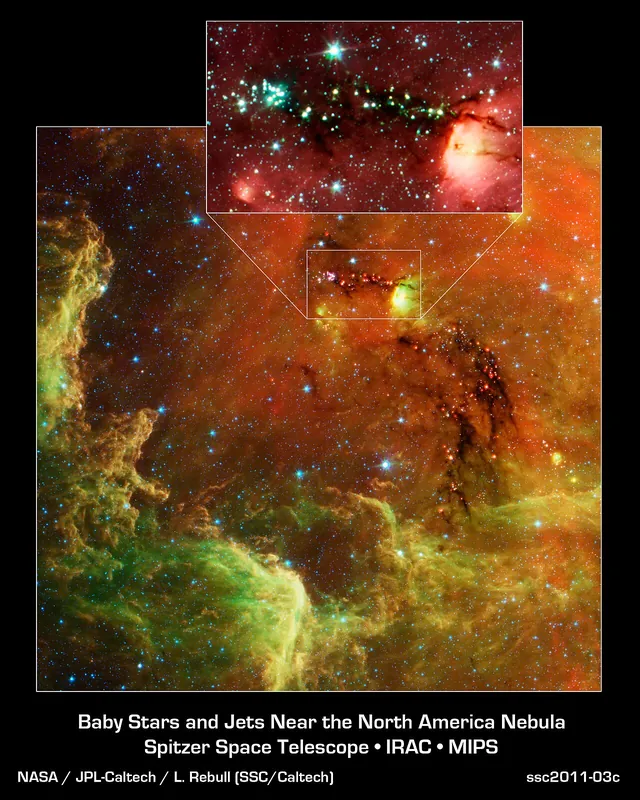
Infrared surveys turned a modest population into a crowd. Before Spitzer only about 200 young stars were known in the complex; its IRAC and MIPS cameras identified 2,076 candidates, 375 of them in the Gulf of Mexico. X-ray images from Chandra and XMM-Newton picked up more than 700 sources, fewer than 30% of them previously known young stars.3131920
Gaia then sorted out who really belongs. Many stars once thought to be spread through the region proved to be unrelated, and the true members fall into at least six groups, labelled A to F, each tied to its own piece of molecular cloud; three are expanding at up to about 8 km/s. A spectroscopic survey of 580 members found a median age of about 1 million years, and nearly all the stars are younger than 3 million years.410
The Bajamar star, named for its position off the nebula’s ‘Bahamas’, is a pair whose brighter star is of type O3.5, which would make it the nearest known massive star of a type earlier than O4. It sits in no cluster. Gaia shows it moving away from its neighbours at about 6 km/s, ejected 1.6 million years ago from the Bermuda cluster with at least four other systems. That cluster has lost more than 200 solar masses this way, including its three most massive stars, which makes it an ‘orphan’ cluster.4514
A second O star, HD 199579, appears on the North America Nebula itself but was long thought too far from the centre to light it. Its Gaia motion suggests that it, too, may have drifted away from the Bermuda cluster, in a separate ejection.4521
- Young stars in the Gulf of Mexico
- 3753
- X-ray sources
- more than 70020Chandra and XMM-Newton
- Members confirmed by spectroscopy
- 58010
- Median age
- about 1 million years10
- Ejection of the Bajamar star
- 1.611 ± 0.011 million years ago5
- Speed of the Bajamar star across the sky
- 6.0 ± 0.2 km/s14relative to the other stars of the complex
- HD 199579
- spectral type O6.5 V((f))z; magnitude 5.9621
Notable features
The Gulf of Mexico
The densest, southern part of the dark cloud L935 and the most active site of star formation in the complex. Visible light cannot get through it, but Spitzer found several hundred young stars inside, and a 2011 survey found 35 new Herbig–Haro objects, glowing shocks driven by jets from newborn stars.3132223
The Cygnus Wall
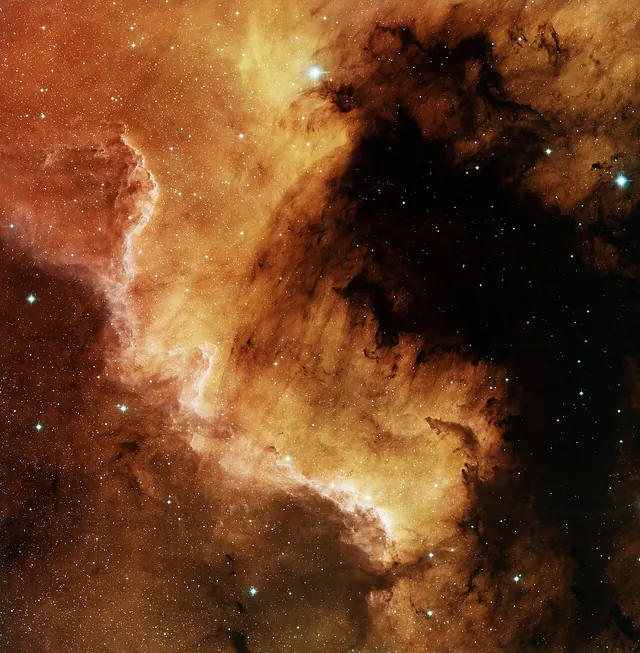
The bright W-shaped ridge along the ‘west coast of Mexico’, an ionisation front where the O star’s radiation meets the edge of a cloud, with dark dusty shapes in silhouette. NASA’s Astronomy Picture of the Day has described it as spanning about 10 light-years in one picture and about 20 in another.41624
The Atlantic Ocean
The thinner central part of L935, east of the Pelican. It holds Group D, the largest of the Gaia groups, and lies mostly in front of the glowing gas. Its star formation is low-level compared with the Gulf.34
HBC 722 and PTF10nvg
Two young stars that flared in 2010. HBC 722 brightened by about 4.7 magnitudes in an outburst of the FU Orionis type that began before May and peaked in September, while PTF10nvg, a young protostar, brightened by more than 5 magnitudes. Such outbursts are often explained by gas from a disc suddenly falling onto the star.252627
MHO 3417
The largest outflow found in the complex: a jet of shocked hydrogen 1.6 parsecs long, emerging from a dense clump of about 500 solar masses in the Gulf. It may be powered by a massive star still forming.3
NGC 6997
A true star cluster set in the nebula’s ‘East Coast’, recorded by William Herschel. Two neighbouring catalogue entries, NGC 6989 and NGC 6996, may be no more than rich patches of the Milky Way.28
Discovery and history
William Herschel discovered the nebula on 24 October 1786 from Slough in England, but saw only its brightest southern part, ‘Central America’. His son John catalogued it, and both saw only an indistinct glow among the Milky Way’s stars; John was unsure his father had seen the same nebula, and William’s entry carries a question mark in the New General Catalogue.11228
The shape became clear only with photography. The German astronomer Max Wolf photographed the area in 1890 and named it the North America Nebula. In 1958 Herbig surveyed 6 square degrees of the complex and found 68 stars showing hydrogen-alpha emission, a mark of youth; many later became famous young stars.113
Radio astronomers listed the ionised gas as W80 in Westerhout’s survey of 1958, and in 1980 Bally and Scoville mapped the surrounding molecular clouds. The ionising star was identified in 2005 and given its name, the Bajamar star, in a 2016 paper by Maíz Apellániz and colleagues.345619
Seeing it for yourself
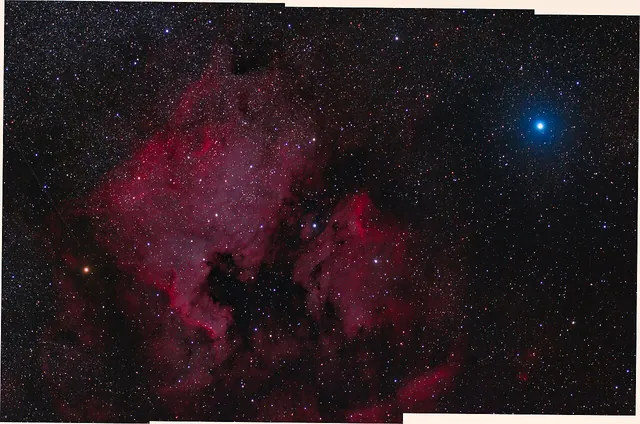
Look about 3° east of Deneb, in the bright band of Milky Way that crosses Cygnus in northern late summer and autumn skies; NASA suggests September as the best month. Under perfect skies the nebula may just be visible to the naked eye, and in very good conditions binoculars show it as a large, shapeless glow.1224
A small telescope of 4 to 6 inches with a wide-field eyepiece fills its view with the nebula. The ‘Atlantic coast’ and ‘Florida’ stand out best against the dark cloud, while ‘Mexico’ is fainter and the ‘West Coast’ blends into the star fields. A UHC nebula filter helps a great deal. Although its total magnitude is about 5, it does not look bright against the Milky Way, and binoculars or a small telescope show it best.12
Telescopes on the North America Nebula
NASA’s Spitzer Space Telescope mapped about 9 square degrees of the complex with its IRAC camera and about 7 with its MIPS camera. In the infrared images released in February 2011 the continent disappears: dusty clouds become transparent, and the Gulf of Mexico turns from a dark cloud into a river of hundreds of young stars.13192329
Hubble’s Wide Field and Planetary Camera 2 imaged part of the nebula in a survey of young T Tauri stars. Chandra and XMM-Newton made the first extensive X-ray survey, with four and seven pointings, and the Zwicky Transient Facility followed 323 variable young stars for more than two years.22030
Radio telescopes map the cold gas. The Purple Mountain Observatory’s 13.7-metre dish surveyed 4.25 square degrees in carbon monoxide and found 611 dense clumps, and the CARMA array mapped the Gulf and the Pelican’s head in finer detail. Near-infrared images of shocked hydrogen revealed hundreds of shocks driven by more than 50 outflows from young stars.34615
Quick answers
- What kind of object is the North America Nebula (NGC 7000)?
- The North America Nebula (NGC 7000) is an emission nebula (H II region).23
- Which constellation is the North America Nebula (NGC 7000) in?
- The North America Nebula (NGC 7000) lies in the constellation Cygnus.29
- How far away is the North America Nebula (NGC 7000)?
- The North America Nebula (NGC 7000) is about 2,600 light-years (795 ± 25 parsecs) from Earth, from Gaia parallaxes of its young stars.47
- How big does the North America Nebula (NGC 7000) look in the sky?
- The North America Nebula (NGC 7000) covers 2° × 1⅔° of sky (about 10 times the area of the full Moon).1
- How big is the North America Nebula (NGC 7000)?
- The North America Nebula (NGC 7000) is about 40 parsecs across (the whole North America–Pelican complex, about 3° across).4
- How bright is the North America Nebula (NGC 7000) in the night sky?
- The North America Nebula (NGC 7000) has an apparent magnitude of 5 (but spread over a large area, so it looks faint).2
- When was the North America Nebula (NGC 7000) discovered?
- The North America Nebula (NGC 7000) was discovered on 24 October 1786, by William Herschel.12
Sources
- 101 Must-See Cosmic Objects: The North America Nebula (Alan Goldstein) — Astronomy magazine, 2022
- Caldwell 20 — NASA Science, Hubble’s Caldwell Catalog, 2025
- Outflows, Dusty Cores, and a Burst of Star Formation in the North America and Pelican Nebulae (Bally et al.) — Astronomical Journal 148, 120 (arXiv:1409.6762), 2014
- The Formation of a Stellar Association in the NGC 7000/IC 5070 Complex: Results from Kinematic Analysis of Stars and Gas (Kuhn et al.) — Astrophysical Journal 899, 128 (arXiv:2006.08622), 2020
- Escape from the Bermuda cluster: orphanization by multiple stellar ejections (Maíz Apellániz et al.) — Astronomy & Astrophysics 657, A72 (arXiv:2110.01484), 2022
- High-resolution CARMA Observation of Molecular Gas in the North America and Pelican Nebulae (Kong et al.) — Astronomical Journal 161, 229 (arXiv:2103.04418), 2021
- The North America and Pelican nebulae: This Week in Astronomy with Dave Eicher — Astronomy magazine, 2024
- SIMBAD: NGC 7000 — CDS, Strasbourg
- NGC 7000 (NGC/IC database) — SEDS
- The First Extensive Spectroscopic Study of Young Stars in the North America and Pelican Nebulae Region (Fang et al.) — Astrophysical Journal 904, 146 (arXiv:2009.11995), 2020
- SIMBAD: Bajamar Star (2MASS J20555125+4352246) — CDS, Strasbourg
- The North America Nebula and the open star cluster Messier 39 — ESO
- The North American and Pelican Nebulae II. MIPS Observations and Analysis (Rebull et al.) — Astrophysical Journal Supplement Series 193, 25 (arXiv:1102.0573), 2011
- Distance and Tangential Velocity of the Main Ionizing Star in the North America/Pelican Nebulae with Gaia EDR3 (Kuhn & Hillenbrand) — Research Notes of the American Astronomical Society (arXiv:2012.05074), 2020
- Molecular Clouds in the North American and Pelican Nebulae: Structures (Zhang, Xu & Yang) — Astronomical Journal 147, 46 (arXiv:1312.3079), 2014
- Along the Cygnus Wall (Astronomy Picture of the Day, 12 March 2015) — NASA, 2015
- NGC 7000: The North America Nebula and the Pelican Nebula — NOIRLab
- WHAM Observations of H-Alpha, [S II], and [N II] toward the Orion and Perseus Arms: Probing the Physical Conditions of the Warm Ionized Medium (Haffner, Reynolds & Tufte) — Astrophysical Journal 523, 223 (arXiv:astro-ph/9904143), 1999
- The North American and Pelican Nebulae I. IRAC Observations (Guieu et al.) — Astrophysical Journal 697, 787 (arXiv:0904.0279), 2009
- X-ray survey of the North-America and Pelican star-forming complex (NGC7000/IC5070) (Damiani, Pillitteri & Prisinzano) — Astronomy & Astrophysics 602, A115 (arXiv:1702.05999), 2017
- SIMBAD: HD 199579 — CDS, Strasbourg
- Star Formation in the Gulf of Mexico (Armond et al.) — Astronomy & Astrophysics (arXiv:1101.4670), 2011
- North America Nebula Disappears (ssc2011-03b) — NASA/JPL-Caltech, Spitzer Space Telescope, 2011
- Along the Cygnus Wall (Astronomy Picture of the Day, 3 July 2014) — NASA, 2014
- The large amplitude outburst of the young star HBC 722 in NGC 7000/IC 5070, a new FU Orionis candidate (Semkov et al.) — Astronomy & Astrophysics (arXiv:1011.1647), 2010
- PTF10nvg: An Outbursting Class I Protostar in the Pelican/North American Nebula (Covey et al.) — arXiv:1011.2565, 2010
- The outburst and nature of two young eruptive stars in the North America/Pelican Nebula Complex (Kóspál et al.) — Astronomy & Astrophysics (arXiv:1011.4009), 2010
- Notes on the NGC objects (Harold G. Corwin Jr.) — NASA/IPAC Extragalactic Database (NED)
- New View of Family Life in the North American Nebula — NASA Jet Propulsion Laboratory, 2011
- A ZTF Look at Optical Variability of Young Stellar Objects in the North America and Pelican Nebulae Complex (Hillenbrand et al.) — arXiv:2203.09633, 2022
Figures checked against these sources in November 2026. Where a quantity is not known, it is left out rather than estimated.

