nebula
Eskimo Nebula (NGC 2392)
NGC 2392 is a planetary nebula in Gemini: the glowing gas cast off by a dying Sun-like star, first seen by William Herschel in 1787. Through ground-based telescopes it looks like a face surrounded by a fur parka, which earned it the nickname “Eskimo” Nebula. NASA stopped using that name in 2020, and the European Space Agency’s 2026 release of Webb images calls it the Lion Nebula.1234
Hubble showed that the “face” is a bubble of gas blown out by the central star’s fast wind, and the “fur” a disc of material dotted with a ring of comet-shaped knots whose tails point away from the star. The nebula began forming about 10,000 years ago. At its heart is a close pair of stars that circle each other every 1.9 days, and the central star gives off the hardest X-rays known from the central star of any planetary nebula.1256
Shape and size in space
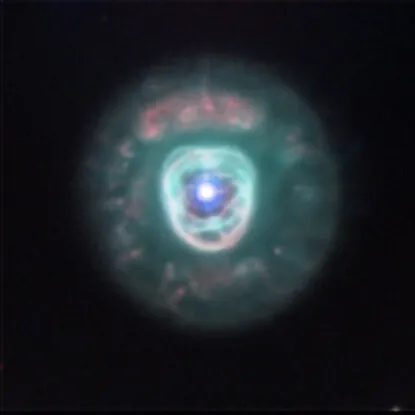
On the sky NGC 2392 looks round, but only because we happen to look at it almost end-on: its main shell is really shaped like a rugby ball. In 1990 a team led by C. R. O’Dell modelled the inner shell as a stretched spheroid, sculpted by the star’s wind, twice as long as it is wide, with its near end tipped 20° from our line of sight. A detailed 3D model published in 2012 by María Teresa García-Díaz and colleagues finds a peanut-like inner shell tilted only 9° from the line of sight.1011
The inner shell is expanding at about 120 km/s along its long axis, probably the fastest expansion known for an elliptical shell in a planetary nebula. Around it lies a slower outer shell, the hood of the parka, flattened rather than stretched, which spreads out at only 16 km/s and has an angular radius of about 23″. Hubble’s images show the inner part as two bubbles, one above and one below the star, one lying in front of the other; each is about 1 light-year long and half a light-year wide, and full of filaments of denser gas.110
Astronomers think a dense ring of gas thrown off around the star’s equator during its red-giant phase gave the nebula its shape. That waist is moving outwards at about 115,000 km/h, too slowly to let the star’s 1.5 million km/h wind push gas along the equator, so the wind sweeps material above and below the star instead, blowing the elongated bubbles.1
The distance is uncertain, and sources disagree. NASA gives about 5,000 light-years, NASA’s Chandra team about 4,200 and the Spitzer team about 3,000. The 2012 model adopted 1.4 kiloparsecs. Gaia measured a parallax of 0.545 ± 0.047 milliarcseconds for the central star, from which Bailer-Jones and colleagues estimate a distance of 1,732 parsecs, most probably between 1,609 and 1,880. Chandra describes the nebula as about 1.2 light-years across.27891012
The star began shedding its outer layers about 10,000 years ago. From the outer shell’s size and speed, the 2012 study estimates its mean age at 9,300 years. The inner shell is much younger in its present form: at today’s speed it would have overtaken the outer shell in only 1,250 years, so its fast expansion must have started long after the star left the giant stage. Webb’s team expects the nebula to disperse in about another 10,000 years.2410
- Parallax of the central star
- 0.545 ± 0.047 mas7
- Inner shell expansion
- about 120 km/s10along its long axis
- Outer shell (the hood)
- angular radius about 23″, expanding at 16 km/s10
- Each inner bubble
- about 1 light-year long, half a light-year wide1
- Age of the outer shell
- about 9,300 years10kinematic age for a distance of 1.4 kpc
What makes it shine
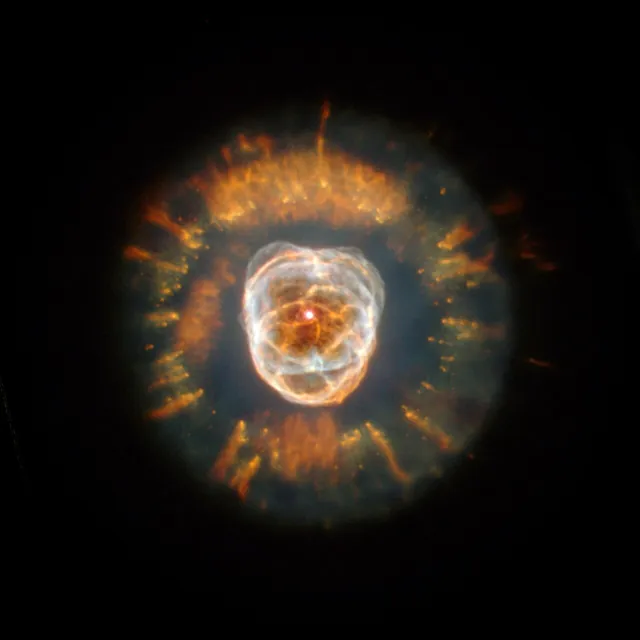
Most of the light comes from glowing gas, not from stars. Ultraviolet radiation from the central star makes the expelled material shine, each element at its own colours. Hubble’s picture combines four filters, so that nitrogen appears red, hydrogen green, oxygen blue and helium violet.1213
Inside the inner shell is gas far hotter still. ESA’s XMM-Newton satellite detected X-rays spread through the inner shell, coming from a thin plasma at about 2 million K. The 2012 study links this hot bubble to the star’s wind striking earlier ejecta and to the fast expansion of the inner shell. Yet the wind does not seem fast enough to produce so many X-rays, which pointed early on to help from a companion star or from the nebula’s jets.101415
The nebula is also more highly ionised than its star seems able to explain. Fits to the star’s spectrum give temperatures of 40,000 to 45,000 K, too cool to produce the highly ionised oxygen and neon (O IV and Ne V) seen in the nebula; other studies require 74,000 to 80,000 K. As early as 1977 Sally Heap found a spectral type of O6f and 35,000 K, against about 92,000 K from the nebula’s helium, and suggested that a second, hotter star must be doing the ionising.10
The star at the centre
The central star, catalogued as HD 59088, shines at Gaia magnitude 10.68 in the middle of the nebula. It is the exposed hot core of a star that has run out of hydrogen fuel in its centre. Chandra’s team describes such a core reaching a surface temperature of about 50,000 °C and driving a wind of some six million kilometres per hour; eventually it will become a white dwarf.79
Its wind is restless. Spectra taken in 2006 and 2010 showed clumps and structures in it changing on timescales as short as about 30 minutes, and hints of a fast wind streaming from the poles. Small shifts in the star’s spectral lines pointed tentatively to a companion. In 2019 Brent Miszalski and colleagues confirmed it: monitoring with the 1.2-metre Mercator telescope showed the star swinging back and forth every 1.902208 ± 0.000013 days.516
The companion has not been seen, but the nebula’s high ionisation demands a hot white dwarf of at least about 0.6 solar masses. The orbit is tilted 7° or less to the sky, matching the 9° tilt of the nebula, so we look down on both from above the pole. Such a tight orbit means the two stars once shared a common envelope, and the companion may be pulling in gas from the primary’s wind.5
That could explain its X-rays. Chandra found NGC 2392 unusually bright in X-rays compared with two similar nebulae, pointing to an unseen companion, and a 2019 analysis of Chandra and XMM-Newton data found it has the hardest X-ray emission of any known planetary-nebula central star: a plasma at about 26 million K, possibly varying every 0.26 days. Gas falling onto the white-dwarf companion is one of the most likely sources.69
Notable features
The face
The bright centre that looks like a face, or a ball of twine, is the inner shell: a bubble of material blown into space by the central star’s intense wind. Its knotted rim is made of many bright filaments over the shell’s surface, which blur into a continuous border in ground-based views.110
The comet-shaped knots
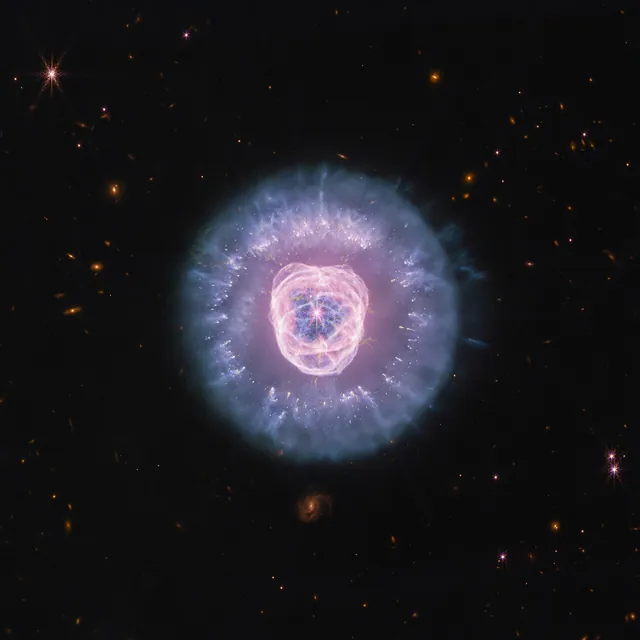
The fur of the hood is a disc of material studded with comet-shaped knots whose tails stream away from the star, like spokes on a wheel; their heads all sit at a similar distance, about 16–17″ from the centre. They barely move along our line of sight. Their origin is debated: a collision of slow and fast gas, wind and radiation striking older shells, or, as O’Dell’s team suggested in 1990, bodies formed with the star. Webb shows them as compact clumps of dust shielding the gas behind them.149101117
The hidden jets
In 1985 two teams found here the first bipolar jet known in a planetary nebula. It points almost straight towards and away from us, so it cannot be seen in pictures and shows up only in spectra. The gas leaves the star at about 165 km/s and speeds up to about 180 km/s; the jets have been flowing for roughly 1,800 years.10
The caps
Three broad, faint patches, which O’Dell’s team once called wisps and later fuzz, form much of the hood’s fur. Spectra show them expanding at about 55 km/s, two on the far side of the inner shell and one on the near side.10
A twin turned sideways
The 2012 model shows that NGC 2392 is built like the Saturn Nebula and the Cat’s Eye Nebula, with a fast inner shell, caps, an equatorial ring of knots and jets, but seen from a direction turned 90°. Its authors argue that elliptical planetary nebulae with such features share a common history.10
Discovery and names
William Herschel found the nebula in 1787. Its round look is only an effect of the angle we see it from, as studies such as D. W. Weedman’s in 1968 showed: it is an elongated shell seen end-on. High-resolution spectroscopy in the 1980s and 1990s, by teams including Reay, Atherton and Taylor, Bruce Balick, and O’Dell, Weiner and Chu, built up the picture of a fast inner shell, an outer disc, an outer envelope, knots and jets.121011
The name “Eskimo” came from its look through ground-based telescopes, a face in a fur-lined hood. In August 2020 NASA announced it would no longer use the name and would use the official International Astronomical Union designations where nicknames are inappropriate; a NASA note calls the term insensitive and offensive. SIMBAD also records the names Clown Nebula and Lion Nebula, and ESA’s 2026 Webb release uses Lion Nebula.134715
- NASA retired “Eskimo”
- August 20203
Seeing it for yourself
At magnitude 9.2 the nebula can be found with a small telescope, though little of its central detail will show. Northern observers see it best in late winter, southern ones in late summer, and a large telescope shows more. Like the Blinking Planetary, Caldwell 15, it seems to blink: stare at the central star and the nebula fades, look slightly away and it returns. With the eye at a telescope the star and inner nebula are easy; the fur of the hood is harder.218
Telescopes on NGC 2392
Hubble photographed the nebula on 10 and 11 January 2000 with its Wide Field and Planetary Camera 2, as its first look at the sky after the December 1999 servicing mission. The picture was released on 24 January 2000. Hubble’s observations also helped astronomers estimate the nebula’s distance and the mass of its star.1213
ESA’s XMM-Newton first revealed its hot gas, and NASA’s Chandra X-ray Observatory observed it for almost 16 hours on 9 September 2007, in a study of three planetary nebulae released on 11 July 2013. NASA’s Spitzer Space Telescope imaged it in infrared light in 2012. From the ground, 21 high-resolution spectra taken across the nebula produced the 2012 3D model. The James Webb Space Telescope imaged it with its NIRCam and MIRI cameras for a release on 10 August 2026.49101214
Quick answers
- What kind of object is the Eskimo Nebula (NGC 2392)?
- The Eskimo Nebula (NGC 2392) is a planetary nebula.27
- Which constellation is the Eskimo Nebula (NGC 2392) in?
- The Eskimo Nebula (NGC 2392) lies in the constellation Gemini.12
- How far away is the Eskimo Nebula (NGC 2392)?
- The Eskimo Nebula (NGC 2392) is 1,732 parsecs from Earth (from the central star’s Gaia parallax; NASA gives about 5,000 light-years).28
- How big is the Eskimo Nebula (NGC 2392)?
- The Eskimo Nebula (NGC 2392) is about 1.2 light-years across (Chandra figure; each of the two inner bubbles is about 1 light-year long).19
- How bright is the Eskimo Nebula (NGC 2392) in the night sky?
- The Eskimo Nebula (NGC 2392) has an apparent magnitude of 9.2.2
Sources
- Hubble resumes gazing at the heavens by taking a look at the “Eskimo” Nebula (STScI-PRC00-07) — Space Telescope Science Institute, via NASA NSSDC, 2000
- Caldwell 39 (Hubble’s Caldwell Catalog) — NASA Science
- NASA to Reexamine Nicknames for Cosmic Objects — NASA, 2020
- Lion Nebula roars to life for Webb (weic2616) — ESA/Webb, 2026
- The post-common-envelope X-ray binary nucleus of the planetary nebula NGC 2392 (Miszalski et al.) — Publications of the Astronomical Society of Australia (arXiv:1903.07264), 2019
- Variable hard X-ray emission from the central star of the Eskimo Nebula (Guerrero et al.) — Astrophysical Journal (arXiv:1909.02605), 2019
- SIMBAD astronomical database: NGC 2392 — Centre de Données astronomiques de Strasbourg (CDS)
- Estimating distances from parallaxes. V: Geometric and photogeometric distances to 1.47 billion stars in Gaia Early Data Release 3 (Bailer-Jones et al.), entry for Gaia 865037169677723904 — Astronomical Journal 161, 147; VizieR catalogue I/352, 2021
- NGC 2392: A Beautiful End to a Star’s Life — Chandra X-ray Center (NASA/SAO), 2013
- A Detailed Morpho-Kinematic Model of the Eskimo, NGC 2392. A Unifying View with the Cat’s Eye and Saturn Planetary Nebulae (García-Díaz et al.) — Astrophysical Journal 761, 172 (arXiv:1211.6717), 2012
- A kinematic determination of the structure of the double ring planetary nebula NGC 2392, the Eskimo (O’Dell, Weiner & Chu) — Astrophysical Journal 362, 226, 1990
- NGC 2392 (sig12-006b) — NASA/JPL-Caltech Spitzer Space Telescope, 2012
- NGC 2392 (heic9910a) — ESA/Hubble, 2000
- XMM-Newton detection of hot gas in the Eskimo Nebula: shocked stellar wind or collimated outflows? (Guerrero et al.) — Astronomy & Astrophysics (arXiv:astro-ph/0412540), 2005
- Hot Gas Inside the Eskimo (High Energy Astrophysics Picture of the Week) — NASA HEASARC, 2013
- Rummaging inside the Eskimo’s parka: variable asymmetric PN fast wind and a binary nucleus? (Prinja & Urbaneja) — Monthly Notices of the Royal Astronomical Society (arXiv:1403.1480), 2014
- Hubble’s first images after Servicing Mission 3A (heic9910) — ESA/Hubble, 2000
- NGC 2392 (noao-n2392kempton) — NSF NOIRLab
Figures checked against these sources in November 2026. Where a quantity is not known, it is left out rather than estimated.

