nebula
Rho Ophiuchi Cloud Complex
The Rho Ophiuchi cloud complex is a sprawling cloud of cold gas and dust on the border of Ophiuchus and Scorpius, and one of the closest places to Earth where stars are being born. Its main cloud lies 137 parsecs away, close enough that even young brown dwarfs too faint to be stars can be studied in detail. Hundreds of young stars, most less than a few million years old, are forming inside it.1234
In photographs it is one of the most colourful parts of the sky. Starlight scattered by fine dust makes blue reflection nebulae around the star Rho Ophiuchi, the red supergiant Antares lights yellow-red clouds below it, and gas excited by ultraviolet light glows red around Sigma Scorpii. Dark lanes mark where the dust is thick enough to hide everything behind it.245
Shape and size in space
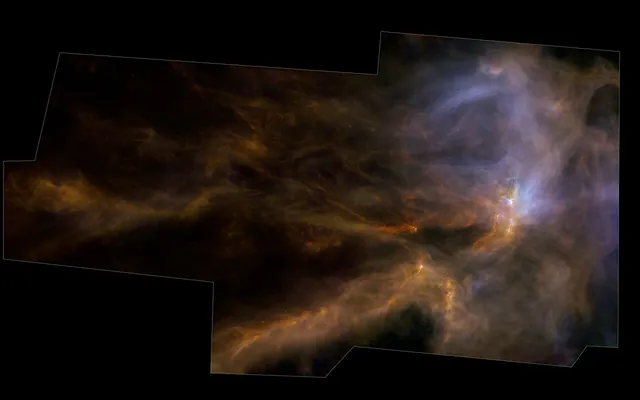
The complex is built around one large, centrally condensed core, the dark cloud Lynds 1688, from which long filamentary streamers trail away: one to the north-east, which includes Lynds 1709, and one to the east and south-east, which includes Lynds 1689. Molecular gas in the core runs along a north-west to south-east axis, while the streamers run roughly at right angles to it.12
For decades the distance was taken to be 160 parsecs. Hipparcos measurements of nearby stars brought it down to between 120 and 145 parsecs, but the young stars inside the cloud are too buried in dust to be measured that way. In 2017 the Very Long Baseline Array measured the parallaxes of 12 young star systems in Lynds 1688 by their radio emission, giving 137.3 ± 1.2 parsecs, an accuracy better than 1%.12
The same survey placed three systems in the eastern streamer, Lynds 1689, at 147.3 ± 3.4 parsecs, about 10 parsecs farther away than the core, a result the authors said still needed confirming. Gaia’s second data release confirmed the radio results in 2018, with a small change in distance from 144.2 ± 1.3 parsecs in Lynds 1689 to 138.4 ± 2.6 parsecs in Lynds 1688. NASA and ESA describe the region as about 390 to 440 light-years away.131314
Estimates of the mass depend on where the cloud’s edge is drawn. Carbon monoxide maps from 1989 gave about 3,050 solar masses of gas in the whole cloud, including 1,447 for Lynds 1688 and 566 for Lynds 1689. A 2025 map of dust from the Herschel and Planck satellites gives 1,367 solar masses for Lynds 1688 and 780 for Lynds 1689; on average its masses are about 40% higher than those from carbon monoxide. In the densest part of the core the dust dims starlight by 50 to 100 magnitudes.2161718
What makes it shine
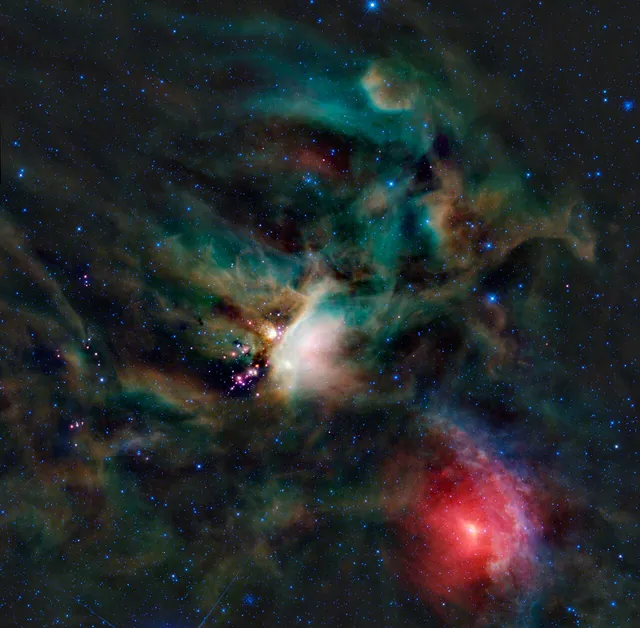
Much of the light in visible pictures is borrowed starlight. Fine dust lit from the front by nearby stars scatters their light and appears blue, while backlit dust blocks the stars behind it and appears dark. B stars of the Scorpius–Centaurus association, together with the red supergiant Antares, light the dust that borders the dark clouds.25
Red glows can be different: there, gas clouds whose atoms are excited by ultraviolet starlight emit their own light. Descriptions of the red cloud engulfing Sigma Scorpii differ: NASA’s Astronomy Picture of the Day counts it among the emission nebulae, while NASA’s WISE team describes the light round the star as its own light reflected off surrounding dust.45
In infrared light the hidden cloud itself glows. Herschel’s far-infrared cameras saw a tangled network of filaments, with bright clumps that are the seeds of future stars. A combined Herschel and Planck map finds the dust at 11 to 36 K, warmest near the ionising stars Zeta Ophiuchi, Rho Ophiuchi, Sigma Scorpii and Pi Scorpii; Rho Ophiuchi sits inside an almost circular shell. The star HD 147889 heats an edge-on boundary on the western edge of the core.21417
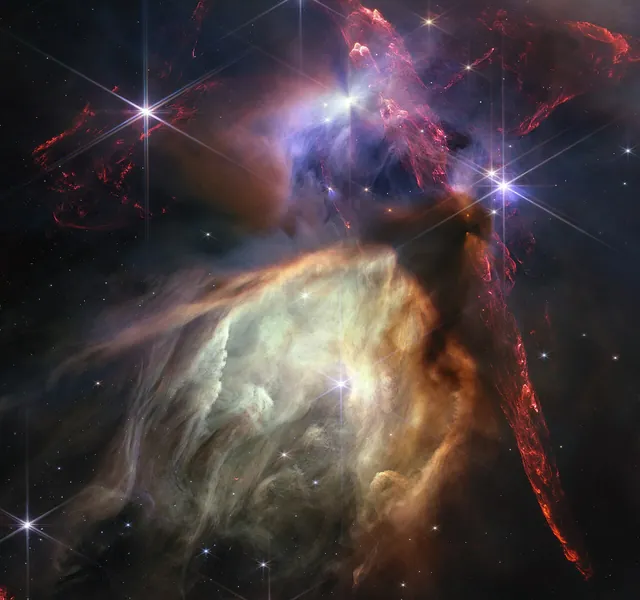
The young stars add light of their own. For their overall output they are far brighter in X-rays than ordinary foreground and background stars, and they flare constantly, which is how X-ray telescopes pick them out. Webb’s image shows huge bipolar jets of molecular hydrogen from newborn stars, ploughing into the surrounding gas.23
The stars inside
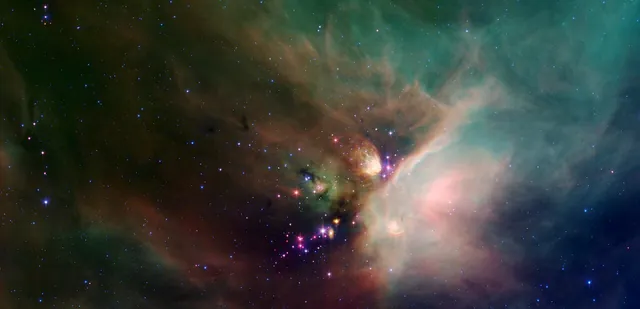
A census of the main cloud in 2008 listed 316 candidate young stars, picked out by their X-rays, infrared glow from dust, lithium or strong hydrogen emission; 201 had been detected in X-rays. In the dense cores, where deep observations with the Chandra X-ray telescope found 90% of the candidates, the census of young stars past the protostar stage is thought to be essentially complete.2
There are two generations. Stars still buried in the dense cores have a median age of about 300,000 years. Around the edges of Lynds 1688 lies an older population of about 100 young stars with a median age of about 2 million years, or up to 5 million allowing for unseen binary companions, indistinguishable from the low-mass stars of the neighbouring Upper Scorpius group. They probably formed together when the cloud was larger.215
The next generation is already waiting. Surveys of the core found about 55 starless clumps of 0.02 to 6.3 solar masses, and their spread of masses resembles that of newborn stars. The youngest protostars, such as VLA 1623 in Lynds 1688 and IRAS 16293−2422 in Lynds 1689, are still wrapped in massive envelopes. Twenty young objects in Lynds 1688 have been confirmed by spectroscopy as likely brown dwarfs, and many have discs.2
Star formation here may have been set off from outside. A shell expanding from the Upper Scorpius group, perhaps driven by a supernova 1 to 1.5 million years ago, is thought to have compressed the core; the runaway star Zeta Ophiuchi may be the surviving companion of the star that exploded. The streamers hold less dense gas and form fewer stars than the core.218
Notable features
Lynds 1688
The main dark cloud and the heart of the complex. It holds the dense cores where stars are forming now, the B2V star HD 147889 on its western edge lights a blue reflection nebula, and X-ray and infrared studies have found more than 300 young stars inside it.215
Rho Ophiuchi and IC 4604
The multiple star Rho Ophiuchi, which gives the cloud its name, sits in a blue reflection nebula about 60′ by 50′ across, catalogued as IC 4604. Wilking and colleagues describe Rho Ophiuchi as a quadruple system; SIMBAD lists its two brightest stars as B2IV and B2V, with a combined magnitude of 4.6.281920
Antares and its nebula
Antares, a red supergiant of type M1.5 with a hot B2 companion, lights the large yellow-red reflection nebula at the south of the complex. Its magnitude is 0.9.2521
Sigma Scorpii and Sh 2-9
The B1 giant Sigma Scorpii, magnitude 2.9, is engulfed by a red cloud; SIMBAD lists Sh 2-9, from the Sharpless catalogue, among the star’s own names.4512
Lynds 1689 and IRAS 16293−2422
The eastern streamer holds a young binary protostar of about the Sun’s mass, IRAS 16293−2422, which drives two bipolar outflows. In 2012 the ALMA telescope found glycolaldehyde, a simple sugar, in the gas falling towards one of its stars.222
ISO-Oph 102
A young brown dwarf of about 60 Jupiter masses. In 2012 ALMA found millimetre-sized grains in the outer part of its dusty disc, a sign that even brown dwarfs may build rocky planets.23
Rogue planets
In 2021 astronomers using ESO telescopes and Gaia reported between 70 and 170 free-floating planets, with masses comparable to Jupiter’s, in a star-forming region close to the Sun in the constellations Scorpius and Ophiuchus: the largest group of such planets yet found.24
The background clusters
Globular clusters share this patch of sky. M4, just to the right of Antares, lies far behind the cloud, about 5,500 light-years away; M80 and NGC 6144 also appear in the WISE view.4525
Discovery and history
E. E. Barnard photographed the region and wrote on plate 13 of his 1927 photographic atlas that it was one of the most extraordinary in the sky. His photographs revealed what he called vacant lanes running from such nebulae for great distances, the structures now called molecular gas filaments. One of the dark nebulae here carries the number Barnard 42 in his catalogue of dark objects.1117
The Index Catalogue entries for the nebulae IC 4603, IC 4604 and IC 4605 are cross-referenced to a report by Barnard in the journal Astronomische Nachrichten, no. 3301. J. L. E. Dreyer’s catalogue described IC 4604 simply as Rho Ophiuchi in an extremely large nebula. The dark clouds are known by their numbers in the Lynds catalogue of dark nebulae, such as Lynds 1688, 1689 and 1709.2101926
Infrared and X-ray surveys then revealed the hidden young stars. Infrared scans from 1973 onwards revealed large numbers of bright infrared sources hidden in Lynds 1688. A study published in 1983 reported 70 highly variable X-ray sources found there by the Einstein X-ray Observatory, young stars flaring so constantly that the field was nicknamed an X-ray Christmas tree. Wide-field infrared cameras gave the first clear picture of where the young stars lie from 1992.2
The distance had been taken as 160 parsecs since 1958. Studies of the neighbouring Upper Scorpius group, then Hipparcos parallaxes and the first radio parallaxes, pulled it down to 120–140 parsecs. The radio parallaxes of 2017, confirmed by Gaia in 2018, finally fixed the main cloud at about 137 parsecs.1213
Seeing it for yourself
The complex is placed for observers in both the northern and southern hemispheres. Antares, a red supergiant at magnitude 0.9, is one of the brighter stars in the night sky, and Rho Ophiuchi shines at magnitude 4.6. The clouds are even more colourful than humans can see, emitting light across the electromagnetic spectrum.252021
NASA suggests using Antares to find the globular cluster M4, which appears just beside it but lies far beyond the cloud. July is the best month for it, and a small telescope shows it as a fuzzy ball of light.525
Telescopes on Rho Ophiuchi
Because it is so close, the cloud has been observed across the entire electromagnetic spectrum. After Einstein, the X-ray satellites ROSAT, ASCA, XMM-Newton and Chandra identified hundreds of X-ray sources with young stars. The Infrared Space Observatory and NASA’s Spitzer Space Telescope mapped the warm dust round young stars; Spitzer’s 2008 image showed the youngest stars, still in their dusty discs, glowing red.215
NASA’s WISE satellite imaged the region in infrared light in 2011, and ESA’s Herschel, which observed from 2009 to 2013, mapped the cold dust in far-infrared light. In 2012 the ALMA telescope found a simple sugar near the protostar IRAS 16293−2422 and signs of planet building around the brown dwarf ISO-Oph 102.4142223
For its first anniversary of science, on 12 July 2023, the James Webb Space Telescope released a NIRCam image of a small part of the cloud, which NASA and ESA call the closest star-forming region to Earth. It shows about 50 young stars, all similar in mass to the Sun or smaller, with jets, a dust cave carved by the star S1, and shadows of discs where planets may be forming.327
Quick answers
- What kind of object is Rho Ophiuchi Cloud Complex?
- Rho Ophiuchi Cloud Complex is a dark molecular cloud complex with reflection and emission nebulae (an active star-forming region).256
- Which constellation is Rho Ophiuchi Cloud Complex in?
- Rho Ophiuchi Cloud Complex lies in the constellation Ophiuchus and Scorpius.489
- How far away is Rho Ophiuchi Cloud Complex?
- Rho Ophiuchi Cloud Complex is 137.3 ± 1.2 parsecs from Earth (to the main cloud, Lynds 1688, from radio parallaxes; Gaia gives 138.4 ± 2.6 pc; NASA and ESA pages say 390–440 light-years).131314
- How big does Rho Ophiuchi Cloud Complex look in the sky?
- Rho Ophiuchi Cloud Complex covers 600′ × 480′ of sky (the whole molecular cloud, as listed in SIMBAD).6
Sources
- The Gould’s Belt Distances Survey (GOBELINS) I. Trigonometric parallax distances and depth of the Ophiuchus complex (Ortiz-León et al.) — Astrophysical Journal 834, 141 (arXiv:1611.06466), 2017
- Star Formation in the ρ Ophiuchi Molecular Cloud (Wilking, Gagné and Allen) — Handbook of Star Forming Regions, Vol. II, Astronomical Society of the Pacific (arXiv:0811.0005), 2008
- Webb celebrates first year of science with close-up on the birth of Sun-like stars (weic2316) — ESA/Webb, 2023
- PIA13974: WISE Unveils a Treasure Trove of Beauty — NASA Jet Propulsion Laboratory, 2011
- Colorful Clouds Near Rho Ophiuchi (Astronomy Picture of the Day, 28 August 2012) — NASA Science, 2012
- SIMBAD astronomical database: Ophiuchus Molecular Cloud — Centre de Données astronomiques de Strasbourg (CDS)
- Revised IC Data for IC 4603 (from W. Steinicke’s Revised NGC and IC Catalog) — SEDS Interactive NGC Catalog
- Revised IC Data for IC 4604 (from W. Steinicke’s Revised NGC and IC Catalog) — SEDS Interactive NGC Catalog
- Revised IC Data for IC 4605 (from W. Steinicke’s Revised NGC and IC Catalog) — SEDS Interactive NGC Catalog
- IC 4605 (NGC/IC data, with Dreyer’s description) — SEDS Interactive NGC Catalog
- SIMBAD astronomical database: Barnard 42 — Centre de Données astronomiques de Strasbourg (CDS)
- SIMBAD astronomical database: sig Sco (Sh 2-9) — Centre de Données astronomiques de Strasbourg (CDS)
- Gaia-DR2 confirms VLBA parallaxes in Ophiuchus, Serpens and Aquila (Ortiz-León et al.) — Astrophysical Journal Letters 869, L33 (arXiv:1812.02360), 2018
- Herschel’s view of a star nursery — European Space Agency, 2017
- Young Stars in Their Baby Blanket of Dust: Rho Ophiuchi (ssc2008-03a) — NASA/JPL-Caltech, Spitzer Space Telescope, 2008
- The Gaia-ESO Survey: Dynamical Analysis of the L1688 region in Ophiuchus (Rigliaco et al.) — Astronomy & Astrophysics (arXiv:1601.05209), 2016
- HP2 Survey V. Ophiuchus: Filament formation in a dispersing cloud complex (Alves, Lombardi and Lada) — Astronomy & Astrophysics (arXiv:2501.13931), 2025
- A SCUBA survey of L1689 – the dog that didn’t bark (Nutter, Ward-Thompson and André) — Monthly Notices of the Royal Astronomical Society (arXiv:astro-ph/0603203), 2006
- IC 4604 (NGC/IC data, with Dreyer’s description) — SEDS Interactive NGC Catalog
- SIMBAD astronomical database: rho Oph — Centre de Données astronomiques de Strasbourg (CDS)
- SIMBAD astronomical database: alf Sco (Antares) — Centre de Données astronomiques de Strasbourg (CDS)
- Sweet Result from ALMA (eso1234) — European Southern Observatory, 2012
- Even Brown Dwarfs May Grow Rocky Planets (eso1248) — European Southern Observatory, 2012
- ESO telescopes help uncover largest group of rogue planets yet (eso2120) — European Southern Observatory, 2021
- Messier 4 — NASA Science, Hubble’s Messier Catalog
- IC 4603 (NGC/IC data, with Dreyer’s description) — SEDS Interactive NGC Catalog
- Webb Celebrates First Year of Science With Close-up on Birth of Sun-like Stars — NASA Science, 2023
Figures checked against these sources in November 2026. Where a quantity is not known, it is left out rather than estimated.

