nebula
Crescent Nebula (NGC 6888)
The Crescent Nebula, NGC 6888, is a glowing shell of gas in Cygnus blown by the massive star WR 136. Late in its life the star swelled into a red supergiant and puffed away some of its bulk. Now a Wolf–Rayet star, it drives a fierce wind into that cast-off material, sweeping it up into a shell of fine filaments.1234
Astronomers regard it as the prototype of a Wolf–Rayet bubble. Inside the shell, gas heated to millions of degrees shines in X-rays, while the shell itself glows in the light of hydrogen, oxygen and sulphur. William Herschel discovered it in 1792, and the star’s Gaia parallax places it 1,669 parsecs away.15678
Shape and size in space
The nebula is an ellipsoidal shell, elongated rather than round, made of a mass of fine filaments. Optical images show bright caps at the two ends of its long axis. In hydrogen light the limb-brightened shell is off-centre from the star, but the full extent of the oxygen emission is centred on WR 136. On the north-western side, near the short axis, a large front of oxygen emission with no hydrogen counterpart bulges outwards: a blowout where the shell has broken open.256
A 2012 study with the PPAK integral-field spectrograph at Calar Alto Observatory pictured the nebula as several nested shells: an inner, broken shell where the red-supergiant and Wolf–Rayet winds have collided, a shell bright in oxygen light from the star’s earlier main-sequence bubble, and a faint outer skin where that early wind met interstellar gas. The shell expands at about 55 to 110 km/s, fastest in the south-west and slowest in the north-west.2
The distance has been revised several times. A 1988 catalogue gave 1.8 kiloparsecs and a 2001 catalogue 1.26 kiloparsecs, the value adopted by the Chandra and XMM-Newton studies. Gaia measured a parallax of 0.577 ± 0.016 milliarcseconds for WR 136, which a 2021 catalogue of Gaia distances converts into a geometric distance of 1,669 parsecs, with a range of 1,631 to 1,711. NASA gives 4,700 light-years and the Chandra team about 5,000.125681012
On the sky the nebula spans about 18′ by 12′ or 13′. Gruendl and colleagues measured a radius of 4.5 parsecs from their oxygen image, for a distance of 1.8 kiloparsecs, and NASA describes it as roughly 16 by 25 light-years for its distance of 4,700 light-years.1259
What makes it shine
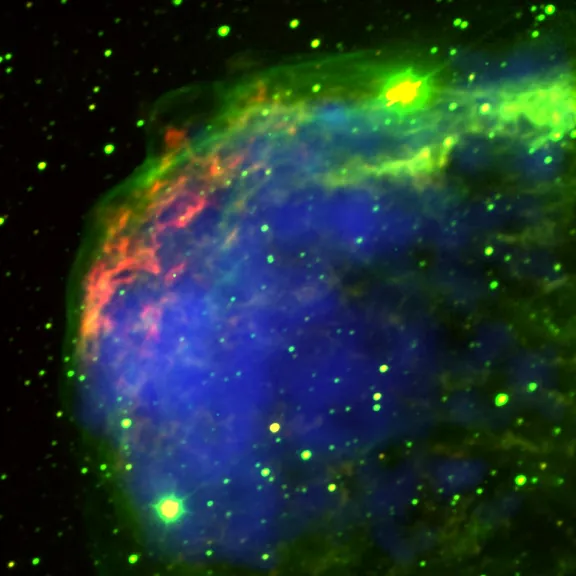
Light from WR 136 ionises the gas in the shell, which glows in the light of hydrogen-alpha, doubly ionised oxygen [O III] and ionised sulphur [S II]. In Hubble’s close-up the colours show how strongly the gas is ionised. The oxygen front generally runs a little ahead of the hydrogen front, which Gruendl and colleagues read as the shock from the bubble pushing into the material around it.1357
Spectra show gas at about 7,700 to 10,200 K with electron densities from under 100 to 360 per cubic centimetre. The shell is rich in nitrogen and helium and slightly poor in oxygen, a sign of material from deep inside the star mixed with interstellar gas. Nitrogen varies by up to a factor of 10, low at the outer edges and much enhanced inside. In one south-western patch the light matches shock waves moving at 250 to 400 km/s.2
Inside the shell is a hot bubble that shines in X-rays. A complete XMM-Newton map, published in 2016, found gas at two temperatures, about 1.4 million and 8.2 million K, gathered in three bright patches: the two caps and the north-western blowout. That is far cooler than the 10 to 100 million K expected from a typical Wolf–Rayet wind, and the mass of hot gas, more than 1.2 solar masses, is more than the star’s wind can have supplied, so cooler material from the shell seems to have mixed into it.36
In infrared light the shell’s dust glows. A 2020 study combining WISE, Spitzer and Herschel images modelled two shells: an inner one of gas only and an outer one of gas mixed with dust, with about 0.14 solar masses of dust in a total of about 25.5 solar masses. Almost all of it, they concluded, was thrown off by WR 136 itself, with very little swept up from interstellar space.13
- Gas temperature in the shell
- about 7,700–10,200 K2
- X-ray gas temperatures
- 1.4 and 8.2 million K6
- X-ray luminosity
- 7.8 × 10³³ erg/s60.3–1.5 keV, for a distance of 1.26 kpc
- Hot gas mass
- more than 1.2 solar masses3
- Total mass of the nebula
- 25.5 solar masses213infrared model, 2020; earlier estimates 5 solar masses ionised and 40 neutral
- Dust mass
- 0.14 solar masses13
The star at the centre
WR 136, also catalogued as HD 192163, is a Wolf–Rayet star of type WN6: a very hot, massive star that is blowing off its outer layers. It shines at magnitude 7.5. A 2019 analysis using Gaia distances found a temperature of 70.8 kK (70.8 thousand kelvin), a radius 5.1 times the Sun’s and a luminosity of 10⁵·⁷⁸ Suns, with about 12% hydrogen still left in its atmosphere. It is also a runaway star.4711
Its wind leaves at about 1,600 km/s, and the 2019 analysis puts its mass loss at 10⁻⁴·² solar masses a year. Estimates of the star’s present mass range from 15 solar masses in a 2006 analysis to 21 to 23 in 2019; a 2020 infrared study suggests it began life with no more than about 50 solar masses. Wolf–Rayet bubbles like this one form around stars that started with at least about 25.245613
The Chandra team describes the star’s history this way: after only 4.5 million years it expanded into a red giant and ejected its outer layers at about 20,000 miles per hour; some 200,000 years later its exposed hot interior began to drive a wind of over 3 million miles per hour into that material. NASA dates the cast-off shell to 250,000 years ago. Gruendl and colleagues derived a dynamical age of 55,000 years for the shell, and models that match its shape put the start of the Wolf–Rayet stage only about 8,000 to 12,000 years ago.13512
WR 136 will likely explode as a supernova in about a hundred thousand years, according to the Chandra team. NASA notes that when it does, the blast could compress the shell and make it glow again.112
Notable features
The caps
Bright arcs at the two ends of the shell’s long axis. Their oxygen front runs closely ahead of their hydrogen front, and they hold two of the three concentrations of X-ray-hot gas.56
The north-western blowout
A large bulge of oxygen emission, with no hydrogen counterpart, pushing out from the north-western edge of the shell near its short axis. It is also seen in mid-infrared images, and Chandra and XMM-Newton found X-ray-emitting gas towards it.356
The filamentary shell
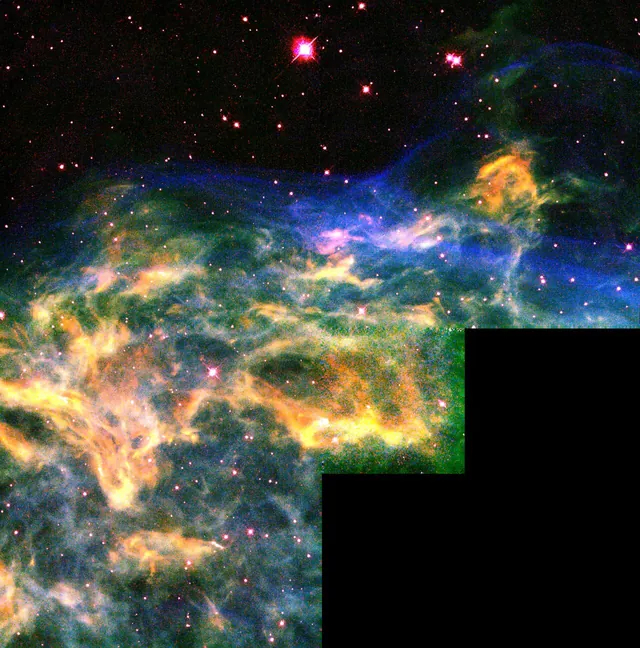
The hydrogen shell is broken into clumps and filaments, enveloped by a faint network of oxygen filaments. Hubble’s Wide Field and Planetary Camera 2 images of part of the rim show the offsets between them with dramatic clarity.35
The outer skin
A faint shell surrounding the whole nebula like a thin skin, thought to mark where the star’s early main-sequence wind met interstellar gas; its composition is typical of material around stars.2
The Soap Bubble Nebula
A faint planetary nebula, PN G075.5+01.7, not far from the Crescent in the sky. The amateur astronomer Dave Jurasevich discovered it on 6 July 2008; it had been missed because it is faint and sits in a diffuse nebula.14
Discovery and history
William Herschel discovered the nebula in 1792 and listed it as number 72 in his fourth class. J. L. E. Dreyer’s New General Catalogue described it as faint, very large and very much extended, with a double star attached. It is also number 27 in the Caldwell catalogue and Sh 2-105 in Sharpless’s catalogue of 1959.13915
In 1965 Johnson and Hogg linked the nebula to its Wolf–Rayet star and were the first to suggest that such nebulae are material ejected by the star sweeping up the surrounding gas. NGC 6888 was one of the first three ring nebulae found around Wolf–Rayet stars, together with NGC 2359 and S 308. A 1975 study showed that its gas is enriched in nitrogen and helium.235
In 1996 García-Segura and colleagues modelled how such bubbles evolve from the main sequence to the Wolf–Rayet stage, and suggested that NGC 6888 came from a star whose red-supergiant wind was slow. Gruendl and colleagues’ hydrogen and oxygen images of 2000 supported the idea that its star had a denser red-supergiant wind than the star of S 308.25
Seeing it for yourself
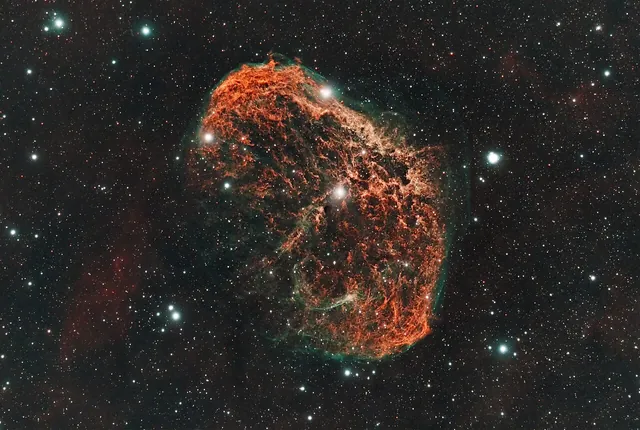
At magnitude 8.8 the Crescent is not visible to the naked eye. NASA suggests looking for it in September with a moderate-to-large telescope fitted with a light-pollution filter. Its central star, WR 136, shines at magnitude 7.5.111
Detailed images, such as the Kitt Peak view at the top of this page, are taken through narrow filters that isolate the light of hydrogen, oxygen and sulphur.7
Telescopes on the Crescent
NGC 6888 is the most studied Wolf–Rayet bubble in X-rays. The Einstein Observatory first detected its X-rays, and ROSAT, ASCA and Suzaku followed. Chandra observed it on 19–20 February 2003, covering about 62% of the nebula, and its sharper view showed that an apparent very hot component in earlier spectra came from point sources along the line of sight. XMM-Newton then mapped the whole nebula.36
The Hubble Space Telescope photographed part of the shell with its Wide Field and Planetary Camera 2 in June 1995, a region only about 3 light-years across. In infrared light IRAS, WISE, Spitzer and Herschel have mapped its dust, and ground-based spectrographs have measured its chemistry and motions.12513
Quick answers
- What kind of object is the Crescent Nebula (NGC 6888)?
- The Crescent Nebula (NGC 6888) is a wind-blown bubble around a Wolf–Rayet star (the prototype of its class).25
- Which constellation is the Crescent Nebula (NGC 6888) in?
- The Crescent Nebula (NGC 6888) lies in the constellation Cygnus.1
- How far away is the Crescent Nebula (NGC 6888)?
- The Crescent Nebula (NGC 6888) is 1,669 parsecs from Earth (1,631–1,711 pc from the Gaia DR3 parallax of WR 136; older estimates 1.26–1.8 kpc; NASA gives 4,700 light-years).125810
- How big is the Crescent Nebula (NGC 6888)?
- The Crescent Nebula (NGC 6888) is roughly 16 by 25 light-years across (NASA, for a distance of 4,700 light-years).1
- How big does the Crescent Nebula (NGC 6888) look in the sky?
- The Crescent Nebula (NGC 6888) covers 18′ × 13′ of sky (Chu and colleagues measured 18′ × 12′).29
- How bright is the Crescent Nebula (NGC 6888) in the night sky?
- The Crescent Nebula (NGC 6888) has an apparent magnitude of 8.8 (too faint for the naked eye).1
- How old is the Crescent Nebula (NGC 6888)?
- The Crescent Nebula (NGC 6888) is about 55,000 years old (dynamical age of the shell; the Wolf–Rayet wind may have begun only 8,000–12,000 years ago, and NASA dates the shed material to 250,000 years ago).135
- When was the Crescent Nebula (NGC 6888) discovered?
- The Crescent Nebula (NGC 6888) was discovered in 1792, by William Herschel.1
Sources
- Caldwell 27 — NASA Science, Hubble’s Caldwell Catalog
- Ionization structure and chemical abundances of the Wolf-Rayet nebula NGC 6888 with integral field spectroscopy (Fernández-Martín et al.) — Astronomy & Astrophysics 541, A119 (arXiv:1204.5742), 2012
- X-ray emission from the Wolf-Rayet bubble NGC 6888. I. Chandra ACIS-S observations (Toalá, Guerrero, Gruendl and Chu) — Astronomical Journal 147, 30 (arXiv:1310.2801), 2014
- The Galactic WN stars revisited: Impact of Gaia distances on fundamental stellar parameters (Hamann et al.) — Astronomy & Astrophysics 625, A57 (arXiv:1904.04687), 2019
- A Morphological Diagnostic for Dynamical Evolution of Wolf-Rayet Bubbles (Gruendl, Chu, Dunne and Points) — Astronomical Journal 120, 2670 (arXiv:astro-ph/0007385), 2000
- X-ray emission from the Wolf-Rayet bubble NGC 6888. II. XMM-Newton EPIC observations (Toalá et al.) — Monthly Notices of the Royal Astronomical Society 456, 4305 (arXiv:1512.01000), 2016
- Crescent, NGC 6888 (noao-04494) — NOIRLab
- Estimating Distances from Parallaxes. V. Geometric and Photogeometric Distances to 1.47 Billion Stars in Gaia EDR3 (Bailer-Jones et al.): entry for WR 136 — Astronomical Journal 161, 147 (VizieR catalogue I/352), 2021
- Revised NGC Data for NGC 6888 (from W. Steinicke’s Revised NGC and IC Catalog) — SEDS Interactive NGC Catalog
- Gaia DR3 source 2061690233159124352 (WR 136): parallax — ESA Gaia mission, Gaia Data Release 3 (VizieR catalogue I/355), 2022
- SIMBAD astronomical database: WR 136 (HD 192163) — Centre de Données astronomiques de Strasbourg (CDS)
- The Crescent Nebula (NGC 6888) — Chandra X-ray Observatory Photo Album, 2003
- Unveiling the stellar origin of the Wolf-Rayet nebula NGC 6888 through infrared observations (Rubio et al.) — Monthly Notices of the Royal Astronomical Society 499, 415 (arXiv:2009.05479), 2020
- Soap Bubble Nebula, PN G075.5+01.7 (noao0904a) — NOIRLab
- NGC 6888 (NGC/IC data, with Dreyer’s description) — SEDS Interactive NGC Catalog
Figures checked against these sources in November 2026. Where a quantity is not known, it is left out rather than estimated.

