nebula
Bubble Nebula (NGC 7635)
The Bubble Nebula, NGC 7635, is a shell of glowing gas in Cassiopeia blown by the wind of a single massive star, BD+60 2522. The wind, streaming off the star at about 2,000 km per second, has swept the surrounding gas into a thin, almost perfectly round shell. Oddly, the star sits well away from the bubble’s centre.1234
How far away and how big it is are both uncertain. The Gaia parallax of its star suggests about 2,830 parsecs, but published distances run from 2.2 to 3.6 kiloparsecs, and NASA and ESA quote 7,100 and 8,000 light-years. Accordingly the bubble is described as anything from 6 to 10 light-years across.134567
Shape and size in space
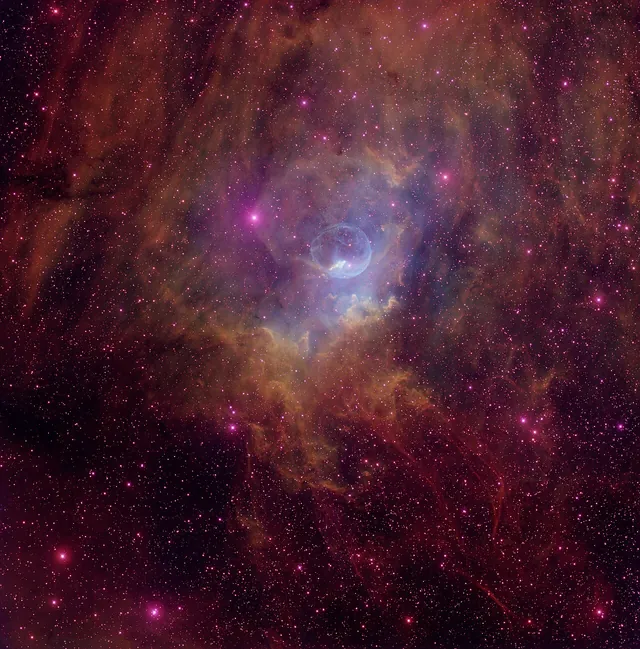
The bubble is part of a much larger glowing region, Sh2-162, in the Perseus arm of our galaxy. It is a blister on the edge of a molecular cloud, and sits inside an ionised cavity about 12′ long from north to south. NOIRLab describes it as one of three shells of gas round its star, and spectra show it is built from a series of nested shells; its round outline may partly be the effect of seeing several shells on top of one another.1211
Its star lies well off-centre, and why is still debated. On one view the bubble has expanded less towards the north-east, where the surrounding gas is denser. On another, the star is moving through space at 20 to 36 km per second, and the bubble is really a bow shock, the shock the star’s wind drives into the gas ahead of it as it moves, seen at an angle that makes it look round.23413
Distances in the literature fall into two groups, 2.2 to 2.6 and 3.5 to 3.6 kiloparsecs; a 2002 Hubble study adopted 2.4 kiloparsecs, and a 2020 study 2.5 from Gaia. The Gaia parallax of the star is 0.334 milliarcseconds, and a catalogue of Gaia-based distances gives 2,830 parsecs. Estimates of its size vary too: NASA has given 6 and 7 light-years across, ESA about 10, and NOIRLab both 6 and 10.12345671112
What makes it shine
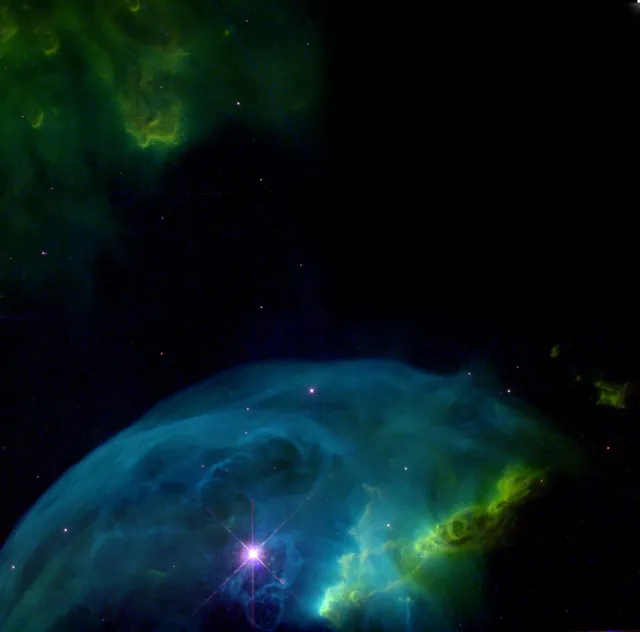
The Bubble is an emission nebula. Its star’s energetic radiation ionises the shell and makes it glow, and BD+60 2522 appears to be the main, if not the only, source of ionisation for the whole region. The surface of the bubble marks the leading edge of the star’s wind, slowing as it ploughs into denser gas and sweeping it up into a thin shell.13811
Different gases glow in different colours. Near the star, oxygen is hot enough to give off blue light, while the cooler pillars glow yellow from hydrogen and nitrogen. The shell expands at up to about 25 km per second, only slightly faster than sound travels in the gas, and the temperature of its gas has been measured at 8,180 kelvin.16
The star’s wind should fill the bubble with extremely hot gas, yet deep observations with ESA’s XMM-Newton found no such gas glowing in X-rays, although the star itself is a bright X-ray source. At radio wavelengths, however, the edge of the bubble gives off non-thermal emission, probably from electrons accelerated where the wind slams to a halt.214
The gas in the shell carries traces of the star itself. Its chemical make-up matches an ordinary H II region at that distance from the galactic centre, except for slightly more helium in the rim, probably mixed in from the stellar wind. The rim and the inner knots also differ by a factor of two in their oxygen content.1
The star inside
BD+60 2522, also catalogued as SAO 20575, is a hot O-type star of magnitude 8.7, classed O6.5 IIIf in 1971 and O6.5(n)fp by SIMBAD. A 2020 analysis of its spectrum found a surface temperature of about 35,000 kelvin, a luminosity of 10^5.4 times the Sun’s and a radius about 15 times the Sun’s. It is thought to belong to the Cas OB2 association of young massive stars.12412
Its mass is uncertain. The 2020 analysis gives 27 ± 7 solar masses; NASA has quoted 15, 40 and 45, and ESA 10 to 20. Its wind blows at about 2,000 km per second and carries away about 1.3 millionths of a solar mass each year. NASA puts the star’s age at about 4 million years and expects it to explode as a supernova in 10 to 20 million years.23468
Accounts of its stage of life differ. NASA’s 2016 release described a star that has lost most of its outer hydrogen and is fusing helium into heavier elements, but the 2020 analysis found it to be a classic young O star, with chemical abundances very close to the Sun’s and X-ray brightness typical of such stars.26
Notable features
The cometary knots
A string of bright knots just west of the star, called cometary for their shape. Hubble showed them to be the ionised edges of a much larger mass of neutral gas, with strong flows evaporating from their surfaces towards the star. ESA describes the individual knots as larger than the Solar System, with masses comparable to Earth’s.14
A loop inside the bubble
A small loop of glowing gas between the star and the brightest knot, first seen by Hubble. It probably formed where the star’s wind collides with gas boiling off that knot.1
Pillars
Dense pillars of cool, dusty hydrogen at the upper left of the 2016 Hubble image, with more ‘fingers’ seen almost face-on behind the translucent bubble. Like the Pillars of Creation in the Eagle Nebula, they are lit by the star’s ultraviolet light.6
A supernova remnant
Faint magenta wisps near the lower right of a Kitt Peak image released in 2007 are the remains of a star that exploded thousands of years ago. The remnant was discovered by its radio waves in the Canadian Galactic Plane Survey in 2005, and that image was the first to show it in visible light.11
Bow shock or bubble?
Computer models published in 2019 reproduce the nebula’s round look, in both visible and infrared light, as a bow shock round a star moving at about 20 km per second through gas, seen at about 60° to our line of sight. They predicted X-rays brightest in the wake behind the star, and suggest the Bubble may be just a favourably oriented example of a common kind of object.13
Discovery and history
William Herschel discovered the nebula in November 1787 and listed it as H IV.52. Dreyer’s New General Catalogue describes it as very faint, with an 8th-magnitude star inside it off-centre. A radio study in 1973 showed it to be a blister on a molecular cloud, and the knots near the star were called cometary in 1974.1815
The Hubble Space Telescope has photographed the Bubble with several cameras: the original Wide Field and Planetary Camera in September 1992, its successor in 1997 and 1999, and Wide Field Camera 3 in February 2016. The 2016 mosaic, the first Hubble picture to show the whole nebula at once, was chosen to mark the 26th anniversary of Hubble’s launch.3468
Seeing it for yourself
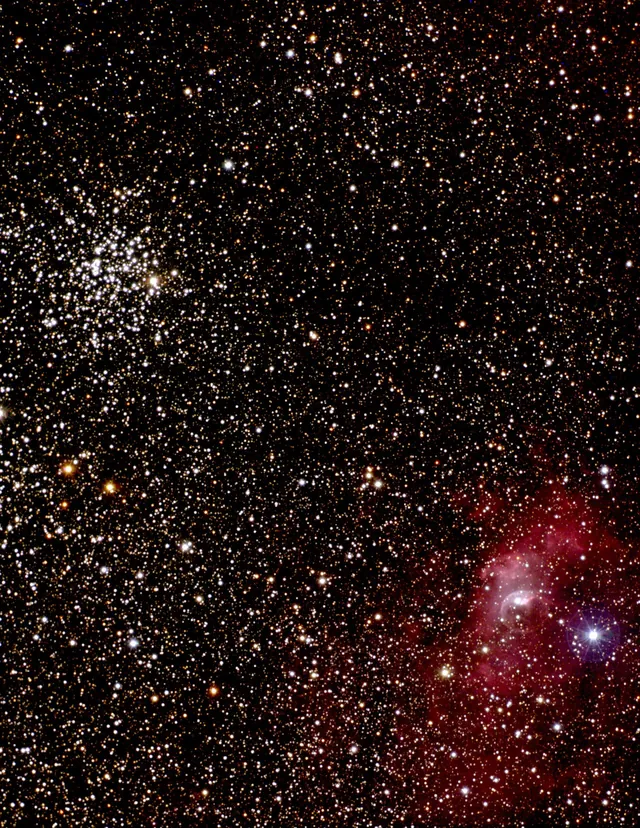
The Bubble is best seen from the Northern Hemisphere in autumn; southern observers need to be near the equator, looking low in the north in spring. At magnitude 10 it needs a large telescope, ideally with a light-pollution filter to raise the contrast, and appears as a dim, diffuse, oval patch. It lies in the same field as the star cluster M52, which a wide-field photograph frames together with it.816
Telescopes on the Bubble
The Bubble is one of only a handful of objects Hubble has imaged with several different instruments. Its spectrograph STIS measured the gas in the knots and the rim, and its images revealed the knots’ true nature and the loop inside the bubble. On the ground, Kitt Peak’s Burrell Schmidt telescope has photographed it beside M52, and the WIYN 3.5-metre telescope used it in 2012 to show off its new One Degree Imager camera.16716
ESA’s XMM-Newton searched it for X-rays from hot gas in a study published in 2020, and the Very Large Array and the Effelsberg radio telescope made the first high-resolution radio maps of it, published in 2022. Gaia has measured the parallax and motion of its star.21214
Quick answers
- What kind of object is the Bubble Nebula (NGC 7635)?
- The Bubble Nebula (NGC 7635) is a wind-blown bubble in an emission nebula.128
- Which constellation is the Bubble Nebula (NGC 7635) in?
- The Bubble Nebula (NGC 7635) lies in the constellation Cassiopeia.46
- How far away is the Bubble Nebula (NGC 7635)?
- The Bubble Nebula (NGC 7635) is about 2,830 parsecs from Earth (Gaia distance of BD+60 2522, 2,730–2,960 pc; published estimates range from 2.2 to 3.6 kpc, and NASA and ESA quote 7,100 and 8,000 light-years).1456
- How big is the Bubble Nebula (NGC 7635)?
- The Bubble Nebula (NGC 7635) is 6 to 10 light-years across (NASA gives 6 or 7, ESA about 10; NOIRLab has given both 6 and 10).346711
- How big does the Bubble Nebula (NGC 7635) look in the sky?
- The Bubble Nebula (NGC 7635) covers 15′ × 8′ of sky (for the catalogued nebula).10
Sources
- Hubble Space Telescope observations of the windblown nebula NGC 7635 (Moore et al.) — Astronomical Journal, 2002
- The Bubble Nebula NGC 7635: testing the wind-blown bubble theory (Toalá et al.) — Monthly Notices of the Royal Astronomical Society, 2020
- An expanding bubble in space (STScI-PRC00-04) — NASA NSSDC Photo Gallery, 2000
- Hubble captures birthday bubble (heic1608) — ESA/Hubble, 2016
- Estimating distances from parallaxes. V: geometric and photogeometric distances to 1.47 billion stars in Gaia EDR3 (Bailer-Jones et al.), entry for BD+60 2522 — VizieR catalogue I/352 (Astronomical Journal), 2021
- Hubble Sees a Star ‘Inflating’ a Giant Bubble — NASA Science, 2016
- WIYN/NOAO: The Bubble Nebula, observed with the new One Degree Imager camera (noao1207) — NOIRLab, 2012
- Caldwell 11 — NASA Science, Hubble’s Caldwell Catalog
- SIMBAD astronomical database: NGC 7635 — Centre de Données astronomiques de Strasbourg (CDS)
- Revised NGC data for NGC 7635 (from W. Steinicke’s Revised NGC and IC Catalog) — SEDS Interactive NGC Catalog
- The Bubble Nebula (NGC 7635) (noao0702a) — NOIRLab, 2007
- SIMBAD astronomical database: BD+60 2522 — Centre de Données astronomiques de Strasbourg (CDS)
- Thermal emission from bow shocks. I. 2D hydrodynamic models of the Bubble Nebula (Green et al.) — Astronomy & Astrophysics, 2019
- And then they were two: detection of non-thermal radio emission from the bow shocks of two runaway stars (Moutzouri et al.) — Astronomy & Astrophysics, 2022
- NGC 7635 (H. Frommert) — SEDS NGC/IC database
- M52 and the Bubble Nebula (noao-m52r) — NOIRLab
Figures checked against these sources in November 2026. Where a quantity is not known, it is left out rather than estimated.

