nebula
California Nebula (NGC 1499)
The California Nebula is a long, faint cloud of glowing hydrogen in Perseus, about 2.5° long and half a degree wide, whose outline resembles the American state. Its glow is powered by a star about a degree away: Xi Persei, also called Menkib, a hot blue-white O-type giant that is one of the hottest stars visible in the night sky.12345
Xi Persei is a runaway, thrown out of the Perseus OB2 association within the last one to two million years and still moving fast, with a shock wave piling up ahead of it. The nebula lies on the southern edge of the giant California Molecular Cloud, which was named after it, but the star that lights it was not born in that cloud.467
Shape and size in space
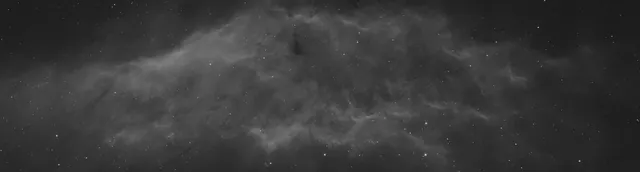
Catalogues give the visible nebula as about 145′ by 40′, roughly 2.5° by 0.5°. It is the brightest part of a much larger glow: the Wisconsin H-Alpha Mapper traced hydrogen emission over a crescent about 5° by 2°, with fainter glowing gas continuing 5 to 7° beyond it.121014
Its distance is that of Xi Persei, and estimates disagree. The star’s Gaia parallax, 2.45 ± 0.26 milliarcseconds, gives a distance of about 418 parsecs; Hipparcos gave 381 parsecs in one analysis, 416 in another and 540 in an older one, and interstellar calcium absorption gives 486 ± 57 parsecs. Popular sources range just as widely: NASA has given both 1,000 and 1,800 light-years, and Astronomy magazine 1,000 to 1,500.3456111214
NASA and NOIRLab describe the glowing nebula as about 100 light-years long. It sits on the southern border of the California Molecular Cloud, a giant cloud of about 100,000 solar masses that stretches some 80 parsecs and lies 450 ± 23 parsecs away; in 2009 Lada and colleagues named it after the nebula. Xi Persei, however, is a runaway from the Perseus OB2 association, which lies more than 100 parsecs closer, and is not a product of star formation in the cloud.47913
- Apparent size
- 145′ × 40′10
- Hydrogen-alpha crescent mapped by WHAM
- about 5° × 2°14
- Distance of Xi Persei (Hipparcos)
- 381 parsecs (+92, −62)6van Leeuwen 2007 reduction
- Distance from calcium absorption
- 486 ± 57 parsecs12
- California Molecular Cloud
- 450 ± 23 parsecs away; about 10⁵ solar masses; about 80 parsecs long7
What makes it shine
The nebula is an H II region: gas heated and ionised by Xi Persei. Its hydrogen glows red in the hydrogen-alpha line, and the Wisconsin H-Alpha Mapper measured more than 250 rayleighs at its brightest.34914
Its light differs from that of a bright nebula such as the North America Nebula. The glow of sulphur and nitrogen relative to hydrogen is 0.14 and 0.39 here, against 0.06 and 0.20 there, and the gas around Xi Persei is more highly ionised and cooler than the faint ionised gas that surrounds it in the Galaxy.14
Unusually, it is also a strong emitter of the blue hydrogen-beta line at 486.1 nanometres, released when an electron drops two energy levels rather than one. That makes a narrowband hydrogen-beta filter a recommended aid for seeing it by eye.113
Infrared telescopes see dust mixed with the gas. Spitzer found warm, soot-like dust that absorbs visible and ultraviolet light and glows in the infrared, and maps from Herschel and Planck show the nebula as a large region of hot dust, although the dust there is too thin to stand out on maps of its opacity.39
The star that lights it
Xi Persei (Menkib, HD 24912) is an O-type giant of spectral type O7.5 III and visual magnitude 4.06, one of the hottest stars visible to the naked eye. Its properties depend on who measures them: NASA quotes a surface temperature of about 37,000 K, about 40 times the Sun’s mass and 330,000 times its light, while a 2026 study adopted 33,500 ± 2,000 K, 26 solar masses and a radius 11.2 times the Sun’s, and another analysis gives 36 solar masses.45612
It is a classic runaway star. It moves away from us at 65 km/s, far faster than the 16 to 20 km/s typical of the Perseus OB2 association it belongs to, and it was probably ejected less than one to two million years ago. No companion of comparable mass has been found, so Kounkel and colleagues suggest that a supernova in a binary system may have set it loose.61215
Where exactly it came from is still open. Its Hipparcos distance matches some of the association’s subgroups, such as Mestor at 390 parsecs, the group nearest to it on the sky, and even if it started in the cluster IC 348 its speed means it would have left within the last one to two million years. Sources also differ on its relation to the nebula’s cloud: NASA has described it as born with other hot stars from the California Nebula a few million years ago, whereas Lada and colleagues conclude it is not a product of star formation in the California Molecular Cloud.467
Its wind blows at about 2,400 km/s. Combining 307 ultraviolet spectra from the IUE satellite (no other O star has as many) with other spectra and space photometry, a 2026 study found a rotation period of 2.0405 days and proposed that the star has a weak magnetic field not yet detected directly.12
Notable features
Xi Persei’s bow shock
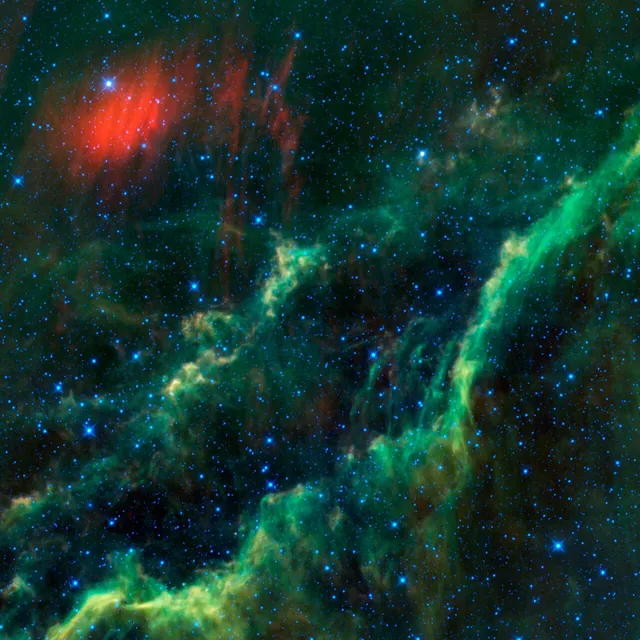
As the runaway star races through space, its fast wind piles up the gas ahead of it into a shock wave. The shock heats dust, which glows as a red cloud in images from NASA’s WISE telescope.412
The ‘West Coast’
The nebula’s brightest strip runs along the state’s ‘West Coast’, which on the sky is its northern edge, just south of a sixth-magnitude star about 1¼° from Menkib.1
The California Molecular Cloud
A giant cloud of about 100,000 solar masses that rivals Orion A in size and mass yet forms far fewer stars. Its best-known site of star formation is the reflection nebula NGC 1579, lit by the young star LkHα 101, which holds an embedded cluster of about 100 stars. Three-dimensional dust maps, supported by Gaia star data, suggest the cloud is a sheet about 120 parsecs deep rather than a thin filament.67
Perseus OB2
The group of hot young stars, first noted by Blaauw in 1944, to which Xi Persei belongs, although its unusual speed long made its membership doubtful. Hipparcos placed the early-type members at 318 ± 27 parsecs. On the sky, the California Nebula lies about a degree from Xi Persei.15
Discovery and history
Edward Emerson Barnard found the nebula on the night of 3 November 1885 while sweeping for comets with the 6-inch Cooke refractor at Vanderbilt University Observatory in Nashville, Tennessee. The whole nebula did not fit in his eyepiece’s field of view, and he called it a ‘very difficult object’. SEDS dates the discovery to about 1884–85.110
Barnard’s position seems to have reached Dreyer in a letter, just in time for the New General Catalogue, and it lies just east of the nebula. The name comes from the outline, which more or less resembles the state of California.210
Its link to a bigger structure came much later. In 2009 infrared extinction maps revealed a giant molecular cloud along its northern side, and Lada, Lombardi and Alves named it the California Molecular Cloud after its most prominent optical feature.7
Seeing it for yourself
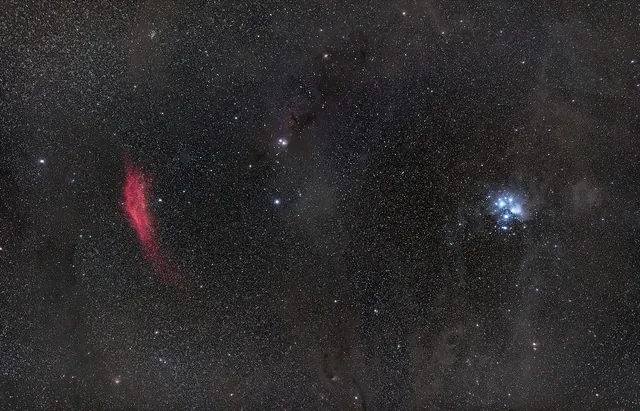
Despite its size, the California Nebula is notoriously hard to see. Under very dark skies it can just be glimpsed with the naked eye, but a telescope helps little because the light is so thinly spread. Tripod-mounted binoculars of 10×50 or larger and rich-field telescopes at low power show it best, and some observers have seen it through a hydrogen-beta filter alone.110
Start at Menkib and sweep north-north-east towards a sixth-magnitude star about 1¼° away: the nebula is brightest just south of it. Keep the eye moving and use averted vision, looking slightly to one side; staring at one spot makes faint light fade. A hydrogen-beta filter helps most, and Astronomy magazine also suggests a filter that passes hydrogen-alpha and cuts airglow.111
Telescopes on the California Nebula
NASA’s WISE telescope imaged Menkib and the nebula in infrared light in a picture released on 7 May 2010. Spitzer had never studied the nebula until its last week, when the science team chose it because it was likely to show strong infrared features: its final mosaic, at 3.6 and 4.5 microns, was taken on 25 January 2020, five days before the mission ended on 30 January.34
Xi Persei itself is one of the most closely studied O stars, observed in the ultraviolet by IUE over 12 years and later by Hubble, in X-rays by Chandra and XMM-Newton, and in visible light by the MOST, BRITE and TESS satellites. Maps from 2MASS, Herschel and Planck, and star motions from Gaia, have charted the California Molecular Cloud beside it.67912
Quick answers
- What kind of object is the California Nebula (NGC 1499)?
- The California Nebula (NGC 1499) is an emission nebula (H II region).89
- Which constellation is the California Nebula (NGC 1499) in?
- The California Nebula (NGC 1499) lies in the constellation Perseus.110
- How far away is the California Nebula (NGC 1499)?
- The California Nebula (NGC 1499) is about 1,000 to 1,500 light-years from Earth (estimates differ; the Gaia distance of its star is 418 parsecs).1112
- How big is the California Nebula (NGC 1499)?
- The California Nebula (NGC 1499) is about 100 light-years across (its length).41113
- How big does the California Nebula (NGC 1499) look in the sky?
- The California Nebula (NGC 1499) covers 145′ × 40′ of sky (about 2.5° × 0.5°).110
- How bright is the California Nebula (NGC 1499) in the night sky?
- The California Nebula (NGC 1499) has an apparent magnitude of 6 (but its very low surface brightness makes it hard to see).11
- When was the California Nebula (NGC 1499) discovered?
- The California Nebula (NGC 1499) was discovered on 3 November 1885, by Edward Emerson Barnard.1
Sources
- California dreamin’ (Stephen James O’Meara) — Astronomy magazine, 2014
- Notes on the NGC objects (Harold G. Corwin Jr.) — NASA/IPAC Extragalactic Database (NED)
- California Nebula Stars in Final Mosaic by NASA’s Spitzer — NASA Jet Propulsion Laboratory, 2020
- PIA13108: Menkhib and the California Nebula — NASA Jet Propulsion Laboratory, 2010
- SIMBAD: ksi Per (Menkib, HD 24912) — CDS, Strasbourg
- Dynamical star forming history of Per OB2 (Kounkel, Deng & Stassun) — arXiv:2206.04703, 2022
- The California Molecular Cloud (Lada, Lombardi & Alves) — Astrophysical Journal 703, 52 (arXiv:0908.0646), 2009
- SIMBAD: NGC 1499 — CDS, Strasbourg
- HP2 survey: III The California Molecular Cloud: A Sleeping Giant Revisited (Lada et al.) — Astronomy & Astrophysics 606, A100 (arXiv:1708.07847), 2017
- The California Nebula, NGC 1499 (Hartmut Frommert) — SEDS
- 101 Must-See Cosmic Objects: California Nebula (Alan Goldstein) — Astronomy magazine, 2022
- Rotation period of the O giant xi Persei: Coexistence of cyclic and periodic variability. A weakly magnetic candidate star (Henrichs, Sudnik & David-Uraz) — Astronomy & Astrophysics 714, A63 (arXiv:2610.12323), 2026
- NGC 1499: The California Nebula — NOIRLab
- WHAM Observations of H-Alpha, [S II], and [N II] toward the Orion and Perseus Arms: Probing the Physical Conditions of the Warm Ionized Medium (Haffner, Reynolds & Tufte) — Astrophysical Journal 523, 223 (arXiv:astro-ph/9904143), 1999
- A Hipparcos census of the nearby OB associations (de Zeeuw et al.) — Astronomical Journal 117, 354 (arXiv:astro-ph/9809227), 1999
- NGC 1499 (NGC/IC database) — SEDS
Figures checked against these sources in November 2026. Where a quantity is not known, it is left out rather than estimated.

