nebula
Butterfly Nebula (NGC 6302)
The Butterfly Nebula, NGC 6302, also called the Bug Nebula, is a planetary nebula in Scorpius and one of the brightest and most extreme known. A dying star has blown two great wings of gas out on either side of a thick, dark ring of dust, which hides the star itself from view. The wings stretch for more than two light-years, and their gas, heated to nearly 20,000 °C, is tearing across space at more than 950,000 km/h.123
Its central star is one of the hottest known in our galaxy, at about 220,000 K, but it shines most brightly in ultraviolet light and is hidden behind a dusty shroud. The James Webb Space Telescope finally pinpointed it in 2025 by the warm dust it heats. The wings were thrown out in a brief event about 2,250 years ago, after the star had spent some 5,000 years shedding the slow, dense ring around its waist.2456
Shape and size in space
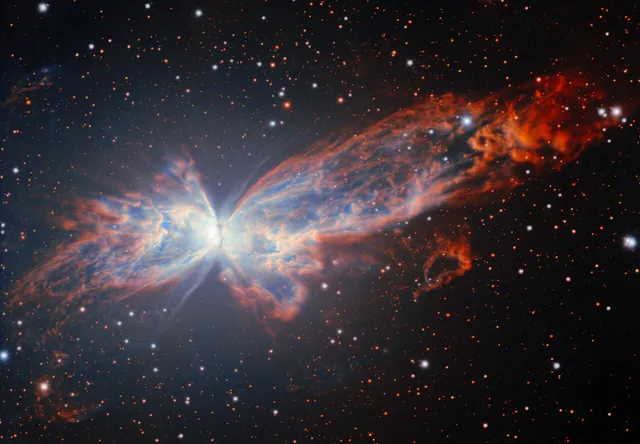
NGC 6302 is a bipolar planetary nebula: two lobes spread in opposite directions to form the butterfly’s wings, and a dark band of dusty gas makes its body. That band is a doughnut-shaped torus seen from the side. It hides the central star and may have given the nebula its shape, by stopping gas from flowing outwards equally in all directions; the thick belt of dust pinches the outflow into an hourglass.14
Hubble’s images record a series of ejections. The star swelled into a red giant some 1,000 times the Sun’s diameter and lost its outer layers. Some gas left its equator slowly, perhaps at only 32,000 km/h, building the torus; other gas flew out at right angles, faster, making the wings. Later, as the star heated up, a far faster wind of charged particles, at more than 3.2 million km/h, ploughed through the wings and reshaped them.18
The nebula’s history can be timed by watching it grow. Comparing Hubble images taken 9.43 years apart, Cezary Szyszka and colleagues found the gas moving faster the further it is from the star, as if it had all set out at once. The lobes were thrown out in a brief event 2,250 ± 35 years ago. The torus formed earlier and more slowly, over about 5,000 years, ending about 2,900 years ago; a pause of roughly 600 years, the “jet lag”, came between them.36
The same kind of measurement gives the best distance. John Meaburn and colleagues compared the positions of 15 knots in the north-western lobe on a photographic plate taken in 1956 with an image from 2007, and from their motion obtained a distance of 1.17 ± 0.14 kiloparsecs. Other figures vary widely: ESA/Hubble gives roughly 3,800 light-years, NASA about 4,000, ESA/Webb about 3,400, and NOIRLab between 2,500 and 3,800.13489
ALMA radio maps show that the dense molecular region at the waist is a massive ring of about a tenth of a solar mass, from which fragments of the lobe walls rise. Inside it lies a smaller, younger ring, tilted about 60° to the main one, which is the same age as the north-western lobes. A model of the whole nebula puts its total mass at 4.7 solar masses, in a very dense disc and a pair of large, thin lobes.1011
- Distance (expansion parallax)
- 1.17 ± 0.14 kpc9
- Other distance estimates
- about 2,500 to 4,000 light-years1348ESA/Hubble 3,800; NASA 4,000; ESA/Webb 3,400; NOIRLab 2,500–3,800
- Wingspan
- more than two light-years1
- Age of the lobes
- 2,250 ± 35 years6
- Mass of the molecular ring
- about 0.1 solar masses11
- Total mass of the nebula
- about 4.7 solar masses10from a 3D photoionisation model
What makes it shine
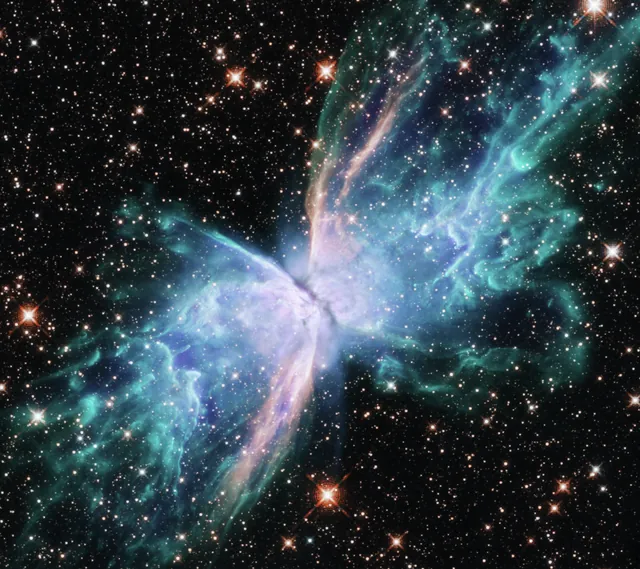
The star’s ultraviolet radiation makes the gas glow, heating the wings to nearly 20,000 °C, unusually hot for a planetary nebula. It is among the most highly ionised nebulae known, with light from atoms whose ionisation takes more than 300 electronvolts; Webb alone identified nearly 200 spectral lines in its core. Each element glows in its own place: the most highly ionised atoms crowd near the centre, and less energetic ones lie further out.14512
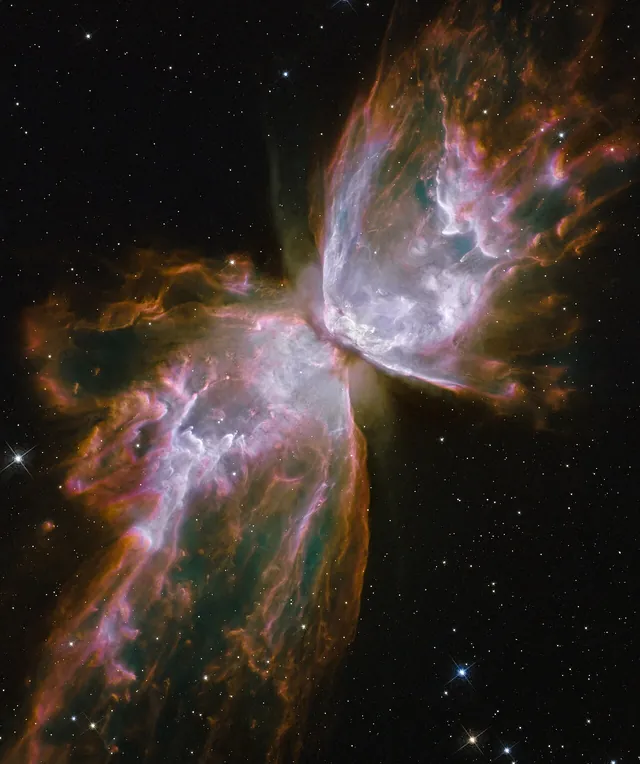
In Hubble’s 2009 image the reddish outer edges are mostly light from nitrogen, the coolest gas visible. White areas glow in sulphur where fast gas overtakes slower gas thrown out earlier, driving shock waves, seen as bright white edges facing the star. Many finger-like projections point back towards the star, perhaps denser blobs that have resisted the wind.1
The nebula’s make-up records the star’s past. Compared with the Sun, a model of its spectrum finds helium enhanced by half, nitrogen by a factor of six, oxygen normal and carbon slightly low. This points to carbon dredged up from the star’s interior being converted into nitrogen in the hot base of its envelope.10
The star at the centre
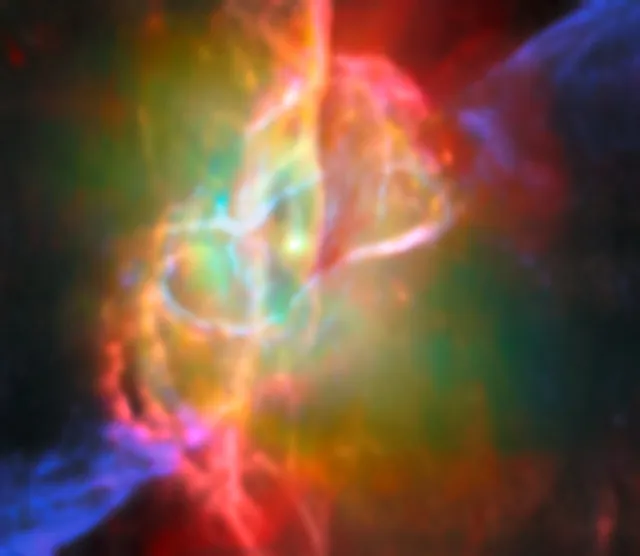
Despite many attempts, the central star long went unseen: it hides behind the dust torus and shines most brightly in ultraviolet light, so it had to be studied through the nebula it lights. To ionise the gas so strongly it must be hotter than 200,000 K, and some estimates reached about 400,000 K. ESA/Hubble gave its surface temperature in 2009 as over 220,000 °C, making it one of the hottest known stars in our galaxy.1212
In 2009 Szyszka’s team reported the star directly detected in Hubble’s new images, just in front of the tilted disc, and estimated that it was rapidly fading. But in 2021 Joel Kastner and colleagues compared new Hubble images with the earlier ones and found that this star is a foreground star, unrelated to the nebula. Shell-like features in the inner lobes instead suggested where the hidden star really lies.121314
Webb settled the question in 2025. Mikako Matsuura’s team found the star’s position by the glow of a previously unseen cloud of warm dust around it, which shines in the mid-infrared that Webb’s MIRI instrument sees. With a temperature of 220,000 K, it is one of the hottest known central stars of a planetary nebula in our galaxy.45
The star began as a fairly massive one. ESA/Hubble describes it as once about five times the mass of the Sun, and a model of the nebula gives an initial mass of about 5.5 solar masses, with today’s remnant at 0.73 to 0.82. The nebula’s spectrum is best matched by a hydrogen-poor star, which may have gone through a late burst of helium burning, and the same model has it leaving the giant stage about 2,100 years ago.110
- Mass today
- 0.73–0.82 solar masses10from a fit to evolutionary tracks
Notable features
The wings
Two broad lobes of glowing gas, more than two light-years from tip to tip, which expand faster the further they reach from the star. Hubble shows walls of compressed gas laced with trailing strands and bubbling outflows; Webb’s data suggest the nebula was shaped not by a steady wind but by a series of sudden bubble ejections.1256
The dark torus
The butterfly’s body is a thick ring of dust and gas seen nearly edge-on, holding most of the nebula’s dust. ESA’s Infrared Space Observatory found hydrocarbons, carbonates such as calcite, water ice and iron in it; Webb found crystalline silicates like quartz and grains about a micrometre across, large for cosmic dust, which have been growing for a long time.245
The iron jets
Webb and Hubble both trace iron. In Hubble’s 2019–2020 images an S-shaped band of light from ionised iron runs along the inner rims of the lobes, which Kastner’s team reads as shocks from fast, narrow winds at about 100 km/s, pointed off the main axis. Webb found iron and nickel tracing a pair of jets blasting out from the star in opposite directions.3414
Carbon molecules in the making
Webb saw light from polycyclic aromatic hydrocarbons, flat carbon molecules like those in smoke and burnt toast, just outside a bubble of gas around the star. The team suspects they form where the bubble bursts into the surrounding gas. It may be the first PAH-forming site found in a planetary nebula, and the first evidence of them forming in an oxygen-rich one.45
Discovery and history
Who found NGC 6302 first is uncertain, and sources give different dates. NOIRLab notes that credit usually goes to a study published in 1907 by the American astronomer Edward E. Barnard, though the Scottish astronomer James Dunlop may have discovered it in 1826. Its official name is NGC 6302, and it is also known as the Butterfly Nebula, the Bug Nebula and Caldwell 69.78
A photographic plate taken by Evans at the South African Astronomical Observatory in 1956 later proved invaluable: half a century on, it let astronomers measure how far the lobe’s knots had moved. Data from ESA’s Infrared Space Observatory revealed carbonates in its torus, reported in 2002. In the Solar System such minerals are taken as a sign of past liquid water; finding them here, where there has never been liquid water, shows that other ways of forming them cannot be ruled out.29
- Discovered
- 1907, Edward E. Barnard8James Dunlop may have found it in 1826
Seeing it for yourself
The Butterfly Nebula is highest, and best seen, from the Southern Hemisphere in winter. From northern latitudes its season is summer, but for most observers it stays low over the southern horizon. At magnitude 9.5 it is just visible in binoculars under dark skies, though a telescope gives a better view. Even then expect something like a small, smoky eraser smudge; a medium to large telescope under dark skies is needed to make out the butterfly shape.3
Telescopes on the Butterfly
Hubble’s Wide Field and Planetary Camera 2 imaged the nebula in 2000, and a 2004 release showed its walls of compressed gas. After astronauts installed Wide Field Camera 3 in May 2009, Hubble photographed the nebula on 27 July 2009, and the picture was released on 9 September as one of the first to show the rejuvenated telescope. Comparing those two sets of images revealed how the lobes are expanding.1236
Hubble returned in 2019 and 2020 to image the nebula from the near-ultraviolet to the near-infrared. ALMA mapped its molecular gas in fine detail. The James Webb Space Telescope’s MIRI spectrometer mapped the core over a region about 18.5″ by 15″, in results released on 27 August 2025, and an image from the Gemini South telescope, released in November 2025, marked 25 years of the International Gemini Observatory.34581114
- Gemini South image released
- 26 November 20258
Quick answers
- What kind of object is the Butterfly Nebula (NGC 6302)?
- The Butterfly Nebula (NGC 6302) is a planetary nebula.37
- Which constellation is the Butterfly Nebula (NGC 6302) in?
- The Butterfly Nebula (NGC 6302) lies in the constellation Scorpius.13
- How far away is the Butterfly Nebula (NGC 6302)?
- The Butterfly Nebula (NGC 6302) is 1.17 ± 0.14 kiloparsecs from Earth (from the measured expansion of one lobe; other estimates range from about 2,500 to 4,000 light-years).389
- How big is the Butterfly Nebula (NGC 6302)?
- The Butterfly Nebula (NGC 6302) is more than two light-years across (wingtip to wingtip).1
- How bright is the Butterfly Nebula (NGC 6302) in the night sky?
- The Butterfly Nebula (NGC 6302) has an apparent magnitude of 9.5.3
- How old is the Butterfly Nebula (NGC 6302)?
- The Butterfly Nebula (NGC 6302) is about 2,250 years old (for the lobes; the dusty torus was cast off over about 5,000 years before that).36
- When was the Butterfly Nebula (NGC 6302) discovered?
- The Butterfly Nebula (NGC 6302) was discovered in 1907, usually credited to a study by Edward E. Barnard; James Dunlop may have found it in 1826.8
Sources
- Butterfly emerges from stellar demise in planetary nebula NGC 6302 (heic0910h) — ESA/Hubble, 2009
- Demise in ice and fire (heic0407) — ESA/Hubble, 2004
- Caldwell 69 (Hubble’s Caldwell Catalog) — NASA Science
- Webb investigates complex heart of a cosmic butterfly (weic2517) — ESA/Webb, 2025
- The JWST/MIRI view of the planetary nebula NGC 6302 I: a UV irradiated torus and a hot bubble triggering PAH formation (Matsuura et al.) — Monthly Notices of the Royal Astronomical Society 542, 1287 (arXiv:2508.19332), 2025
- The expansion proper motions of the planetary nebula NGC 6302 from HST imaging (Szyszka, Zijlstra & Walsh) — Monthly Notices of the Royal Astronomical Society (arXiv:1105.3381), 2011
- SIMBAD astronomical database: NGC 6302 — Centre de Données astronomiques de Strasbourg (CDS)
- Gemini South celebrates 25th anniversary with stunning snapshot of the Butterfly Nebula (noirlab2530) — NSF NOIRLab, 2025
- Hubble-type outflows of the high-excitation, poly-polar planetary nebula NGC 6302 from expansion proper motions (Meaburn et al.) — Monthly Notices of the Royal Astronomical Society (arXiv:0711.4359), 2008
- A 3D photoionization model of the extreme planetary nebula NGC 6302 (Wright et al.) — Monthly Notices of the Royal Astronomical Society (arXiv:1107.4554), 2011
- ALMA high spatial resolution observations of the dense molecular region of NGC 6302 (Santander-García et al.) — Astronomy & Astrophysics 597, A27 (arXiv:1609.06455), 2017
- Detection of the central star of the planetary nebula NGC 6302 (Szyszka et al.) — Astrophysical Journal 707, L32 (arXiv:0909.5143), 2009
- Newly discovered star one of hottest in Galaxy — Jodrell Bank Centre for Astrophysics, University of Manchester, 2009
- Panchromatic HST/WFC3 imaging studies of young, rapidly evolving planetary nebulae. I. NGC 6302 (Kastner et al.) — Astrophysical Journal (arXiv:2105.13953), 2022
Figures checked against these sources in November 2026. Where a quantity is not known, it is left out rather than estimated.

