nebula
Iris Nebula (NGC 7023)
The Iris Nebula, NGC 7023, is a blue flower of dust in Cepheus, about 6 light-years across. It does not glow by itself: it is a reflection nebula, whose dust scatters the light of the young, hot double star HD 200775 at its heart. Gaia’s parallax of that star puts the nebula about 350 parsecs away, while NASA and ESA pages give 1,300 to 1,400 light-years.1234567
Astronomers treat the Iris as a natural laboratory for interstellar dust and molecules. Close to the star, starlight is breaking dust grains and large carbon molecules apart, and it was here, in 2010, that the carbon cage molecule C60, buckminsterfullerene, was first firmly detected in its neutral form in interstellar space.2891011
Shape and size in space
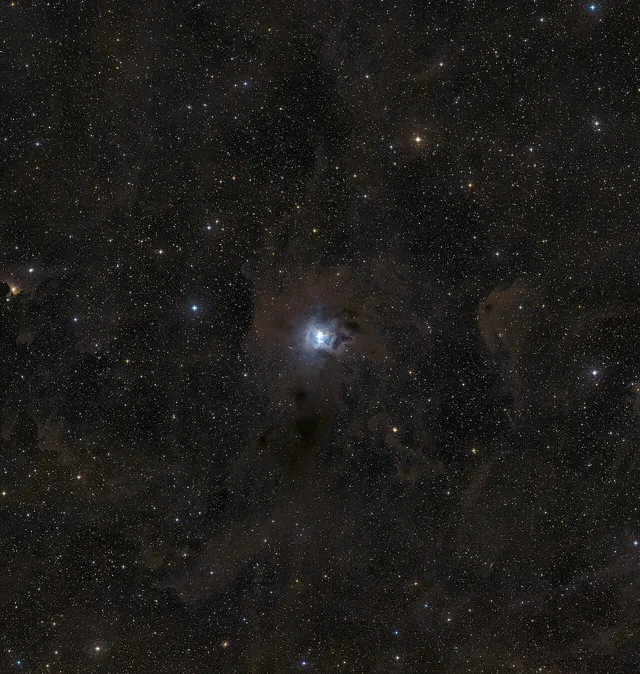
The Iris sits at the northern edge of a long molecular cloud made of the dark clouds L 1167 to L 1174. That cloud spans 0.5° by 1° on the sky, or 3.9 by 7.7 parsecs at the distance assumed when it was mapped, and holds some 600 solar masses of molecular hydrogen. HD 200775 lies inside a biconical cavity in the cloud, probably dug out by an old outflow from the star, though no fast-moving gas remains in it today.3
Bright filaments to the north-west, south and east mark photodissociation regions: layers of gas and dust where the far-ultraviolet light of a hot star breaks molecules apart. Here they line the walls of the cavity, where the star’s light meets dense gas. The north-western one is lit almost exactly side-on as we see it, which lets telescopes look straight across its layers, and its gas rises to densities of 100,000 to 1 million hydrogen atoms per cubic centimetre at the front.68916
Its distance was long uncertain. Estimates range from 288 parsecs, from the dimming of stars along the line of sight, to 440 parsecs from the star’s spectrum, the most often quoted value; the Hipparcos parallax gave 430 parsecs but was disturbed by the star’s orbital motion. The Gaia parallax of HD 200775 is 2.82 milliarcseconds, and a catalogue of Gaia-based distances gives 352 parsecs. NASA and ESA pages still quote 1,300 to 1,400 light-years.123457
What makes it shine
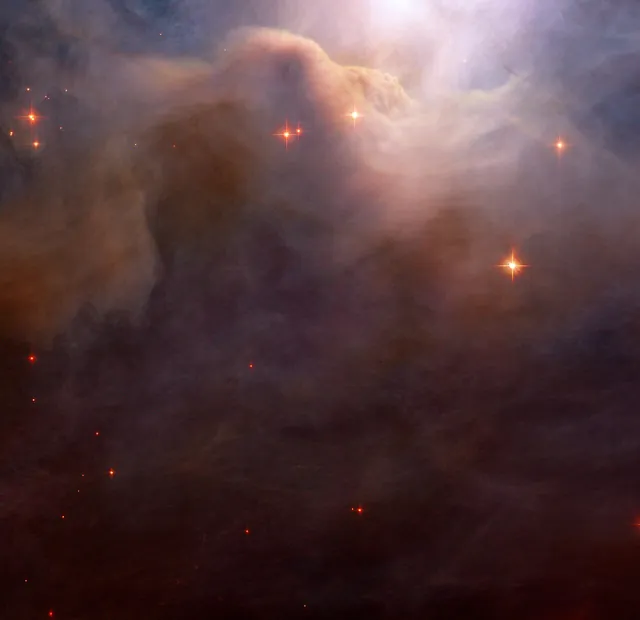
The Iris is a reflection nebula: its colour is the scattered light of its central star. Its dust grains are tiny, 10 to 100 times smaller than household dust, and they scatter blue light more readily, giving a bluish glow like our own sky. Further out, the dust is seen as faint brown clouds that block the stars behind them.1217
Parts of the Iris are unexpectedly red. This extended red emission comes from narrow filaments on the cloud surfaces and is thought to come from an unknown compound, most likely based on hydrocarbons, that glows when lit by starlight. Hubble resolved the filaments and showed that the process is started by ultraviolet light of wavelengths shorter than 118 nanometres; later work found the red glow strongest where small dust grains are being broken down into free carbon molecules.121618
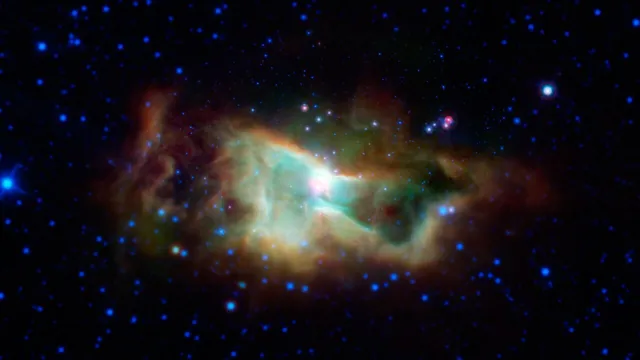
In infrared light the cloud glows on its own, from complex carbon molecules called polycyclic aromatic hydrocarbons, or PAHs, and from very small dust grains. The PAHs shine at the cloud surface nearest the star, while the very small grains lie slightly deeper, consistent with the grains breaking down to release free PAHs.789
- Ultraviolet that starts the red glow
- shorter than 118 nm18
The stars inside
HD 200775, also called V380 Cephei, is a Herbig Be star, a young massive star. It is classed B2Ve and shines at magnitude 7.4, and ESA gives it about ten times the mass of the Sun. It is in fact a double star whose two components are similar in temperature, about 5 astronomical units apart, circling each other in about 3.6 years. Gas from a disc round the pair still feeds them: their hydrogen emission strengthens each time the two stars are closest.2341519
One of the pair carries a magnetic field of about 1,000 gauss at its poles, with a structure like the fields of the magnetic Ap and Bp stars on the main sequence. That supports the ‘fossil field’ explanation for the magnetism of those stars. The magnetic star rotates once every 4.33 days.15
HD 200775 is not alone. In 1953 a small cluster of variable stars with hydrogen emission was found centred on the nebula, and some two dozen variable stars were studied in 1962. The young star PV Cephei, more than 10 parsecs to the west, may have been thrown out of this group at least 100,000 years ago.3
Notable features
Buckminsterfullerene (C60)
In 2010 the Spitzer Space Telescope confirmed infrared features of C60, a closed cage of 60 carbon atoms, in the Iris: the first firm detection of neutral C60 in interstellar space. Its emission peaks on the central star, and the researchers found that 0.1 to 0.6 per cent of interstellar carbon is in C60.1011
Fullerenes made from the top down
In the Iris, C60 is found closest to the star, while PAHs shine further out. Researchers argued in 2012 that ultraviolet light converts PAHs into graphene and then C60, stripping their hydrogen and folding them into a cage, rather than C60 being built up from smaller pieces. A model published in 2015 found that this could turn a large PAH into C60 in about 100,000 years.10112021
Ionised C60
Closest to the star, 7.5″ from it, Spitzer spectra show four extra infrared bands that researchers attributed in 2013 to C60+, the positively charged form of the molecule.20
The red filaments
Thin red filaments on the cloud surfaces in the north-west of the nebula. Hubble imaged them to find out what produces the extended red emission, and the cause is still uncertain: doubly charged PAHs were suggested in 2006, and pairs of singly charged PAHs in 2008.21618
Molecules worn down by starlight
The star’s light is grinding the dust down. Models suggest that PAHs with fewer than about 50 carbon atoms cannot survive in the north-western region, and maps from the SOFIA airborne observatory found PAHs of about 70 carbon atoms in the cavity but about 50 at the surface of the cloud. Strong emission from silicon ions in the cavity, found by the Infrared Space Observatory, shows that silicate grains there are partly evaporating.6
The north-western filament
A prototype of a photodissociation region lit by a B star, and a key target for the Herschel and James Webb space telescopes. The ultraviolet light striking it is about 2,600 times the average in the Sun’s neighbourhood. Webb has found ices of water, carbon dioxide and carbon monoxide in parts of the nebula.68
Discovery and history
William Herschel discovered the Iris on 18 October 1794, and it entered his catalogue as H IV.74. J. L. E. Dreyer’s New General Catalogue describes it as a 7th-magnitude star in an extremely faint, extremely large nebulosity. Vesto Slipher observed it in detail as early as 1918.1314
The first model of its photodissociation region was published in 1988, based on far-infrared observations from NASA’s Kuiper Airborne Observatory. The Iris has since become the prototype of a photodissociation region lit by a B-type star.68
Seeing it for yourself
The Iris lies close to the north celestial pole and is almost impossible to see from the Southern Hemisphere. NASA suggests a telescope in early autumn, star-hopping from the two brightest stars of Cepheus. It shines at magnitude 7 but is faint and diffuse, so dark skies away from city lights are recommended.1
Telescopes on the Iris
Hubble’s Advanced Camera for Surveys and its infrared NICMOS camera studied the Iris’s red filaments, in a programme led by Karl Gordon of the Space Telescope Science Institute. Between 2003 and 2005 the Spitzer Space Telescope mapped where its PAHs lie, and its spectra found C60 and C60+.1271020
The Herschel Space Observatory measured the gas and dust in its walls, and results published in 2025 and 2026 from the James Webb Space Telescope mapped the north-western filament at a resolution of about 0.0002 parsecs, between wavelengths of 0.97 and 28 microns. Researchers speculate that the carbon molecules there are in an intermediate stage of change that comes before fullerenes form.682122
Quick answers
- What kind of object is the Iris Nebula (NGC 7023)?
- The Iris Nebula (NGC 7023) is a reflection nebula.123
- Which constellation is the Iris Nebula (NGC 7023) in?
- The Iris Nebula (NGC 7023) lies in the constellation Cepheus.12
- How far away is the Iris Nebula (NGC 7023)?
- The Iris Nebula (NGC 7023) is about 350 parsecs from Earth (Gaia parallax of HD 200775, 2.82 mas; NASA and ESA quote 1,300–1,400 light-years, and older estimates range from 288 to 440 pc).1234567
- How big is the Iris Nebula (NGC 7023)?
- The Iris Nebula (NGC 7023) is about 6 light-years across (at NASA’s distance of 1,400 light-years).12
- How big does the Iris Nebula (NGC 7023) look in the sky?
- The Iris Nebula (NGC 7023) covers 10′ × 8′ of sky (SEDS gives 18′).1314
Sources
- Caldwell 4 — NASA Science, Hubble’s Caldwell Catalog
- Blushing dusty nebula (heic0915) — ESA/Hubble, 2009
- Star Forming Regions in Cepheus (M. Kun, Z. T. Kiss & Z. Balog) — Handbook of Star Forming Regions, Vol. I (Astronomical Society of the Pacific), 2008
- SIMBAD astronomical database: HD 200775 — Centre de Données astronomiques de Strasbourg (CDS)
- Estimating distances from parallaxes. V: geometric and photogeometric distances to 1.47 billion stars in Gaia EDR3 (Bailer-Jones et al.), entry for HD 200775 — VizieR catalogue I/352 (Astronomical Journal), 2021
- JWST observations of photodissociation regions. II. Aliphatic/aromatic carbonaceous dust, ices, and gas phase spectral line inventory (Misselt et al.) — Astronomy & Astrophysics, 2025
- Infrared Iris (sig13-005) — NASA/JPL-Caltech, Spitzer Space Telescope, 2013
- Gas morphology and energetics at the surface of PDRs: new insights with Herschel observations of NGC 7023 (Joblin et al.) — Astronomy & Astrophysics, 2010
- Analysis of the emission of very small dust particles from Spitzer spectro-imagery data using blind signal separation methods (Berné et al.) — Astronomy & Astrophysics, 2007
- C60 in reflection nebulae (Sellgren et al.) — Astrophysical Journal Letters, 2010
- Top-down formation of fullerenes in the interstellar medium (Berné, Montillaud & Joblin) — Astronomy & Astrophysics, 2015
- SIMBAD astronomical database: NGC 7023 — Centre de Données astronomiques de Strasbourg (CDS)
- Revised NGC data for NGC 7023 (from W. Steinicke’s Revised NGC and IC Catalog) — SEDS Interactive NGC Catalog
- NGC 7023 (H. Frommert) — SEDS NGC/IC database
- Characterization of the magnetic field of the Herbig Be star HD 200775 (Alecian et al.) — Monthly Notices of the Royal Astronomical Society, 2008
- Extended red emission and the evolution of carbonaceous nanograins in NGC 7023 (Berné et al.) — Astronomy & Astrophysics, 2008
- Iris Nebula NGC 7023 (noao-ngc7023) — NOIRLab
- The excitation of extended red emission: new constraints on its carrier from HST observations of NGC 7023 (Witt et al.) — Astrophysical Journal, 2006
- Enhanced H-alpha activity at periastron in the young and massive spectroscopic binary HD 200775 (Benisty et al.) — Astronomy & Astrophysics, 2013
- Interstellar C60+ (Berné, Mulas & Joblin) — Astronomy & Astrophysics, 2013
- Formation of buckminsterfullerene (C60) in interstellar space (Berné & Tielens) — Proceedings of the National Academy of Sciences, 2012
- JWST observations of photodissociation regions. IV. Carbonaceous emission band sub-components in NGC 7023 have distinct spatial distributions (Van De Putte et al.) — Astronomy & Astrophysics, 2026
Figures checked against these sources in November 2026. Where a quantity is not known, it is left out rather than estimated.

