asteroid moon
Dimorphos
Dimorphos is the small moon of the near-Earth asteroid Didymos, about 151 metres across, roughly the size of the Great Pyramid of Giza. On 26 September 2022 NASA’s DART spacecraft deliberately crashed into it at 6.1 km/s in the first full-scale test of planetary defence: a rehearsal for nudging a dangerous asteroid off course. Images taken seconds before impact showed a squat, boulder-strewn rubble pile.123
The collision shortened Dimorphos’s 11-hour 55-minute orbit around Didymos by 33 minutes, more than 25 times the minimum change NASA had set for success, because debris blasted from the surface added a powerful recoil. Hubble watched that debris stretch into a comet-like tail, and an Italian cubesat, LICIACube, photographed the plume up close. ESA’s Hera spacecraft arrived in November 2026 to inspect the aftermath.456789
Size and physical properties
DART’s camera saw only part of Dimorphos, lit from one side, but enough to build a shape model: an oblate spheroid measuring 177 × 174 × 116 m, with the same volume as a sphere 151 m across. That squashed-ball shape was unusual among the moons of binary asteroids observed before. Its mass, about 4.3 × 10⁹ kg, is inferred by assuming it is as dense as Didymos.1
If Dimorphos is made of the same stony material as Didymos, an assumed bulk density of 2.4 g/cm³ implies that roughly 30 per cent of its volume is empty space, much of it in the gaps between boulders. NASA describes it as a loosely packed rubble pile like the asteroid Bennu. A 2026 study of the pair’s motion around the Sun found it slightly less dense than previously thought.11012
The impact changed its shape. Before DART, Dimorphos was roughly symmetrical, like a squashed ball wider than it is tall; models fitted to the timing of mutual eclipses after the impact show a triaxial ellipsoid, which NASA likens to an oblong watermelon. Its gravity is about 200,000 times weaker than Earth’s, and ESA’s Hera is set to measure its mass and new shape directly.91013
- Dimensions before impact
- 177 × 174 × 116 m1±2, ±4 and ±2 m
- Volume
- 0.00181 km³1±10%
- Volume-equivalent diameter
- 151 ± 5 m1
- Mass
- about 4.3 × 10⁹ kg1inferred, not measured
- Bulk density
- 2.4 ± 0.3 g/cm³1assumed equal to that of the whole binary system
- Porosity
- about 30%1if made of L or LL chondrite rock
- Surface gravity
- about 0.05 mm/s²9roughly 200,000 times weaker than Earth’s
Orbit and the deflection
Before the impact Dimorphos followed a well-defined circular orbit about 1,189 m from Didymos, completing a circuit every 11.921 hours, a period refined from mutual eclipses observed between 2003 and 2022. DART struck its leading side head-on to slow it down, so that it would drop into a smaller orbit and go round faster.510
Radar and light curves gave the answer within two weeks: the period had shortened by 32 minutes, give or take 2, later refined to 33.0 ± 1.0 minutes. Had DART’s momentum simply been absorbed, the change would have been only about seven minutes. As Dimorphos kept losing material, the orbit settled at 11 hours 22 minutes 3 seconds, 33 minutes 15 seconds shorter than before.4510
The new orbit lies about 37 m closer to Didymos, at a mean distance of 1,152 m. It is slightly elongated rather than circular, and Dimorphos now rocks back and forth as it goes round. Because the two are bound together, the push also shifted their shared orbit around the Sun, changing its 770-day period by about 0.15 seconds.1012
- Orbital period before impact
- 11.92148 hours5±0.00013 h (3σ); 11 h 55 min
- Orbital period after impact
- 11 h 22 min 3 s10settled value, accurate to about 1.5 seconds
- Minimum change for mission success
- 73 seconds4
- Orbital speed
- about 18 cm/s2
- Instant change in orbital speed
- 2.70 ± 0.10 mm/s6along the direction of motion
Discovery
Dimorphos was found in November 2003, when Didymos passed 7.2 million km from Earth. Echoes from NASA’s Goldstone Solar System Radar first suggested a second body. Light curves analysed by Petr Pravec and colleagues then revealed the regular dips of mutual eclipses, and radar images from the Arecibo Observatory on 23 November confirmed the moon. It was designated S/2003 (65803) 1.311
Surface
DART’s last images showed a surface covered with boulders and no clear impact craters, a sign of youth. The final complete frame, at 5.5 cm per pixel, covered about 880 m² around the impact site, where 953 boulders and pebbles from 0.16 to 6.5 m long were counted. NASA scientists estimate the surface is less than 300,000 years old, against about 12.5 million years for Didymos.13
The boulders resemble those on other rubble-pile asteroids, including Itokawa, Bennu and Ryugu, which suggests these small worlds formed and evolved in similar ways. Scientists think Dimorphos itself gathered from material shed by the fast-spinning Didymos, and its weak surface probably helped DART move it so much further than expected.13
The impact and its aftermath
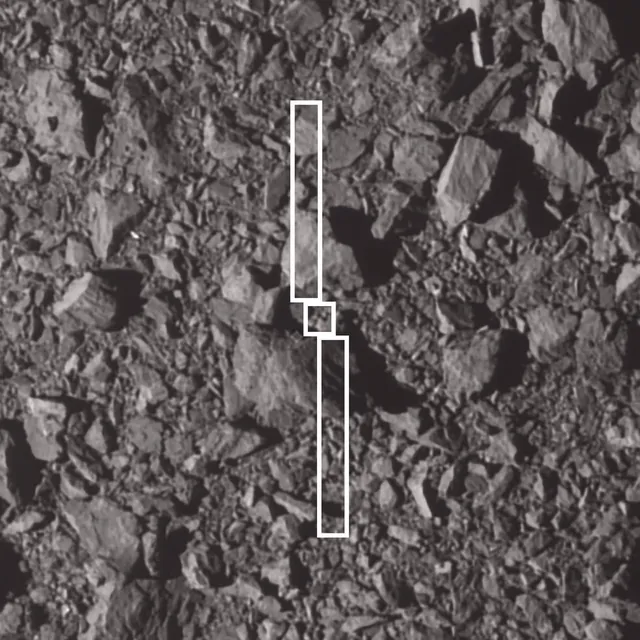
DART impact site
DART struck between two large boulders, 6.5 m and 6.1 m long, about 25 m from the centre of the face it approached, at 73° from the horizontal. Its solar arrays brushed both boulders a split second before the spacecraft body, which carried about 88 per cent of its 579 kg mass, hit the ground between them.1
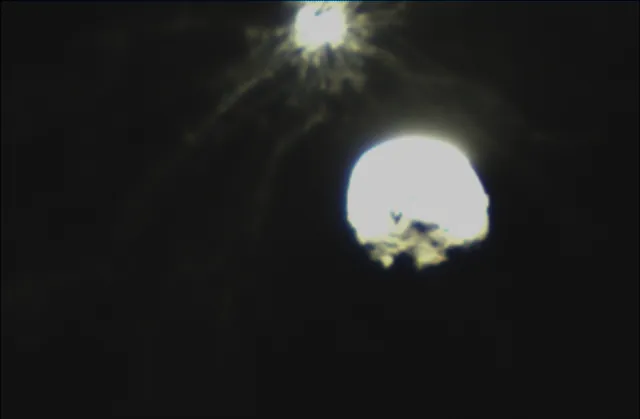
Ejecta plume
LICIACube photographed the plume from 71 seconds before the impact until 320 seconds after. It was a cone opening at about 140°, threaded with filaments, dust and single or clustered boulders, with debris moving at speeds from a few tens of metres per second up to about 500 m/s. The plume was blue near Dimorphos and redder farther out.8
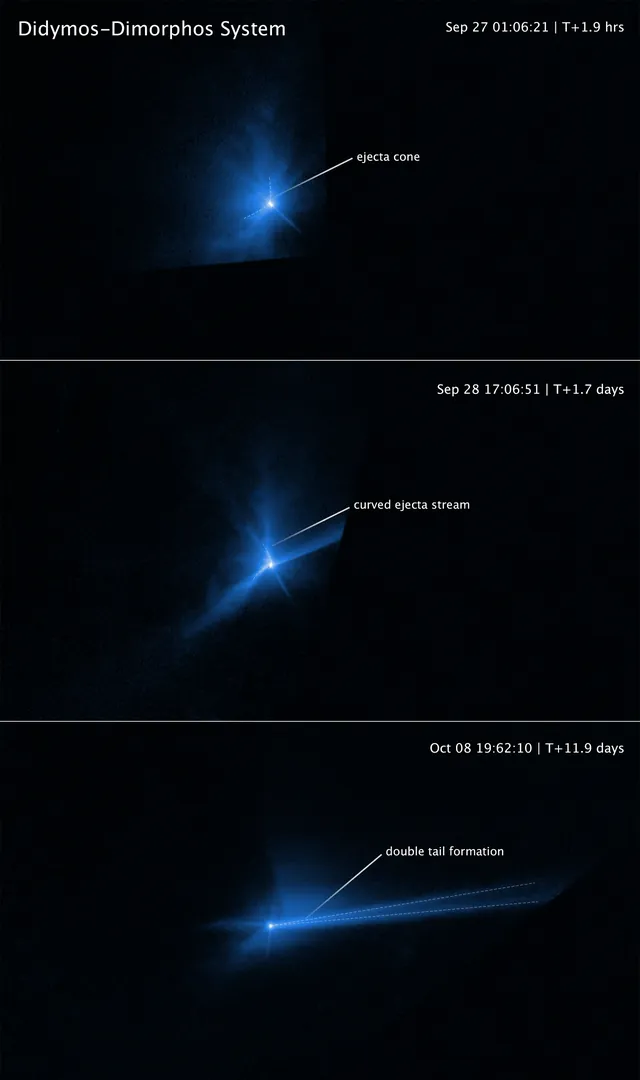
Debris tail
Hubble followed the debris from 15 minutes to 18.5 days after impact. About three hours in, sunlight began pushing dust into a tail that soon stretched beyond 1,500 km, past the edge of Hubble’s images, and a second tail appeared days later. ESA says the plume spread across 10,000 km of space.27
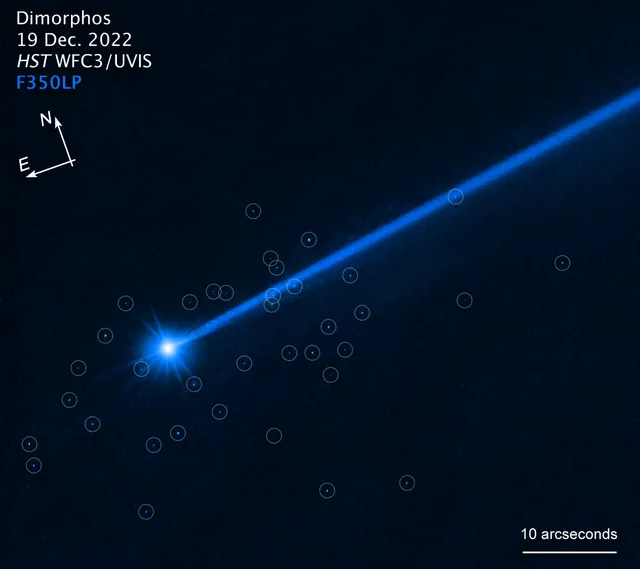
Boulder swarm
In December 2022 Hubble found 37 boulders drifting away from Dimorphos at about 1 km per hour, each between 1 m and 6.7 m across. Together they hold about 0.1 per cent of its mass, and the team estimates that the impact shook off 2 per cent of the boulders on its surface.14
Exploration
DART launched on 24 November 2021 and hit Dimorphos at 23:14 UTC on 26 September 2022, about 11 million km from Earth. Its only instrument, the DRACO camera, guided it in and sent images until the final seconds. It carried a passenger, the Italian Space Agency’s LICIACube, released on 11 September, which flew past about 58 km from Dimorphos some 167 seconds after the impact and returned 426 science images.368
The change in orbit showed how hard DART pushed. Assuming both asteroids share a density of 2.4 g/cm³, the momentum delivered was about 3.6 times DART’s own, and between 2.2 and 4.9 times across plausible densities, so the recoil from escaping debris gave more push than the spacecraft itself. A 2026 analysis of the pair’s orbit around the Sun put the enhancement at about two.612
ESA’s Hera, launched on 7 October 2024, reached the Didymos system in November 2026 and began surveying it from 25 to 30 km away. Its ‘crash site investigation’ aims to find out whether DART left a crater or reshaped Dimorphos entirely, to measure its mass and structure, and to explain why the deflection was so much larger than simulations predicted. Detailed images are due on 25 November.291315
Quick answers
- How big is Dimorphos?
- Dimorphos has a mean radius of about 76 m (volume-equivalent diameter 151 ± 5 m).1
- How massive is Dimorphos?
- Dimorphos has a mass of about 4.3 × 10⁹ kg (inferred by assuming it is as dense as Didymos).1
- How strong is gravity on Dimorphos?
- Gravity at the surface of Dimorphos is about 0.05 mm/s² (roughly 200,000 times weaker than Earth’s).9
- How far is Dimorphos from Didymos?
- Dimorphos is 1.15 km from Didymos (mean distance since the impact; 1.19 km before).210
- How long is a year on Dimorphos?
- A year on Dimorphos lasts 2.11 Earth years (769 days, travelling with Didymos).311
- How far is Dimorphos from the Sun?
- Dimorphos is 1.64 au from the Sun (about 246 million km on average, with Didymos).11
Sources
- Daly et al., Successful kinetic impact into an asteroid for planetary defence — Nature, 2023
- First light: Hera resolves two asteroids instead of one — European Space Agency, 2026
- Didymos & Dimorphos — NASA Science, 2026
- NASA Confirms DART Mission Impact Changed Asteroid’s Motion in Space — NASA, 2022
- Thomas et al., Orbital period change of Dimorphos due to the DART kinetic impact — Nature, 2023
- Cheng et al., Momentum transfer from the DART mission kinetic impact on asteroid Dimorphos — Nature, 2023
- Li et al., Ejecta from the DART-produced active asteroid Dimorphos — Nature, 2023
- Dotto et al., The Dimorphos ejecta plume properties revealed by LICIACube — Nature, 2024
- Hera spacecraft in ‘rectangular orbit’ around target asteroids — European Space Agency, 2026
- NASA Study: Asteroid’s Orbit, Shape Changed After DART Impact — NASA Jet Propulsion Laboratory, 2024
- Small-Body Database Lookup: 65803 Didymos (1996 GT), satellite data — NASA/JPL Solar System Dynamics, 2026
- NASA’s DART Mission Changed Orbit of Asteroid Didymos Around Sun — NASA, 2026
- Hera — European Space Agency, 2026
- Hubble sees boulders escaping from asteroid Dimorphos — European Space Agency, 2023
- Hera spies a half-hidden asteroid moonlet — European Space Agency, 2026
Figures checked against these sources in November 2026. Where a quantity is not known, it is left out rather than estimated.

