asteroid
Didymos
Didymos is a near-Earth asteroid about 780 metres across with a small moon of its own, Dimorphos. Shaped like a spinning top with a sharp ridge around its equator, it turns once every 2.26 hours, fast enough that it is close to coming apart. Its name, suggested by its discoverer Joseph Montani, is Greek for “twin”.1234
The pair was chosen as the target of NASA’s DART spacecraft, which crashed into Dimorphos on 26 September 2022 and shortened its orbit around Didymos by 33 minutes, the first time people had purposely changed the motion of a natural body in space. The push even altered the binary’s 770-day orbit around the Sun by about 0.15 seconds. In November 2026 ESA’s Hera spacecraft arrived to survey both asteroids close up.1567
Size and physical properties
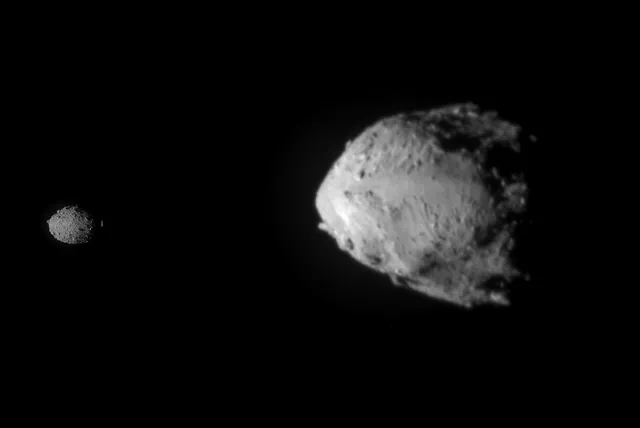
DART’s camera gave the first close look at Didymos minutes before the spacecraft struck its moon. A preliminary shape model built from those images measures 849 × 851 × 620 m, the same volume as a sphere 761 m across: broad at the equator and squat from pole to pole. Earlier radar work gave a diameter of about 780 m, the figure ESA uses, while NASA quotes about 805 m.1248
DART did not weigh Didymos directly. The orbit of Dimorphos gives the mass of the whole pair, about 5.6 × 10¹¹ kg, and dividing by the volumes of both bodies gives a bulk density of about 2.4 g/cm³; earlier radar work gave 2.17 g/cm³. Gravity at the surface is feeble, roughly 40,000 times weaker than Earth’s, and the system reflects about 15 per cent of the sunlight falling on it.478
- Dimensions (radar)
- 797 × 783 × 761 m4uncertainties 6%, 6% and 10%
- Volume-equivalent diameter
- 761 ± 26 m8
- Mass of the binary system
- (5.6 ± 0.5) × 10¹¹ kg8
- Bulk density
- 2.4 ± 0.3 g/cm³48for the whole system, from DART; radar gives 2.17 ± 0.35 g/cm³ for Didymos
- Surface gravity
- about 0.25 mm/s²7roughly 40,000 times weaker than Earth’s
- Geometric albedo
- 0.15 ± 0.028whole system, in visible light
- Absolute magnitude
- 18.114
Orbit and rotation
Didymos is an Apollo-type near-Earth asteroid. Its orbit is markedly elongated, carrying it from 1.01 au from the Sun, just outside Earth’s orbit, out to 2.27 au, a little beyond Mars, and it is tilted 3.4° to the plane of Earth’s orbit. One circuit takes 769 days, about 2.1 years. It passed 7.2 million km from Earth in November 2003 and 10.7 million km in October 2022.14
JPL lists Didymos as a potentially hazardous asteroid because its orbit comes within 0.04 au of Earth’s, but NASA stresses that neither it nor its moon posed any hazard before or after DART’s impact. That impact changed the pair’s 770-day orbital period around the Sun by about 0.15 seconds, a change in speed of 11.7 micrometres per second, measured with the help of 22 stellar occultations.469
Didymos spins once every 2.26 hours. ESA notes that this is fast enough to leave it close to coming apart, and models suggest the spin may make loose material flow from higher latitudes towards the equator. Light curves taken after DART’s impact showed no change in the rotation period, to within about five seconds.245
Discovery and naming
Joseph Montani of the Spacewatch survey discovered Didymos on 11 April 1996 at Kitt Peak National Observatory, south-west of Tucson, Arizona. It received the provisional designation 1996 GT and later the permanent number 65803. Montani also suggested its name, Greek for “twin”, a fitting choice for an asteroid that turned out to have a companion.14
The companion came to light during the close pass of November 2003. Echoes from NASA’s Goldstone Solar System Radar first raised suspicions of a second body. Optical light curves, analysed by Petr Pravec and colleagues, then showed the dips of the two bodies eclipsing each other, and radar images from the Arecibo Observatory on 23 November 2003 confirmed the moon, now called Dimorphos.14
- Designations
- 1996 GT; (65803) Didymos4
Surface and composition
DART’s images showed rockier terrain on the higher parts of Didymos and smoother ground at lower elevations, with more craters than on its moon. Hera’s first close views in November 2026, from 56 km away, revealed large boulders, smoother regions and a surprisingly sharp ridge running round the equator, the hallmark of its spinning-top shape.12
Researchers estimate that the surface of Didymos is about 12.5 million years old, 40 to 130 times older than that of Dimorphos, and DART team studies suggest that its surface material is weak. Its spectrum places it among the stony S-type asteroids, and the closest matching meteorites are the L and LL ordinary chondrites.148
Its moon, Dimorphos
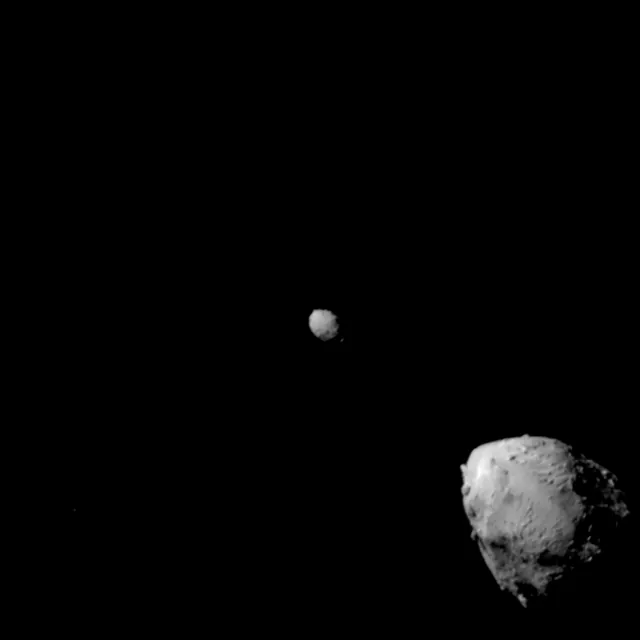
Dimorphos is about 151 m across. Before DART struck it, it circled Didymos every 11 hours 55 minutes at a distance of about 1.19 km. The impact shortened that orbit to 11 hours 22 minutes and brought the moon about 37 m closer, leaving its path slightly elongated. A 2026 study of the pair’s motion around the Sun found Dimorphos slightly less dense than previously thought.6810
The spinning-top shape of Didymos is common among binary asteroids. Scientists think that sunlight, absorbed and re-emitted unevenly, slowly sped up its spin over millions of years until material was shed from the surface and gathered into a moonlet, a process called rotational fission. The young, rubbly Dimorphos fits that picture, though other origins have not been conclusively ruled out.126
- Distance between them
- 1,152 m10mean, after the impact; 1,189 m before
Exploration
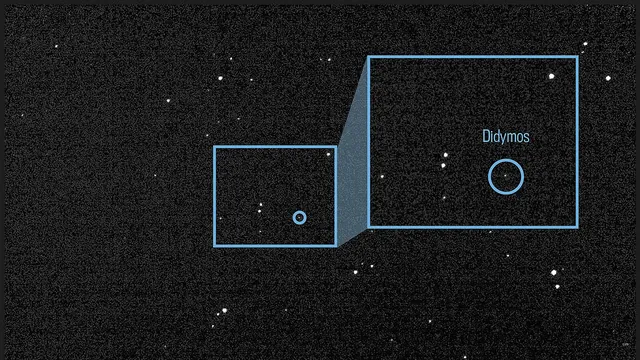
NASA’s DART spacecraft launched on a SpaceX Falcon 9 from Vandenberg Space Force Base in California on 24 November 2021. Its only instrument, the DRACO camera, helped it navigate to the Didymos system, and on 26 September 2022 it sent back images of Didymos during its final minutes before striking Dimorphos at about 6.1 km/s, some 11 million km from Earth.1
ESA’s Hera launched on 7 October 2024, swung past Mars in March 2025 and braked with a pair of thruster firings a week apart in October 2026. From 1,280 km away it resolved Didymos and Dimorphos as two separate objects for the first time, and in November 2026 it arrived, tracing slow ‘rectangular orbits’ 25 to 30 km from the pair at about 12 cm/s.37111213
Hera began with an early characterisation phase to gather the big picture. It is next due to move in to about 20 km for a detailed characterisation phase, release two shoebox-sized CubeSats for a closer survey and eventually attempt landings. ESA has said it will publish its first detailed images of both asteroids on 25 November 2026.2713
Quick answers
- How big is Didymos?
- Didymos has a mean radius of about 380 m (volume-equivalent diameter 761 ± 26 m; other estimates give 780–805 m).148
- How massive is Didymos?
- Didymos has a mass of about 5.6 × 10¹¹ kg (mass of the whole binary; Dimorphos adds less than 1 per cent).8
- How strong is gravity on Didymos?
- Gravity at the surface of Didymos is about 0.25 mm/s² (roughly 40,000 times weaker than Earth’s).7
- How far is Didymos from the Sun?
- Didymos is 1.64 au from the Sun (about 246 million km on average, ranging from 1.01 to 2.27 au).14
- When was Didymos discovered?
- Didymos was discovered on 11 April 1996, by Joseph Montani of Spacewatch at Kitt Peak, Arizona.14
Sources
- Didymos & Dimorphos — NASA Science, 2026
- Hera spies a half-hidden asteroid moonlet — European Space Agency, 2026
- Hera — European Space Agency, 2026
- Small-Body Database Lookup: 65803 Didymos (1996 GT) — NASA/JPL Solar System Dynamics, 2026
- Thomas et al., Orbital period change of Dimorphos due to the DART kinetic impact — Nature, 2023
- NASA’s DART Mission Changed Orbit of Asteroid Didymos Around Sun — NASA, 2026
- Hera spacecraft in ‘rectangular orbit’ around target asteroids — European Space Agency, 2026
- Daly et al., Successful kinetic impact into an asteroid for planetary defence — Nature, 2023
- NASA Confirms DART Mission Impact Changed Asteroid’s Motion in Space — NASA, 2022
- NASA Study: Asteroid’s Orbit, Shape Changed After DART Impact — NASA Jet Propulsion Laboratory, 2024
- ESA’s Hera targets early arrival at Didymos asteroids — European Space Agency, 2025
- Braking news! Time for ESA’s Hera asteroid mission to go slow — European Space Agency, 2026
- First light: Hera resolves two asteroids instead of one — European Space Agency, 2026
Figures checked against these sources in November 2026. Where a quantity is not known, it is left out rather than estimated.

