planet
Mars
Mars is the fourth planet from the Sun: a cold desert world about half as wide as Earth, with roughly a tenth of its mass and a little over a third of its surface gravity. Its red colour is rust, iron minerals oxidised in the dust that coats the ground and hangs in the thin carbon dioxide air. It has seasons, polar ice caps, giant extinct volcanoes and the largest canyon in the Solar System.12
A day on Mars, called a sol, lasts just under 24 hours 40 minutes, and a year lasts 687 Earth days. Dry river valleys, deltas and lakebeds show that the planet was once warmer and wetter, with a thicker atmosphere. No other planet has been explored so thoroughly: it is the only one where rovers have driven across the surface, and two are at work there today.123
Size and physical properties
Mars has a mean radius of 3,389.5 km, a little over half of Earth’s, but only about 15 per cent of Earth’s volume and less than 11 per cent of its mass. Its surface has nearly the same area as Earth’s dry land. Gravity at the surface is 3.73 m/s², 38 per cent of Earth’s, so a visitor would weigh a little over a third of what they do at home.12
The planet is slightly flattened by its spin: the equator is 20 km farther from the centre than the poles. Its landscape is far more rugged than Earth’s, with about 30 km between the lowest basin floor and the highest volcanic summit, one and a half times the range of heights found on Earth.15
- Equatorial radius
- 3,396.2 km1
- Polar radius
- 3,376.2 km1
- Mean radius
- 3,389.5 km10.532 × Earth
- Flattening
- 0.005891
- Mass
- 6.4169 × 10²³ kg10.107 Earths
- Volume
- 1.6312 × 10¹¹ km³10.151 Earths
- Mean density
- 3,934 kg/m³1Earth: 5,513
- Gravity
- 3.73 m/s²1mean, at the surface; 0.38 × Earth
- Escape velocity
- 5.03 km/s1
- Geometric albedo
- 0.1701
- Bond albedo
- 0.2501
Orbit and rotation
Mars orbits at an average of 228 million km from the Sun, about one and a half times Earth’s distance, and sunlight takes 13 minutes to reach it. The orbit is markedly oval: the planet is 206.7 million km from the Sun at its closest and 249.3 million km at its farthest. One circuit takes 687 Earth days, or 669.6 Martian days.12
A Martian solar day, called a sol, lasts 24.66 hours. The axis is tilted by 25.19 degrees, close to Earth’s 23.44, so Mars has four seasons, but the oval orbit makes them unequal. Spring in the northern hemisphere is the longest at 194 sols and northern autumn the shortest at 142; northern summer lasts 178 sols and northern winter 154.12
About every 26 months Earth catches up with Mars and the two line up on the same side of the Sun. At these oppositions Mars is at its nearest and brightest, but because of its oval orbit some are far closer than others. On 27 August 2003 the planets were 55.8 million km apart, closer than they had been in nearly 60,000 years.16
- Mean orbital speed
- 24.08 km/s1
- Orbital eccentricity
- 0.09351Earth: 0.0167
- Orbital inclination
- 1.848°1to Earth’s orbit
- Rotation period
- 24.6229 hours1relative to the stars
- Length of day
- 24.6597 hours1one sol
- Speed of rotation at the equator
- 241 m/s1867 km/h; derived from the equatorial radius and rotation period
- Axial tilt
- 25.19°1
- Brightest in our sky
- magnitude −2.941
Discovery and naming
Mars is easy to see with the naked eye and has been known since prehistoric times, so it has no discoverer. The Romans named it after their god of war because its colour recalled blood; the Egyptians called it Her Desher, the red one. Its two moons were found by the astronomer Asaph Hall in August 1877. The first close-up pictures came from NASA’s Mariner 4, which flew past in July 1965 and showed a barren, heavily cratered surface.1278
Atmosphere and weather
The air on Mars is about 95 per cent carbon dioxide, with a little nitrogen and argon and only traces of oxygen and water vapour. It is less than 1 per cent as dense as Earth’s. The average pressure at the surface is 6.36 millibars, and it rises and falls between about 4.0 and 8.7 millibars with the seasons. Suspended dust makes the sky hazy and red rather than blue.129
So thin an atmosphere holds little heat, and temperatures swing widely. The average is about −59 °C, and NASA gives extremes of roughly −153 °C and 20 °C. At the Viking 1 landing site the temperature ranged between −89 °C and −31 °C in the course of a day. The air is also too thin for liquid water to last long on the surface.12
Dust storms are common. About once a decade a series of them runs away and wraps the whole planet in haze, and months can pass before the dust settles. A major storm hid the surface when Mariner 9 arrived in 1971, and Hubble and Mars Global Surveyor watched another engulf the planet in 2001. The global storm of 2018, in which towers of dust rose 80 km, ended the mission of the solar-powered rover Opportunity.2101112
- Carbon dioxide (CO₂)
- 95.1%1by volume
- Nitrogen (N₂)
- 2.59%1
- Argon
- 1.94%1
- Oxygen (O₂)
- 0.16%1
- Carbon monoxide
- 0.06%1
- Water vapour
- 210 parts per million1
- Surface pressure
- 6.36 millibars1at the mean radius; 4.0 to 8.7 depending on season
- Average temperature
- about 214 K (−59 °C)1
- Daily temperature range
- 184 K to 242 K (−89 to −31 °C)1at the Viking 1 landing site
- Wind speed
- 2–7 m/s in summer, 17–30 m/s in a dust storm1at the Viking landing sites
- Scale height
- 11.0 km1
- Total mass of the atmosphere
- about 2.5 × 10¹⁶ kg1
Surface and geology
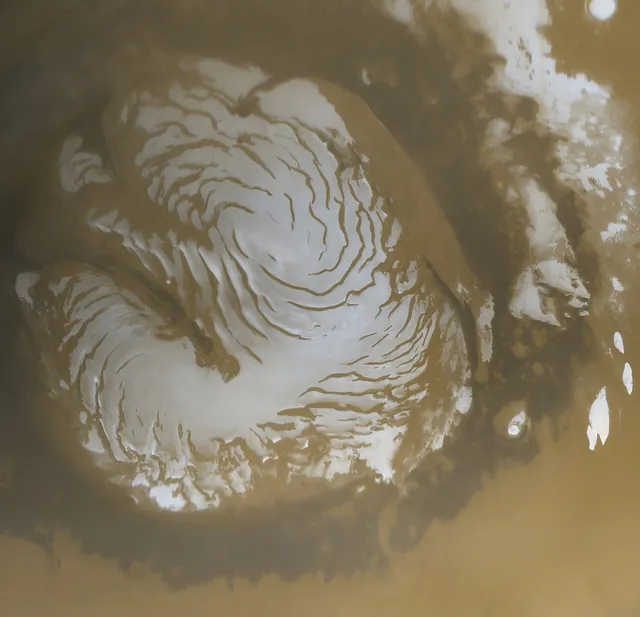
Seen up close, Mars is a rocky desert of browns, golds and tans, reddened by oxidised iron in its rocks and dust. Its two halves are strikingly different. The south is high, rough and heavily cratered; the north is a smooth lowland lying about 5 km lower on average. The boundary between them follows an ellipse of about 10,600 by 8,500 km, which may be the rim of a giant impact basin, though other explanations involving the mantle have also been proposed.251314
There is abundant evidence that water once flowed here: networks of ancient river valleys, deltas and lakebeds, and minerals that form only in liquid water. Some features point to huge floods about 3.5 billion years ago. Perseverance has found that Jezero crater once held a stable lake fed by a river, and Curiosity has found chemical and mineral evidence that Gale crater was once habitable.2315
Both poles carry ice caps up to 3.5 km thick. Each has a core of water ice beneath a thin coat of carbon dioxide ice, most of which turns to vapour in summer; in the south a residual sheet of dry ice survives. The south polar layered deposits alone hold enough water ice to cover the planet in a layer about 11 m deep. Water ice also lies just beneath the soil at high latitudes, where the Phoenix lander dug into it in 2008.16171819
- Height of the south above the north
- about 5 km5on average
- Boundary between the hemispheres
- an ellipse of about 10,600 × 8,500 km14
- Share of Mars covered by the northern basin
- about 40%13
- Thickness of the polar caps
- up to 3.5 km16
- Surface of the south polar cap
- 85% carbon dioxide ice, 15% water ice16measured by Mars Express
What hides inside
Like Earth, Mars has a crust, a rocky mantle and a metal core. Most of what is known about them comes from NASA’s InSight lander, whose seismometer recorded more than 1,300 marsquakes between 2018 and 2022. Beneath the lander the crust is 25 to 40 km thick, thinner than expected, and built of three layers. The planet’s strong, cold outer shell, the lithosphere, is about 500 km thick.22021
The core is molten: iron and nickel with lighter elements such as sulphur mixed in. InSight’s first results put its radius at about 1,800 km, considerably larger than expected. Two studies in 2023 argued that the outermost part of this is really a layer of molten rock at the base of the mantle, which would shrink the metal core to between 1,650 and 1,675 km.12202223
In 2025 a team re-examining InSight’s recordings reported seismic waves that had passed through a solid inner core about 613 km in radius. All of these figures rest on the recordings of a single seismometer, and the estimates of the core’s size have already been revised once, so they should be read as the current best measurements rather than settled values.12024
Magnetic field and the lost atmosphere
Mars has no global magnetic field today. Mars Global Surveyor found instead that parts of the crust, above all in the ancient southern highlands, are strongly magnetised, in bands about 160 km wide whose fields point in alternating directions. They are a fossil of a field generated in the molten core some 4 billion years ago. The northern lowlands are largely free of magnetism, which suggests their crust formed after that dynamo died.225
With no global field to deflect it, the solar wind strips gas from the top of the atmosphere. NASA’s MAVEN orbiter measured the loss at about 100 grams every second. From the argon that remains, its team concluded that about 65 per cent of the argon ever in the atmosphere has escaped to space, and that the solar wind and radiation were responsible for most of the loss that turned Mars from a warmer, wetter world into a cold desert.262728
- Global magnetic field
- none today2
- Age of the crustal magnetism
- about 4 billion years2
- Magnetic bands in the southern highlands
- about 160 km wide and 970 km long25given as 100 and 600 miles
- Crustal magnetism at the InSight site
- 10 times stronger than expected from orbit20
- Gas lost to the solar wind
- about 100 g every second26
- Argon lost to space
- about 65%27
Notable features
Olympus Mons
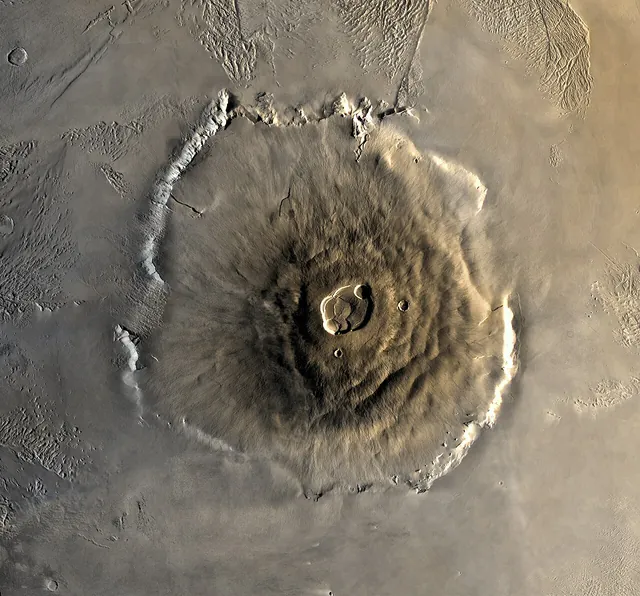
The largest volcano in the Solar System: a shield volcano about 610 km across, with a base as large as Arizona. Laser measurements from orbit put its summit about 25 km above the planet’s mean surface level, over two and a half times Mount Everest’s height. Six overlapping collapse pits at the summit together measure about 65 by 80 km.2293031
Valles Marineris
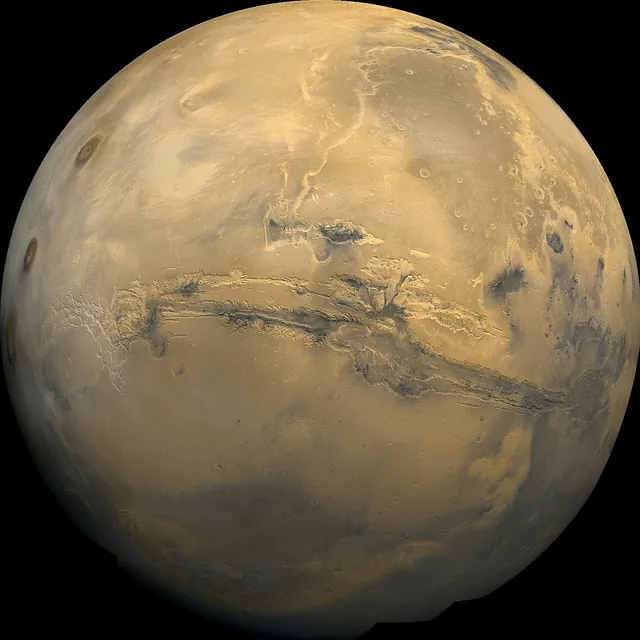
The largest canyon system in the Solar System, named in honour of the Mariner 9 science team. The Gazetteer of Planetary Nomenclature gives its extent as 3,761 km. NASA puts it at about 600 km across at its widest and about 9 km deep at its deepest, more than ten times as long and as wide as Earth’s Grand Canyon.229
Tharsis
A huge volcanic bulge that holds the most intensely and most recently active volcanic region on Mars. Three great shield volcanoes, Arsia, Pavonis and Ascraeus Mons, stand in a line along it about 700 km apart, each 350 to 400 km wide and about 17 km above the surrounding plain. Olympus Mons lies to their west.2932
Hellas Planitia
A giant impact basin in the southern hemisphere, 2,299 km across in the Gazetteer. Laser measurements by Mars Global Surveyor showed it to be nearly 9 km deep, with a ring of thrown-out debris that rises about 2 km above its surroundings and stretches 4,000 km from the basin’s centre.529
Gale crater
A crater 154 km across that contains a layered mountain, Mount Sharp. Curiosity landed here on 6 August 2012 and soon found chemical and mineral evidence that the site could once have supported microbial life. On 26 August 2026 the rover marked 1 km of height gained on its climb up the mountain’s slope.1529
Jezero crater
A crater about 45 km wide (47.5 km in the Gazetteer) on the western edge of the plain Isidis Planitia, just north of the equator. More than 3.5 billion years ago rivers spilled over its wall and formed a lake, leaving a delta of sediment. Perseverance has explored it since 18 February 2021.329
Moons
Mars has two small moons, Phobos and Deimos, both discovered by Asaph Hall in August 1877: Deimos on the 11th and Phobos on the 17th. He named them after the sons of Ares, the Greek counterpart of Mars; the names mean fear and dread. Both are dark, lumpy and cratered, too small for gravity to pull them into spheres. They may be captured asteroids, though some evidence contradicts that idea.24733
Phobos, about 27 by 22 by 18 km, circles just 9,378 km from the centre of Mars and completes three orbits a day. It is creeping inwards by 1.8 m every hundred years, and in about 50 million years will either crash into Mars or break up into a ring. Deimos, about 15 by 12 by 11 km, orbits 23,459 km out and takes about 30 hours. Mars has no rings today.12733
Exploration
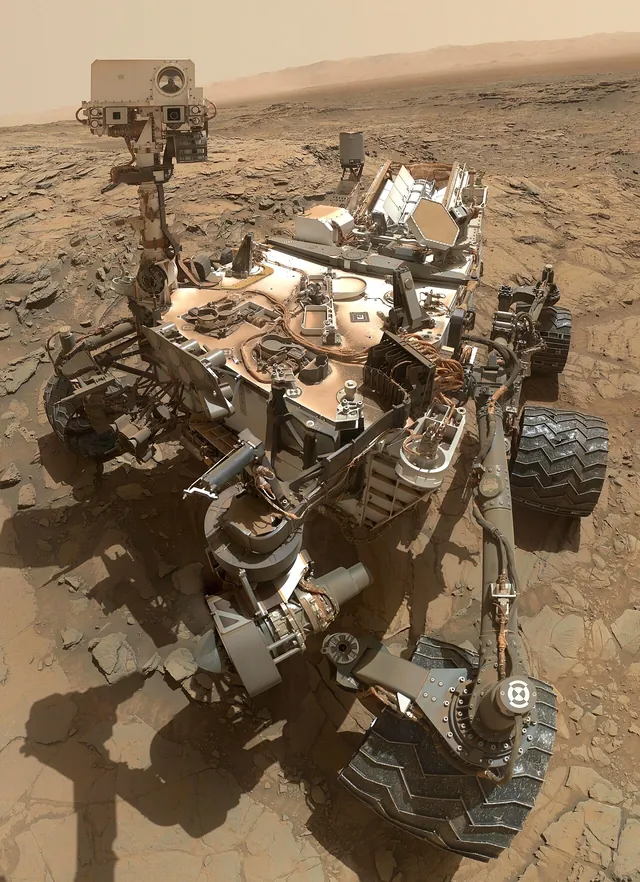
Mariner 4 made the first successful flyby in July 1965, returning 21 grainy pictures of a cratered surface. Mariner 9 became the first spacecraft to orbit another planet on 14 November 1971 and mapped 85 per cent of Mars. Viking 1 landed on 20 July 1976 and sent the first pictures from the ground, followed by Viking 2 that September. Mars Pathfinder delivered the first rover, Sojourner, on 4 July 1997, and the twin rovers Spirit and Opportunity arrived in January 2004.81134353637
As of November 2026 two NASA rovers are at work: Curiosity, in Gale crater since 6 August 2012, and Perseverance, which landed in Jezero crater on 18 February 2021 and on 11 October 2026 passed Opportunity’s distance record with 45.22 km driven. Its helicopter, Ingenuity, made the first powered flight on another planet on 19 April 2021. Overhead, NASA’s Mars Odyssey and Mars Reconnaissance Orbiter and ESA’s Mars Express and Trace Gas Orbiter are still working; NASA’s MAVEN fell silent on 6 December 2025.39152838394041
More spacecraft are on the way. NASA’s twin ESCAPADE orbiters, launched on 13 November 2025, are due in September 2027. Japan’s MMX set off on 20 October 2026 to collect a sample from Phobos and return it in 2031. ESA’s Rosalind Franklin rover is due to launch in 2028 and land at Oxia Planum in 2030. Mars Sample Return, the NASA and ESA plan to fetch Perseverance’s samples, is now described by NASA in the past tense, as a campaign that was proposed.242434445
- Mariner 4
- Flyby at 9,846 km, 15 July 1965801:00 Universal Time; the evening of 14 July in the United States
- Mariner 9
- In orbit 14 November 1971 to 27 October 1972117,329 pictures returned
- Viking 1
- Landed 20 July 1976; lander worked until 11 November 198234
- Viking 2
- Landed 3 September 1976; lander worked until 12 April 198035
- Mars Pathfinder and Sojourner
- Landed 4 July 1997; last data 27 September 199736
- Mars Global Surveyor
- In orbit from 12 September 1997; mission ended 14 November 200646
- Mars Odyssey
- In orbit since 24 October 2001; still operating38the longest-serving spacecraft at Mars
- Mars Express (ESA)
- Launched 2 June 2003, arrived December 2003; in operation40
- Spirit
- Landed 3 January 2004; mission ended 201037drove 7.7 km
- Opportunity
- Landed 24 January 2004; last contact 10 June 201837drove 45.16 km
- Mars Reconnaissance Orbiter
- In orbit since 10 March 2006; still operating39
- Phoenix
- Landed 25 May 2008; mission ended 2 November 200819
- MAVEN
- In orbit from 21 September 2014; contact lost 6 December 202528end of mission declared 3 June 2026
- ExoMars Trace Gas Orbiter (ESA)
- Launched 14 March 2016, arrived 19 October 2016; still operating4147
- InSight
- Landed 26 November 2018; mission ended 15 December 202221
- Tianwen-1 and the Zhurong rover (China)
- Launched 23 July 2020; rover landed in Utopia Planitia on 15 May 20214950Zhurong drove 1,921 m
- Perseverance
- Landed 18 February 2021; still operating345.22 km driven by 11 October 2026
- Ingenuity
- 72 flights, 19 April 2021 to 18 January 2024917.0 km flown in 128.8 minutes
- MMX (Japan)
- Launched 20 October 2026; sample return planned for 203143
- Rosalind Franklin (ESA)
- Launch planned for 2028; landing in 203044
Quick answers
- How big is Mars?
- Mars has a mean radius of 3,389.5 km (0.532 × Earth).1
- How massive is Mars?
- Mars has a mass of 6.417 × 10²³ kg (0.107 × Earth).1
- How long is a day on Mars?
- A day on Mars lasts 24.66 hours (one sol).1
- How long is a year on Mars?
- A year on Mars lasts 687 Earth days (1.88 Earth years).1
- How far is Mars from the Sun?
- Mars is 228.0 million km from the Sun (1.52 au on average).1
- How fast does Mars move through space?
- Mars moves along its orbit at 24.08 km/s (mean).1
- What is Mars’ axial tilt?
- Mars’ axis is tilted by 25.19°.1
- What is the temperature on Mars?
- The temperature on Mars is −59 °C (average; extremes of about −153 °C and 20 °C).12
- How many moons does Mars have?
- Mars has 2 known moons.4
- What is Mars made of?
- Mars is made of rock, with a core of iron, nickel and sulphur.2
Sources
- Mars Fact Sheet — NASA Space Science Data Coordinated Archive, 2025
- Mars: Facts — NASA Science
- Mars 2020: Perseverance Rover — NASA Science, 2026
- Planetary Satellite Discovery Circumstances — NASA/JPL Solar System Dynamics
- First Global 3-D View of Mars Reveals Deep Basin, Pathways for Water Flow — NASA Jet Propulsion Laboratory, 1999
- Mars: Closest Encounter — NASA Science, 2003
- Phobos — NASA Science
- Mariner 4 — NASA Science
- Ingenuity Mars Helicopter — NASA Science
- Global Storms on Mars Launch Dust Towers Into the Sky — NASA, 2019
- Mariner 9 — NASA Science
- Scientists Track “Perfect Storm” on Mars — NASA Science, 2001
- NASA Spacecraft Reveal Largest Crater in Solar System — NASA Jet Propulsion Laboratory, 2008
- The Borealis basin and the origin of the martian crustal dichotomy — Nature, 2008
- Mars Science Laboratory: Curiosity Rover — NASA Science, 2026
- Mars Express science highlights: 4. Probing the polar regions — European Space Agency
- Mars’ South Pole Ice Deep and Wide — NASA Jet Propulsion Laboratory, 2007
- The Changing Ice Cap of Mars — NASA Science
- Mars Phoenix — NASA Science
- InSight: Science Highlights — NASA Science
- InSight Lander — NASA Science
- Evidence for a liquid silicate layer atop the Martian core — Nature, 2023
- Geophysical evidence for an enriched molten silicate layer above Mars’s core — Nature, 2023
- Seismic detection of a 600-km solid inner core in Mars — Nature, 2025
- Magnetic Stripes Preserve Record of Ancient Mars (Release 99-56) — NASA Goddard Space Flight Center, 1999
- NASA Mission Reveals Speed of Solar Wind Stripping Martian Atmosphere — NASA, 2015
- NASA’s MAVEN Reveals Most of Mars’ Atmosphere Was Lost to Space — NASA, 2017
- MAVEN — NASA Science, 2026
- Gazetteer of Planetary Nomenclature: Mars — International Astronomical Union and US Geological Survey
- A Planet of Superlatives: Hellas, Olympus Mons, and Valles Marineris — NASA Scientific Visualization Studio
- Geologic Map of Olympus Mons Caldera, Mars (Scientific Investigations Map 3470) — US Geological Survey, 2021
- Tharsis Volcano — NASA Science, 1998
- Deimos — NASA Science
- Viking 1 — NASA Science
- Viking 2 — NASA Science
- Mars Pathfinder — NASA Science
- Mars Exploration Rovers: Spirit and Opportunity — NASA Science
- 2001 Mars Odyssey — NASA Science
- Mars Reconnaissance Orbiter — NASA Science
- Mars Express — European Space Agency
- ExoMars Trace Gas Orbiter — European Space Agency
- ESCAPADE — NASA Science
- Martian Moons eXploration (MMX) — Japan Aerospace Exploration Agency, 2026
- ExoMars Rosalind Franklin rover — European Space Agency
- Mars Sample Return — NASA Science, 2026
- Mars Global Surveyor — NASA Science
- ExoMars Factsheet — European Space Agency
- Emirates Mars Mission (Hope) — Laboratory for Atmospheric and Space Physics, University of Colorado Boulder
- Chronology of Mars Exploration — NASA Space Science Data Coordinated Archive, 2024
- Tianwen-1 mission marks 1st year on Mars — China National Space Administration, 2022
Figures checked against these sources in November 2026. Where a quantity is not known, it is left out rather than estimated.

