moon
Phobos
Phobos is the larger and inner of Mars’s two moons: a dark, lumpy body about 27 km long that looks more like an asteroid than a round moon. It orbits only about 6,000 km above the Martian surface, closer to its planet than any other known moon, and circles Mars three times a day. Seen from Mars it usually rises in the west and races across the sky to set in the east, twice a day.123
Its days are numbered. Tides are drawing Phobos inward by about 1.8 m every century, and within roughly 50 million years it should either crash into Mars or break up into a ring. How it formed is still unsettled: it may be a captured asteroid, or it may have gathered from debris thrown up by a giant impact on Mars. Japan’s MMX spacecraft, launched in October 2026, aims to bring a sample home in 2031.245
Size and shape
Phobos is shaped more like a potato than a ball. NASA gives its size as 27 by 22 by 18 km, and the radius of a sphere of the same volume is 11.08 km. Its mass is about 1.06 × 10¹⁶ kg, so gravity at the surface is less than a thousandth of Earth’s: a 68 kg person would weigh about as much as 68 g does at home.12781314
Its mean density of about 1.87 g/cm³ is low for rock. Close flybys by Mars Express suggested that between a quarter and a third of Phobos may be empty space, making it a rubble pile of blocks with gaps between them. A layer of powdery regolith perhaps 100 m thick covers the surface, which reflects only about 7 per cent of the sunlight that falls on it.67815
Orbit and rotation
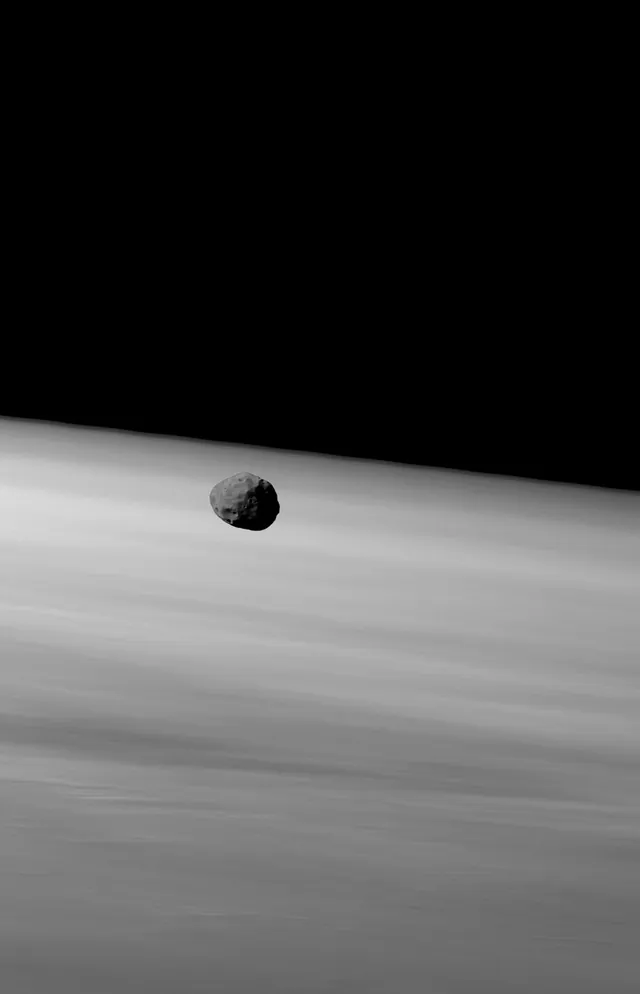
Phobos orbits 9,378 km from the centre of Mars, only about 6,000 km above the ground; no known moon orbits closer to its planet. It goes round in 7 hours 39 minutes, much faster than Mars turns, which takes about 24.6 hours. So from the surface Phobos usually rises in the west and sets in the east, twice a day, and from some places on Mars it cannot always be seen.1237
Being so close and so fast, Phobos raises tides on Mars that slowly drag it inward. NASA puts the rate at about 1.8 m per century and expects the moon to crash or break up into a ring within 50 million years; a 2015 NASA report gave about 2 m per century and 30 to 50 million years, and a 2021 study less than 39 million years.21516
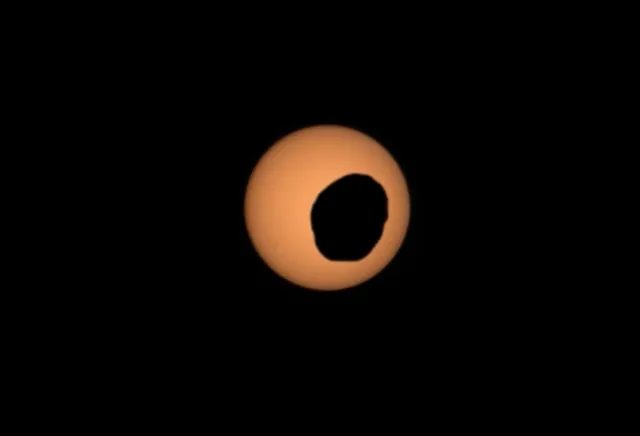
Like our Moon, Phobos is tidally locked: it turns once on its axis for each orbit, keeping the same face towards Mars. Rovers that film it crossing the Sun help to measure tiny shifts in its orbit, which in turn reveal how the interior of Mars flexes under the moon’s pull.2717
- Rotation
- Synchronous70.31891 days, equal to the orbit
Discovery and naming
Asaph Hall found both moons of Mars in August 1877, searching close to the planet with the 26-inch refractor of the US Naval Observatory in Washington. According to NASA he was about to give up when his wife, Angeline, urged him on. He spotted Deimos on 11 August and Phobos six nights later, on 17 August.121011
Sources tell the naming story slightly differently. NASA says Hall named the moons after the sons of Ares, the Greek counterpart of Mars, with Phobos meaning fear. The IAU’s gazetteer says the name belongs to one of the horses that drew the war god’s chariot, also called an attendant or son of Mars in Homer’s Iliad, and translates the Greek word as flight.1210
- Telescope
- 26-inch Alvan Clark refractor11
Craters and grooves
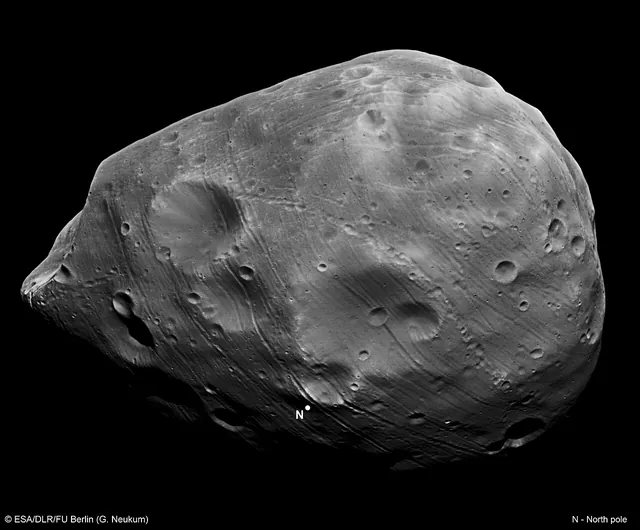
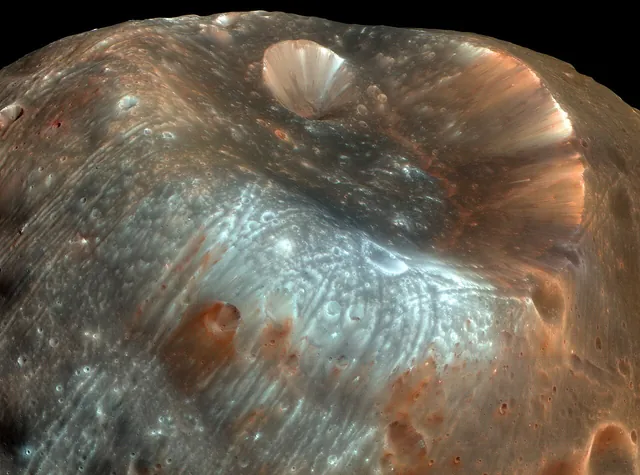
Phobos is battered by craters, and its surface has been pounded into fine powder by countless small impacts. The biggest scar, Stickney, is 9 km across, and NASA says the blow that made it nearly shattered the moon. Streaks on its walls are landslides that slid down in the feeble gravity, and fresh material near its rim looks bluer than the rest of Phobos in enhanced colour.11419
Long, shallow grooves and chains of pits wrap around the moon. They were once taken for cracks from the Stickney impact, but they do not radiate from the crater. One idea is that they were dug by debris thrown off Mars; another, from 2015 modelling, is that they are stretch marks from tides pulling on a weak, rubbly interior. Which is right is not settled.1415
Phobos has no atmosphere, and temperatures swing wildly between day and night. Measurements found highs of about −4 °C on the sunlit side and lows of about −112 °C on the dark side, only a few kilometres away. NASA suggests the fine surface dust is to blame, because it cannot retain heat.1
Composition and origin
Phobos is among the darker objects in the Solar System. NASA describes its surface as resembling C-type asteroids and blackish carbon-rich meteorites, perhaps mixed with ice. Infrared data tell a less tidy story: scientists with the Emirates Mars Mission say Phobos and Deimos look more like basaltic Mars rock than the D-type asteroids often used as their analogue.1212
Its origin is an open question. An asteroid captured whole would explain the look, but would be expected to follow a tilted, stretched orbit, not Phobos’s near-circular path over the equator. A giant impact on Mars could have thrown out a disc of debris that clumped into moons. Other proposals include an asteroid torn apart near Mars, or a single larger moon that broke up into Phobos and Deimos.4131620
Notable features
Stickney
The largest crater on Phobos, 9 km across in the IAU gazetteer, close to the moon’s equator. It carries the maiden name of Angeline Stickney Hall, wife of the discoverer, who encouraged his search. The impact that made it came close to shattering Phobos.1219
Hall
A crater 5.4 km across near the south pole of Phobos, named in 1973 after Asaph Hall, the American astronomer who discovered both Martian moons in 1877. Several other early craters honour astronomers, among them Roche, d’Arrest and Sharpless.19
Kepler Dorsum
A ridge in the southern hemisphere, given a size of 15 km in the IAU gazetteer, the only ridge named on Phobos. It is named after Johannes Kepler, the German astronomer, and its name was approved in 1987.19
Laputa Regio and Lagado Planitia
Laputa Regio, a region 14 km across, and Lagado Planitia, a plain 4 km across, were named in 2011 after the flying island and the city ruled from it in Jonathan Swift’s Gulliver’s Travels. Swift’s novel also supplies names for craters such as Gulliver, Flimnap and Limtoc.19
Gulliver
A crater 5.5 km across in the northern hemisphere, the largest named crater on Phobos after Stickney. It is named after Lemuel Gulliver, the surgeon and voyager of Swift’s novel, and was approved in 2006 along with a set of other Lilliputian names.19
Exploration
NASA’s Mariner 9, which reached Mars orbit on 14 November 1971, returned at least 80 photos of the two moons. The Soviet Union then sent Phobos 1 and 2 in July 1988. A faulty software upload lost Phobos 1 in September 1988. Phobos 2 studied Phobos from Mars orbit, but contact was lost in March 1989, shortly before it was to fly within 50 m of the surface and drop two landers.22122
Russia’s Phobos-Grunt, launched on 8 November 2011 to return about 100 cm³ of soil, never left Earth orbit and fell into the Pacific on 15 January 2012. Orbiters have kept watching: ESA’s Mars Express passed 67 km away in 2010 and 45 km in December 2013, and NASA’s rovers, from Spirit and Opportunity in 2004 to Curiosity and Perseverance, have filmed Phobos crossing the Sun.61723242526
Japan’s Martian Moons eXploration (MMX) lifted off on an H3 rocket from Tanegashima on 20 October 2026. After about a year’s cruise it is to enter a quasi-satellite orbit around Phobos, land twice to collect at least 10 g of surface material, observe Deimos, and return the sample capsule to Australia in 2031. A NASA instrument on board will map the elements Phobos is made of.45
- Phobos 1 and 2 launched
- 7 and 12 July 198822
- Contact with Phobos 2 lost
- 27 March 198922final attempt to reacquire the signal
- Closest Mars Express flyby
- 45 km629 December 2013
- Perseverance films a transit
- 2 April 202217a little over 40 seconds
- MMX launch
- 20 October 20265
- MMX sample return
- 20315capsule to be recovered in Australia
Quick answers
- How big is Phobos?
- Phobos has a mean radius of 11.08 km (the radius of a sphere of the same volume).8
- How far is Phobos from Mars?
- Phobos is 9,378 km from Mars (from the planet’s centre; about 6,000 km above the surface).27
- How long does Phobos take to complete one orbit?
- Phobos completes one orbit in 7 hours 39 minutes (0.31891 days).79
- How long is a day on Phobos?
- A day on Phobos lasts 7 hours 39 minutes (synchronous: one face always turned to Mars).27
- What is the temperature on Phobos?
- The temperature on Phobos is −112 °C to −4 °C (night-side low to day-side high).1
Sources
- Phobos — NASA Science
- Mars Moons: Facts — NASA Science
- NASA Orbiter Eyes Phobos Over Mars Horizon — NASA Jet Propulsion Laboratory, 2003
- Making Mars’ Moons: Supercomputers Offer ‘Disruptive’ New Explanation — NASA, 2024
- MMX – Martian Moons eXploration — JAXA, 2026
- Mars Express heading towards daring flyby of Phobos — European Space Agency, 2013
- Mars Fact Sheet — NASA Space Science Data Coordinated Archive, 2025
- Planetary Satellite Physical Parameters — NASA/JPL Solar System Dynamics
- Planetary Satellite Mean Elements — NASA/JPL Solar System Dynamics
- Planet and Satellite Names and Discoverers — IAU/USGS Gazetteer of Planetary Nomenclature
- Fear and Dread: The Moons of Mars (Astronomy Picture of the Day, 30 October 2020) — NASA, 2020
- Emirates Mars Mission unveils new Deimos observations at EGU23, announces mission extension — Emirates News Agency (WAM), 2023
- Martian Moons Have a Common Ancestor — University of Zurich, 2021
- Phobos from 6,800 Kilometers (Color) (PIA10368) — NASA Photojournal, 2008
- Mars’ Moon Phobos is Slowly Falling Apart — NASA, 2015
- Bagheri et al., Dynamical evidence for Phobos and Deimos as remnants of a disrupted common progenitor — Nature Astronomy, 2021
- NASA’s Perseverance Rover Captures Video of Solar Eclipse on Mars — NASA Jet Propulsion Laboratory, 2022
- Planetary Satellite Discovery Circumstances — NASA/JPL Solar System Dynamics
- Phobos: all approved feature names — IAU/USGS Gazetteer of Planetary Nomenclature
- Edwards et al., The First Observations of Deimos from the Emirates Mars Mission (EMM) Flybys, EGU23-9807 — EGU General Assembly 2023, 2023
- Mariner 9 — NASA Science
- Phobos Project Information — NASA Space Science Data Coordinated Archive, 2019
- Phobos-Soil mission summary — ESA Science & Technology
- Space debris experts confirm estimate for Phobos–Grunt reentry — European Space Agency, 2012
- Curiosity Observes Phobos Eclipse: Sol 2359 (PIA23133) — NASA Photojournal, 2019
- Perseverance Captures Another Phobos Transit (PIA26811) — NASA Photojournal, 2026
Figures checked against these sources in November 2026. Where a quantity is not known, it is left out rather than estimated.

