moon
Deimos
Deimos is the smaller and outer of Mars’s two moons, a dark, lumpy body about 15 km long that orbits roughly 23,500 km from the centre of the planet. It takes about 30 hours to go round, and like our Moon it keeps the same face turned towards Mars. A thick blanket of pulverised rock has filled in many of its craters, giving it a smooth, softened look.1234
Asaph Hall discovered it on 11 August 1877, six nights before he found Phobos. Unlike its doomed sibling, Deimos is very slowly drifting away from Mars. Where the two moons came from is still debated: they may be captured asteroids, or they may have formed from debris around Mars. In 2023 the UAE’s Hope orbiter swept within about 100 km of Deimos, the closest any spacecraft had come since 1977.13567
Size and shape
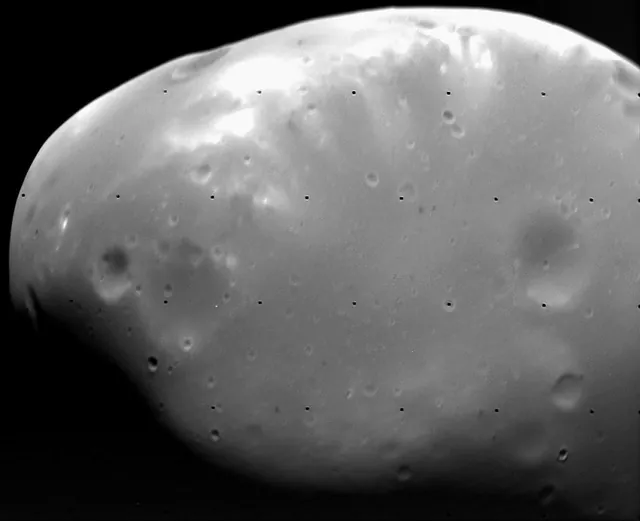
Deimos is one of the smallest moons in the Solar System. NASA gives its size as 15 by 12 by 11 km, less irregular than Phobos, and the radius of a sphere of the same volume is 6.2 km. The gravitational parameter in JPL’s current ephemeris corresponds to a mass of about 1.4 × 10¹⁵ kg, while NASA’s NSSDC fact sheet lists 2.4 × 10¹⁵ kg.1238
Its density, about 1.5 g/cm³ by JPL’s figures, is very low for rock, which suggests a porous body with many cavities inside. Deimos is also very dark, reflecting only about 8 per cent of the sunlight that strikes it, and HiRISE colour images show it as a reddish object much like Phobos.24811
Orbit and rotation
Deimos circles Mars at 23,459 km from the planet’s centre, about two and a half times as far out as Phobos, on an almost perfectly circular path close to the Martian equator. One orbit takes 1.26244 days, or 30 hours 18 minutes. Like Phobos and our own Moon, it is tidally locked, turning once for each orbit so that the same side always faces Mars.23411
Phobos lies inside the distance at which an orbit keeps pace with Mars’s spin, so tides drag it inward. Deimos sits just outside it, on the other side of this synchronous radius, and the tides it raises push it very slowly outward instead, much as our Moon is slowly receding from Earth.511
Discovery and naming
Asaph Hall found Deimos on 11 August 1877 with the 26-inch refractor of the US Naval Observatory in Washington. NASA tells how he was ready to abandon his search for a Martian moon when his wife, Angeline, urged him to keep going; he found Deimos the next night, and Phobos six nights after that.13910
NASA says Hall named the moons after the sons of Ares, the Greek counterpart of Mars, and that Deimos means dread. The IAU’s gazetteer instead describes Deimos as one of the horses that drew the war god’s chariot, also called an attendant or son of Mars in Homer’s Iliad, and translates the name as fear.139
- Telescope
- 26-inch Alvan Clark refractor10
A smooth, dusty surface
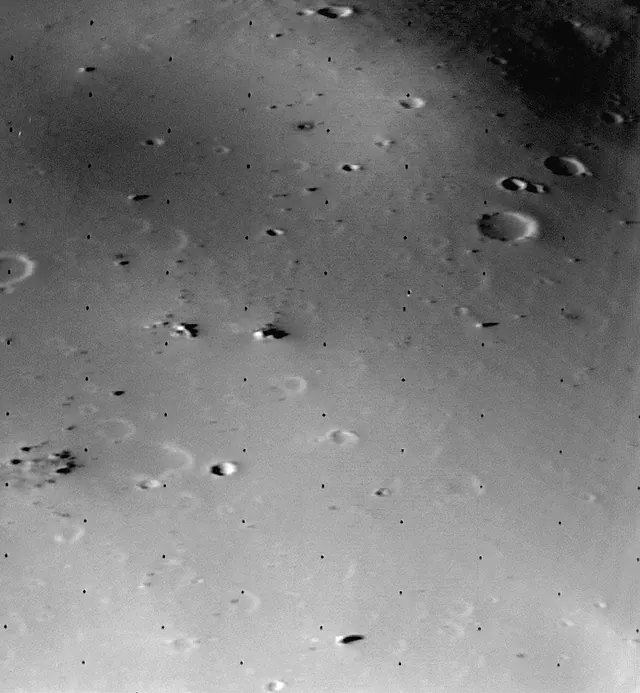
Deimos is heavily cratered, yet it looks smoother than Phobos. Its craters are mostly smaller than 2.5 km, the largest about 2.3 km, and it lacks Phobos’s grooves and ridges. A thick layer of regolith, rock pulverised by meteorite impacts, partly fills the craters; NASA suggests it may be up to 100 m deep, while the Viking team estimated about 50 m.114
Deimos is too small to hold on to the debris that impacts throw up. Instead the dust stays in orbit around Mars near Deimos’s own path and is swept up again as a dusty coating. Viking 2’s closest images show craters half buried and blocks 10 to 30 m across, and only the freshest craters stand out sharply.1414
Enhanced-colour HiRISE images reveal subtle variations: the smoothest areas are redder, while fresh craters and ridges look less red. Exposure to space slowly darkens and reddens the surface, so the brighter patches mark material uncovered recently by impacts or by loose regolith sliding downhill.4
Composition and origin
NASA describes Deimos as a dark body whose surface resembles the C-type asteroids of the outer asteroid belt. Infrared measurements by the Hope orbiter challenge this. Its scientists reported in 2023 that Deimos looks more like basaltic Mars rock than a D-type asteroid, which they took as a sign of a planetary origin rather than a captured one.17
No explanation for the two moons is yet agreed. Capture would fit their asteroid-like looks but not their near-circular, equatorial orbits. A giant impact on Mars could have made a debris disc, though such a disc mostly stays close to the planet, and Deimos is far out. Other ideas include a passing asteroid ripped apart by Mars, or a single larger moon that broke in two.561115
Named features
Voltaire
One of only two named features on Deimos: a crater 1.9 km across at 22° north, named in 1973 after the French writer François-Marie Arouet, who wrote as Voltaire. It is not the largest crater on the moon; NASA puts that at about 2.3 km.116
Swift
The other named crater on Deimos, 1 km across at 12.5° north, named in 1973 after the writer Jonathan Swift. Swift’s Gulliver’s Travels also supplies many of the names on Phobos, among them Laputa Regio and the crater Gulliver.1617
Exploration
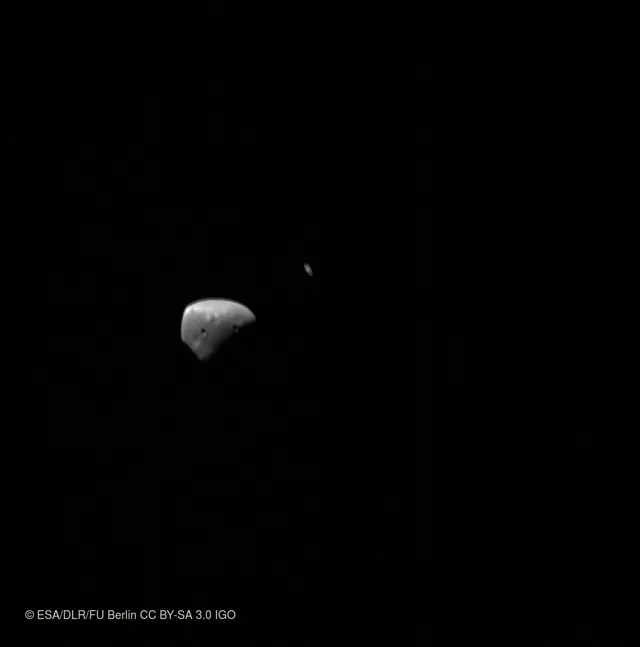
Deimos is harder to study than Phobos because it orbits beyond most spacecraft. NASA’s Mariner 9 photographed both moons from 1971, and in October 1977 Viking 2 passed only about 30 km from Deimos, taking pictures that show details as small as 3 m. NASA’s Mars Reconnaissance Orbiter imaged it in colour in February 2009.471418
The UAE’s Hope orbiter changed its path to make repeated close flybys, beginning in late January 2023. On 10 March 2023 it came within about 100 km, the nearest since Viking in 1977, and observed regions on the far side that had never been studied for their composition. Japan’s MMX, launched in October 2026, is to observe Deimos near the end of its mission.71920
Quick answers
- How big is Deimos?
- Deimos has a mean radius of 6.2 km (the radius of a sphere of the same volume).8
- How massive is Deimos?
- Deimos has a mass of 1.44 × 10¹⁵ kg (from JPL’s GM; NSSDC lists 2.4 × 10¹⁵ kg).28
- How far is Deimos from Mars?
- Deimos is 23,459 km from Mars (from the planet’s centre).2
- How long does Deimos take to complete one orbit?
- Deimos completes one orbit in 30 hours 18 minutes (1.26244 days).24
- How long is a day on Deimos?
- A day on Deimos lasts 30 hours 18 minutes (synchronous: one face always turned to Mars).23
Sources
- Deimos — NASA Science
- Mars Fact Sheet — NASA Space Science Data Coordinated Archive, 2025
- Mars Moons: Facts — NASA Science
- Deimos, Moon of Mars, in Color-Enhanced HiRISE Views (PIA11826) — NASA Photojournal, 2009
- Bagheri et al., Dynamical evidence for Phobos and Deimos as remnants of a disrupted common progenitor — Nature Astronomy, 2021
- Making Mars’ Moons: Supercomputers Offer ‘Disruptive’ New Explanation — NASA, 2024
- Emirates Mars Mission unveils new Deimos observations at EGU23, announces mission extension — Emirates News Agency (WAM), 2023
- Planetary Satellite Physical Parameters — NASA/JPL Solar System Dynamics
- Planet and Satellite Names and Discoverers — IAU/USGS Gazetteer of Planetary Nomenclature
- Fear and Dread: The Moons of Mars (Astronomy Picture of the Day, 30 October 2020) — NASA, 2020
- Martian Moons Have a Common Ancestor — University of Zurich, 2021
- Planetary Satellite Mean Elements — NASA/JPL Solar System Dynamics
- Planetary Satellite Discovery Circumstances — NASA/JPL Solar System Dynamics
- Deimos – Viking 2 Orbiter: high-resolution view from 30 km (423B63) — NASA Space Science Data Coordinated Archive
- Edwards et al., The First Observations of Deimos from the Emirates Mars Mission (EMM) Flybys, EGU23-9807 — EGU General Assembly 2023, 2023
- Deimos: all approved feature names — IAU/USGS Gazetteer of Planetary Nomenclature
- Phobos: all approved feature names — IAU/USGS Gazetteer of Planetary Nomenclature
- Mariner 9 — NASA Science
- Deimos flyby — The Planetary Society, 2023
- MMX – Martian Moons eXploration — JAXA, 2026
Figures checked against these sources in November 2026. Where a quantity is not known, it is left out rather than estimated.

