galaxy
Sculptor Galaxy (NGC 253)
The Sculptor Galaxy, NGC 253, is a large spiral seen almost edge-on in the southern constellation Sculptor, about 11 million light-years away. It is the brightest member of the Sculptor Group, one of the closest groups of galaxies to our own Local Group, and one of the brightest galaxies beyond it: good binoculars show it as an elongated haze. Caroline Herschel discovered it in 1783 while hunting for comets.12345
NGC 253 is a starburst galaxy, forming stars at an exceptional rate in a dusty region around its centre. ALMA has caught the resulting wind carrying cold gas out of the galaxy at up to almost a million kilometres per hour, perhaps faster than the gas is being turned into stars. The starburst also makes it one of only two such galaxies seen to shine in gamma rays from hundreds of MeV to several TeV.25678
Shape and size
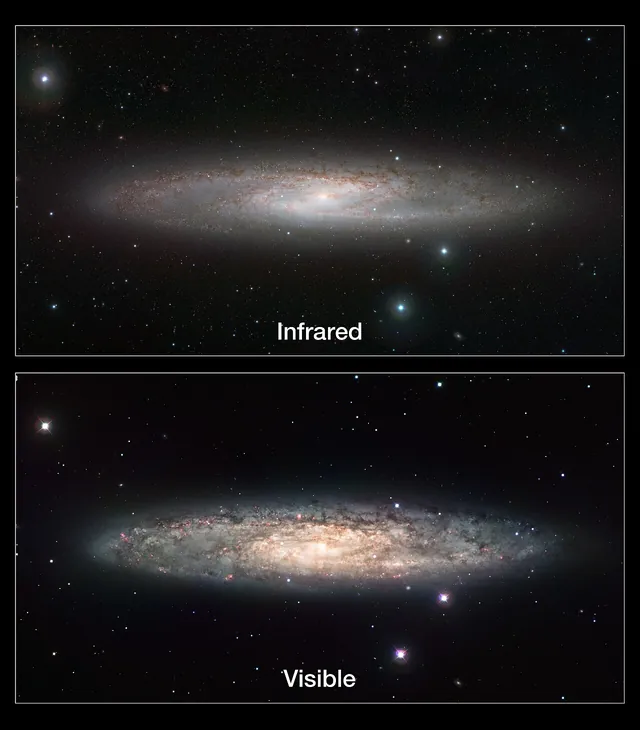
NGC 253 is a spiral galaxy tilted almost edge-on to us, so its disc appears as a long silvery oval, the look behind its nickname the Silver Coin. Its spiral arms show clearly in the outer parts, around a bright core. In visible light thick dust hides much of the disc; infrared images from ESO’s VISTA telescope see through it and reveal a prominent bar of stars across the centre.259
Its distance is still quoted in several ways. A 2021 study adopted 3.70 Mpc, about 12 million light-years, and two of its dwarf companions measure 3.62 and 3.66 Mpc by the red giant method. ESO’s 2025 study, which checked the distance with planetary nebulae, uses 11 million; ESO in 2013 gave 11.5 million, and NASA’s Caldwell page quotes both 10 and 13 million.125610
NGC 253 is the brightest member of the Sculptor Group, a gathering of galaxies near the south galactic pole that is one of the closest groups to our own. The motions of seven small companion galaxies give it a total mass of about 810 billion Suns. It is one of five large nearby spirals whose rotation slows towards the edge; together they carry only about a fifth as much mass per unit of light as the Milky Way or the Andromeda Galaxy.2310
- Distance adopted in 2021
- 3.70 Mpc (about 12 million light-years)10
- Distance used by ESO in 2025
- 11 million light-years1
- Morphological type
- SAB(s)c9a weakly barred spiral
- Total mass
- (8.1 ± 2.6) × 10¹¹ solar masses10
- Mass-to-light ratio
- 8.5 ± 2.7 solar units10total mass per unit of near-infrared K-band light
- Recession velocity
- 259 km/s9
A starburst galaxy
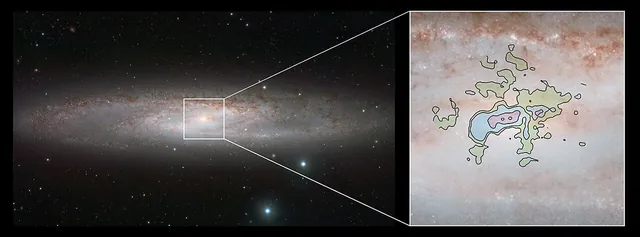
Hubble’s visible and infrared images show that the dust in NGC 253 goes hand in hand with frantic star formation, earning it the title of starburst galaxy: one that is using up its gas in a relatively short time. The burst began about 30 million years ago. It is one of the closest starburst galaxies, which makes it an ideal laboratory for studying how such outbursts affect a galaxy.5612
At the very centre, ALMA images with 2-parsec resolution reveal about fourteen bright, compact knots of dust only 2 to 3 parsecs across. Most are probably super star clusters still forming inside their natal clouds, invisible even in Hubble’s near-infrared images. The team argues that this hidden phase lasts about a million years and produces a large fraction of the starburst’s stars.13
The starburst drives a powerful wind. In 2013 ALMA traced cold, dense molecular gas streaming out alongside hot ionised gas, at between 150,000 and almost 1,000,000 kilometres per hour. The outflow carries at least 3 and probably about 9 solar masses of gas a year, more than is turned into stars, and at that rate the galaxy could run out of gas in as little as 60 million years.67
Notable features
The superwind
A stream of energetic material pouring out of the galaxy’s centre, driven by the starburst. ALMA found columns of cold, dense gas tracing an arc almost perfectly aligned with the edges of the hot, ionised outflow seen earlier, showing gas being kicked out by young stars and swept into the halo.612
The central bar
A prominent bar of stars crosses the nuclear region but is hidden in visible light by thick dust. It was revealed by VISTA’s infrared images in 2010, which also show the spiral arms spreading over the whole disc and huge numbers of cool red stars.2
Planetary nebulae
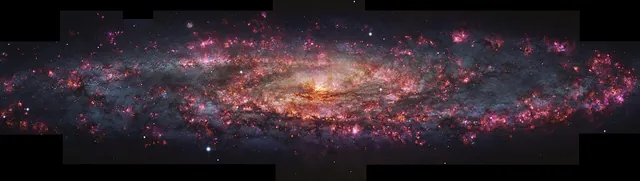
ESO’s 2025 MUSE map found around 500 planetary nebulae, the glowing shells cast off by dying Sun-like stars, where most galaxies beyond our neighbourhood yield fewer than 100. Because their brightness is predictable, they serve as a check on the galaxy’s distance.1
Supernova 1940E
As of the SEDS catalogue’s 1998 entry, the only supernova discovered in NGC 253. Fritz Zwicky found it 51″ west and 21″ south of the nucleus, and it brightened to magnitude 14.0, as announced in IAU Circular 848.3
Discovery
Caroline Herschel, sister of William Herschel, discovered NGC 253 on 23 September 1783 while hunting for comets. She used a small Newtonian sweeper with a focal length of 27 inches and a magnification of 30. It was one of her major discoveries, and William entered it in his own catalogue as H V.1.35
Seeing it for yourself
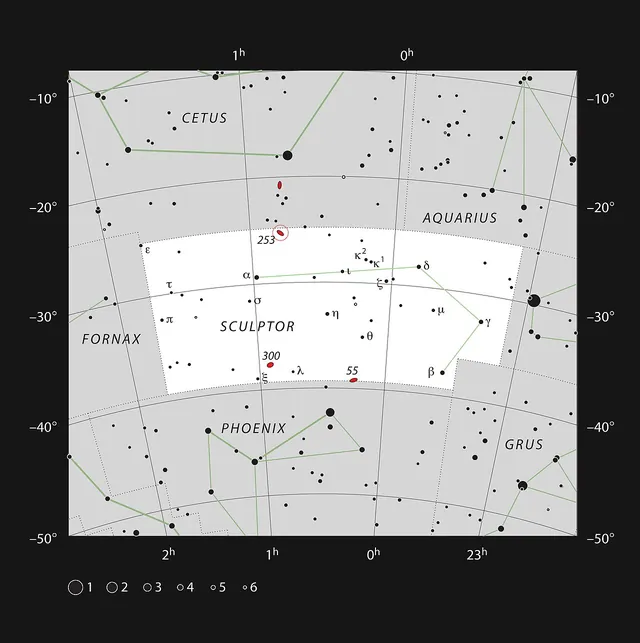
NGC 253 lies in Sculptor, near its border with Cetus. At about magnitude 7 it is bright enough to be seen through good binoculars from a dark site as an elongated haze, and it is quite a sight even in small telescopes. It is best seen in spring from the Southern Hemisphere; from the Northern Hemisphere it sits low in the southern sky in autumn.24511
Telescopes on the Sculptor Galaxy
ESO’s VISTA telescope made NGC 253 the subject of one of its first mini-surveys, released in 2010, to study red giants in its halo, its dwarf satellites and possible new globular clusters. Hubble studied it in the ACS Nearby Galaxy Survey Treasury programme, and in 2025 ESO’s MUSE instrument spent over 50 hours building a map of an area about 65,000 light-years wide in thousands of colours.125
NGC 253 also shines at the highest energies. In 2009 the H.E.S.S. telescopes detected gamma rays above 220 GeV, implying a density of cosmic rays about a thousand times that at the centre of the Milky Way, and the Fermi space telescope then detected it above 200 MeV. Supernova remnants in the starburst are thought to accelerate the cosmic rays.81415
- VISTA infrared image released
- 16 June 20102
- ALMA outflow study published
- 25 July 2013, in Nature6using 16 ALMA antennas
- MUSE mosaic
- over 50 hours, more than 100 exposures1released 18 June 2025
- Very-high-energy gamma rays
- detected above 220 GeV by H.E.S.S.14
- High-energy gamma rays
- detected above 200 MeV by Fermi15
Quick answers
- What kind of object is the Sculptor Galaxy (NGC 253)?
- The Sculptor Galaxy (NGC 253) is a starburst barred spiral galaxy (SAB(s)c).259
- Which constellation is the Sculptor Galaxy (NGC 253) in?
- The Sculptor Galaxy (NGC 253) lies in the constellation Sculptor.25
- How far away is the Sculptor Galaxy (NGC 253)?
- The Sculptor Galaxy (NGC 253) is about 11 million light-years from Earth (3.70 Mpc adopted in a 2021 study; published figures range from 10 to 13 million light-years).12510
- How bright is the Sculptor Galaxy (NGC 253) in the night sky?
- The Sculptor Galaxy (NGC 253) has an apparent magnitude of 7.3 (visual; other catalogues give 7.1 to 7.6).3511
- How big does the Sculptor Galaxy (NGC 253) look in the sky?
- The Sculptor Galaxy (NGC 253) covers 29′ × 6.8′ of sky.11
- How massive is the Sculptor Galaxy (NGC 253)?
- The Sculptor Galaxy (NGC 253) has a mass of (8.1 ± 2.6) × 10¹¹ solar masses (total, from the motions of its satellite galaxies).10
Sources
- Astronomers capture most detailed thousand-colour image of a galaxy (eso2510) — European Southern Observatory, 2025
- VISTA Views the Sculptor Galaxy (eso1025) — European Southern Observatory, 2010
- Spiral Galaxy NGC 253 (H. Frommert & C. Kronberg) — SEDS Messier Database (Observatoire de Paris mirror), 1998
- The galaxy NGC 253 in the constellation of Sculptor (eso1152b) — European Southern Observatory, 2011
- Caldwell 65 (the Sculptor Galaxy) — NASA Science, Hubble’s Caldwell Catalog
- Starburst to Star Bust: ALMA Sheds Light on Mystery of Missing Massive Galaxies (eso1334) — European Southern Observatory, 2013
- The Starburst-Driven Molecular Wind in NGC 253 and the Suppression of Star Formation (Bolatto et al.) — Nature 499, 450 (arXiv:1307.6259), 2013
- The starburst galaxy NGC 253 revisited by H.E.S.S. and Fermi-LAT (H.E.S.S. Collaboration) — Astronomy & Astrophysics 617, A73 (arXiv:1806.03866), 2018
- SIMBAD astronomical database: NGC 253 — Centre de Données astronomiques de Strasbourg (CDS)
- Distance and mass of the NGC 253 galaxy group (Karachentsev et al.) — Astronomical Journal 161, 205 (arXiv:2102.11354), 2021
- Revised NGC Data for NGC 253 (from W. Steinicke’s Revised NGC and IC Catalog) — SEDS Interactive NGC Catalog
- Starbursting sculptor galaxy (potw1017a) — European Southern Observatory, 2010
- Forming Super Star Clusters in the Central Starburst of NGC 253 (Leroy et al.) — Astrophysical Journal 869, 126 (arXiv:1804.02083), 2018
- Detection of Gamma Rays From a Starburst Galaxy (H.E.S.S. Collaboration) — Science 326, 1080 (arXiv:0909.4651), 2009
- Detection of Gamma-Ray Emission from the Starburst Galaxies M82 and NGC 253 with the Large Area Telescope on Fermi (Fermi LAT Collaboration) — Astrophysical Journal Letters 709, L152 (arXiv:0911.5327), 2010
Figures checked against these sources in November 2026. Where a quantity is not known, it is left out rather than estimated.

