galaxy
Black Eye Galaxy (M64)
The Black Eye Galaxy, Messier 64, is a spiral galaxy in Coma Berenices about 17 million light-years away. Its nickname comes from a dark band of dust that sweeps across one side of its bright nucleus, like a bruise beneath an eye. William Herschel made the comparison in the 1780s, and the dust band shows even in small telescopes.123
Beneath the dust lies something stranger. Gas in the galaxy’s outer regions turns in the opposite direction to the gas and stars of its inner disc, and new stars are forming where the two meet. Astronomers have long suspected that the outer gas arrived when M64 swallowed a smaller galaxy, and in 2023 deep images revealed a faint shell of stars left by just such a merger.1234
Shape and size
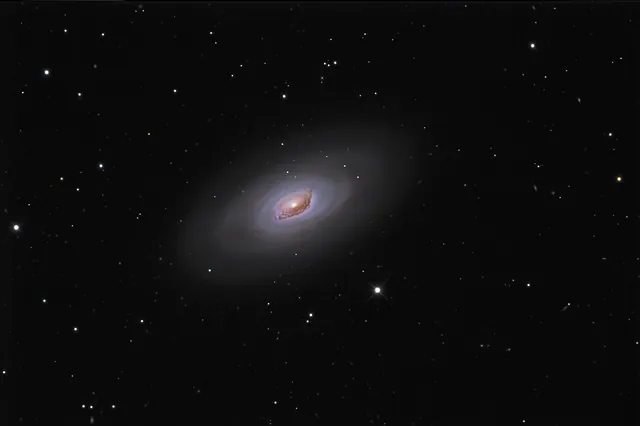
M64 is a spiral with a large bright core, classed by Allan Sandage simply as Sb and by Gérard de Vaucouleurs as (R)SA(rs)ab. Its distance is poorly known. NASA and ESA quote 17 million light-years, while recent research papers have adopted 4.4 megaparsecs (about 14 million light-years) and 7.27 megaparsecs (about 24 million). At 19 million light-years its 9.3′ length would span about 51,000 light-years.12346
The galaxy holds two discs that turn in opposite directions. An inner disc about 3,000 light-years in radius rubs along the inner edge of an outer disc that extends to at least 40,000 light-years. The outer gas, roughly 500 million solar masses of it, counter-rotates relative to the inner gas disc and to the bulk of the stars. That is comparable to all the gas in the Small Magellanic Cloud.134
A 2024 study split the galaxy’s light into parts: a classical bulge and a flatter pseudobulge of roughly equal mass, each giving about an eighth of the light, and an outer disc giving three quarters. M64 has few close neighbours. It forms a small group with the irregular galaxy UGC 8024, and has also been counted in the Canes Venatici I cloud with M94.36
- Morphological type
- (R)SA(rs)ab3de Vaucouleurs; Sandage: Sb
- Inner disc
- about 3,000 light-years in radius3
- Outer, counter-rotating disc
- extends to at least 40,000 light-years3
- Mass of counter-rotating gas
- about 5 × 10⁸ solar masses4
- Share of light
- outer disc 75%; pseudobulge about 13%; classical bulge about 12%6
- Total stellar mass
- about 2.8 × 10¹⁰ solar masses4value adopted in the 2023 halo study
- Absolute magnitude
- −21.07 (V band)6at an assumed distance of 7.27 Mpc
What makes it shine
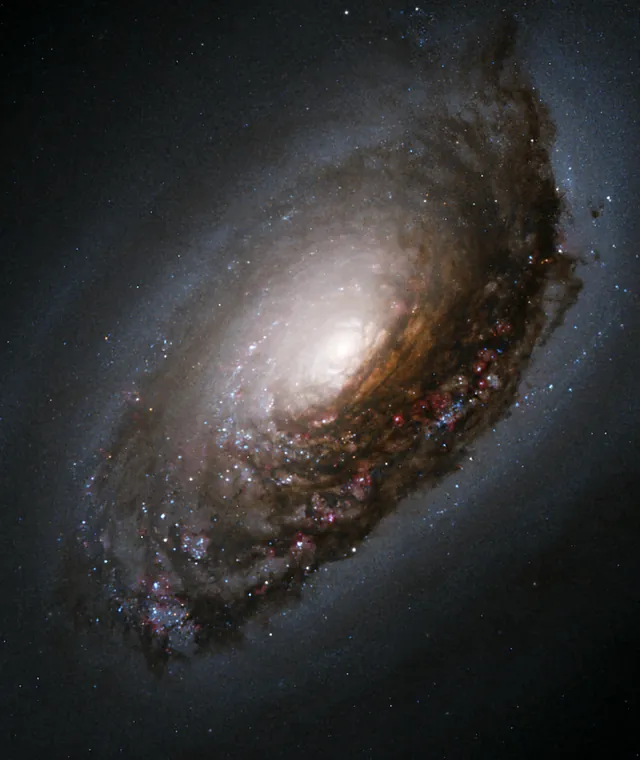
Most of M64’s light comes from its stars, but its most striking glow comes from where the two discs meet. There the colliding gas is compressed and forms new stars. Hubble shows them as hot blue stars and pink clouds of hydrogen that fluoresce in their ultraviolet light, scattered through the dust band on one side of the nucleus.123
The inner galaxy is unusually rich in molecular gas, the raw material of stars. Radio maps resolved 25 giant molecular clouds there, with mean surface densities at least 2.5 times those of clouds in the Local Group, and found them forming stars. The nucleus is mildly active, with weak emission lines of the Seyfert 2 type, and the galaxy is also a radio source, PKS 1254+21.357
The stars inside
Hubble photometry of M64’s outer disc separates two populations of red giant stars: a metal-rich disc population and a metal-poor halo. In 2020 the same images revealed M64’s first known globular cluster, M64-GC1, about 7 kiloparsecs east of the centre. Its stars match 12-billion-year-old models with about a thirtieth of the Sun’s iron abundance, marking it as a member of the halo.8
Subaru Telescope images of the wider halo found a shell of stars about 45 kiloparsecs to the south-east and a fainter plume reaching beyond 100 kiloparsecs to the north-west. Together with accreted stars nearer the centre they add up to about 500 million solar masses: the remains of a satellite much like the Small Magellanic Cloud, about a fiftieth of M64’s own stellar mass.4
- First globular cluster found
- M64-GC1 (2020)8about 7 kpc from the centre
- Age of M64-GC1
- about 12 billion years8[Fe/H] = −1.5 ± 0.2
- Southern shell
- 1.80 ± 0.54 × 10⁸ solar masses, about 45 kpc away4
- Northern plume
- 1.42 ± 0.71 × 10⁸ solar masses, beyond 100 kpc4
- Swallowed satellite
- about 5 × 10⁸ solar masses of stars4a merger ratio of about 52:1
- Central black hole
- 8.4 (+1.7, −0.6) million solar masses6
Notable features
The black eye
A band of dark dust lies in front of the bright core, to the south-south-west of the nucleus, and obscures the stars behind it. It also shows which side of the galaxy is nearer: the southern side appears closer to us. Blue knots of young stars are embedded in it.23
Two discs turning opposite ways
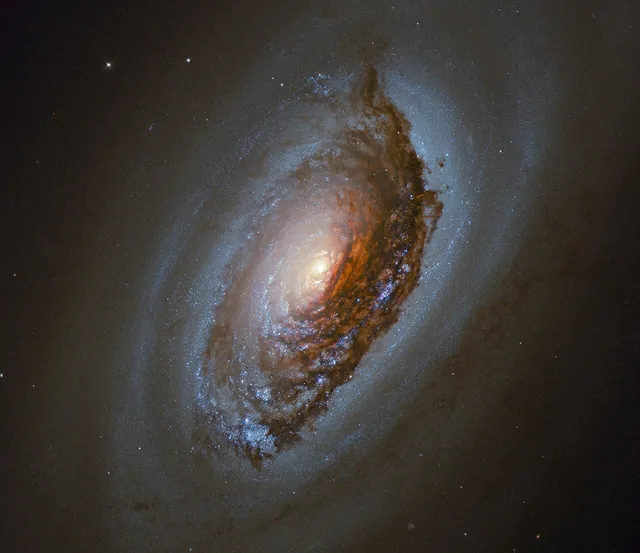
The gas in M64’s outer regions rotates in the opposite direction to the gas and stars of its inner regions. Where the two discs collide the gas is compressed and new stars form, which is thought to be why the dust band is so prominent.124
Shell and plume of a swallowed galaxy
Faint streams of red giant stars around M64 trace a satellite galaxy torn apart on a plunging orbit. Its last close pass was probably less than a billion years ago. Its study’s authors argue that it brought the counter-rotating gas, rather than a passing dwarf galaxy, Coma P.4
A small central black hole
Stellar motions measured with Hubble give the central black hole a mass of about 8.4 million Suns, one of the smallest found by modelling stellar dynamics. The authors note that, at the three-sigma level, their models remain marginally consistent with no black hole at all.6
Discovery and history
Edward Pigott discovered M64 on 23 March 1779, just 12 days before Johann Elert Bode found it independently on 4 April. Charles Messier came upon it on 1 March 1780 and catalogued it. Bode published in 1779 and Messier in 1780, but Pigott’s report was only read to the Royal Society in January 1781, and his priority was rediscovered by Bryn Jones in 2002.13
William Herschel, who observed M64 in 1785 and 1789, first described its dark dust feature and compared it to a black eye. The counter-rotating outer disc of hydrogen gas was reported much later, in 1992, and where it came from has been debated ever since.34
Seeing it for yourself
M64 lies in Coma Berenices, about three quarters of a degree east-north-east of the fifth-magnitude double star 35 Comae Berenices. Good binoculars show it as a bright oval with a large core. The dark dust band, south-south-west of the nucleus, can be glimpsed in telescopes from about 10 cm (4 inches) aperture and is clearly seen in 15 cm (6-inch) instruments.3
NASA’s Hubble observing guide names May as the best month to look for the Black Eye Galaxy. Catalogues disagree on its brightness: the SEDS catalogue gives a visual magnitude of 8.5, while NASA quotes 9.8 and recommends a moderately sized telescope and a dark site.13
Telescopes on M64
The Hubble Heritage Team released a celebrated view of M64’s core on 5 February 2004, taken with the Wide Field Planetary Camera 2 through four filters. Hubble returned for the PHANGS-HST survey of nearby star-forming galaxies, and ESA/Hubble published that view on 22 February 2021. Hubble spectroscopy and infrared photometry were later used to weigh the central black hole.269
On 20 March 2026 NASA released a new Hubble image combining ultraviolet, visible and near-infrared light, alongside a composite with near- and mid-infrared data from the James Webb Space Telescope, both made to study star formation. From the ground, Subaru’s Hyper Suprime-Cam surveyed the halo in 2019, reaching about 115 kiloparsecs from the galaxy.14
Quick answers
- What kind of object is the Black Eye Galaxy (M64)?
- The Black Eye Galaxy (M64) is a spiral galaxy, type (R)SA(rs)ab (SIMBAD lists it as SABa).35
- Which constellation is the Black Eye Galaxy (M64) in?
- The Black Eye Galaxy (M64) lies in the constellation Coma Berenices.13
- How far away is the Black Eye Galaxy (M64)?
- The Black Eye Galaxy (M64) is about 17 million light-years from Earth (published estimates range from about 14 to 24 million light-years).1246
- How big is the Black Eye Galaxy (M64)?
- The Black Eye Galaxy (M64) is about 51,000 light-years across (from its 9.3′ length at an adopted 19 million light-years).3
- How bright is the Black Eye Galaxy (M64) in the night sky?
- The Black Eye Galaxy (M64) has an apparent magnitude of 8.5 (visual; NASA quotes 9.8).135
- How big does the Black Eye Galaxy (M64) look in the sky?
- The Black Eye Galaxy (M64) covers 9.3′ × 5.4′ of sky.3
- When was the Black Eye Galaxy (M64) discovered?
- The Black Eye Galaxy (M64) was discovered on 23 March 1779, by Edward Pigott.3
Sources
- Messier 64 (The Black Eye Galaxy) — NASA Science, Hubble’s Messier Catalog
- Eye in the Sky (potw2108a) — ESA/Hubble, 2021
- Messier 64 (H. Frommert & C. Kronberg) — SEDS Messier Database (Observatoire de Paris mirror), 2007
- Origins of the Evil Eye: M64’s Stellar Halo Reveals the Recent Accretion of an SMC-mass Satellite (Smercina et al.) — Astrophysical Journal Letters (arXiv:2305.17135), 2023
- SIMBAD astronomical database: M 64 — Centre de Données astronomiques de Strasbourg (CDS)
- The Black Hole Mass and Photometric Components of NGC 4826 (Gültekin et al.) — Astrophysical Journal, accepted (arXiv:2409.11575), 2024
- Giant Molecular Clouds in M64 (Rosolowsky & Blitz) — Astrophysical Journal 623, 826 (arXiv:astro-ph/0501387), 2005
- A New Metal-poor Globular Cluster and Resolved Stars in the Outer Disk of the Black Eye Galaxy M64 (Kang et al.) — Astrophysical Journal (arXiv:2005.09633), 2020
- An Abrasive Collision Gives One Galaxy a “Black Eye” — NASA Science (Hubble news release), 2004
Figures checked against these sources in November 2026. Where a quantity is not known, it is left out rather than estimated.

