galaxy
M77 (Cetus A)
Messier 77 is a large barred spiral galaxy in Cetus, about 47 million light-years away, and one of the most studied galaxies in the sky. At its heart is one of the nearest and brightest active nuclei of the kind called Seyfert galaxies: a supermassive black hole swallowing gas and dust, which makes the tiny central region shine as brightly as tens of thousands of ordinary galaxies.123
Yet from Earth the black hole itself is hidden. A thick ring of dust and gas around it blocks our direct view, just as the unified model of active galaxies predicts for galaxies seen from the side. ESO’s Very Large Telescope Interferometer and the ALMA radio telescope have now imaged that dusty ring, and in 2022 the IceCube detector found evidence of neutrinos streaming from M77’s core.1456
Shape and size
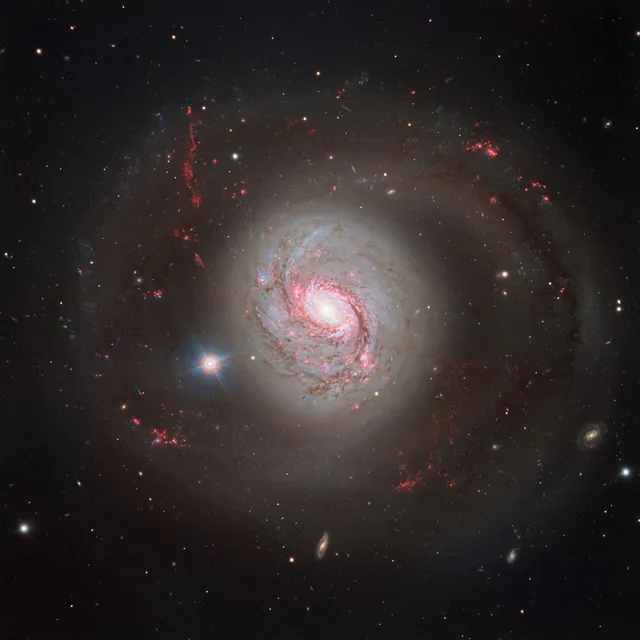
M77 is a barred spiral with loosely wound arms and a relatively small central bulge, seen nearly face-on. At about 100,000 light-years across it is one of the largest galaxies in the Messier catalogue, and its gravity warps nearby galaxies. Its broad inner arms hold a young stellar population, while farther out a smoother, yellowish older population dominates.237
Its distance is uncertain. ESO quotes 47 million light-years, ESA and NASA 45 million, and the SEDS catalogue about 60 million. A 2026 study of Cepheid variable stars in Hubble images found 10.72 megaparsecs, about 35 million light-years. M77 dominates a small group of galaxies that includes NGC 1055 and NGC 1073.1237910
Measurements of the inner disc’s rotation in 1959 showed it tilted by 51° to our line of sight and gave it a mass of 27 billion Suns; the whole galaxy is thought to have a mass of about a trillion. Halton Arp included it in his atlas of peculiar galaxies as number 37, a spiral with a low-surface-brightness companion on one arm.3
What makes it shine
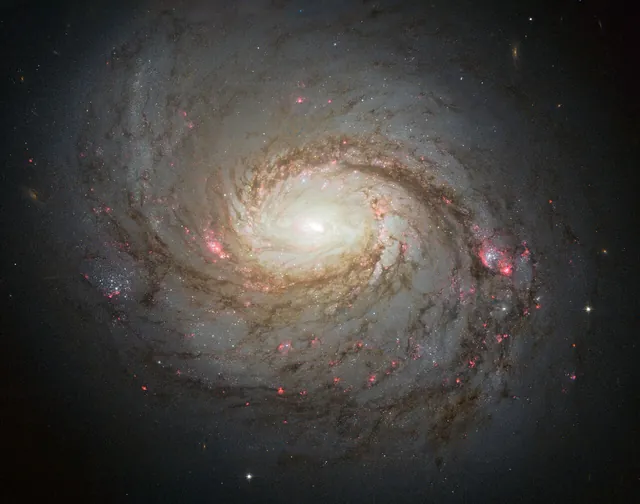
M77’s arms glow with knotty red clumps of newborn stars, whose light ionises the surrounding gas, while dust lanes appear reddened. Ultraviolet images show intense star formation in an inner bar, in regions among the brightest of their kind known. Red, thread-like filaments of gas surround the galaxy, picked out in ESO’s image.237
The nucleus is far brighter still. Gas spiralling into a black hole of about 15 million solar masses heats up and radiates, and this small region can be tens of thousands of times brighter than a typical galaxy. Active galaxies like M77 shine at nearly every wavelength from gamma rays to radio waves; as a Type 2 Seyfert it is particularly bright in the infrared.279
Its spectrum shows broad emission lines from gas clouds moving out of the core at several hundred kilometres per second. The core is also a strong radio source, discovered by Bernard Mills in 1952 and named Cetus A. In ultraviolet light Hubble has seen brightness changes in the core, implying an enormous energy source hidden there.39
Notable features
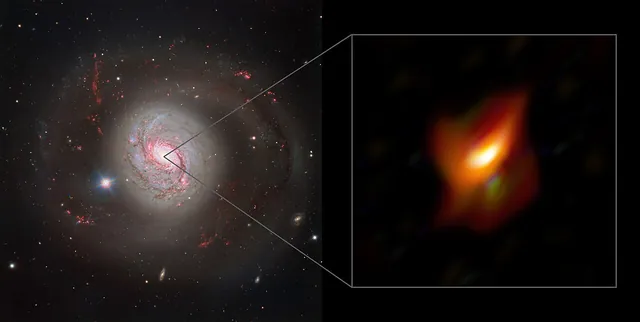
The dusty torus
ALMA has imaged a disc of dust and molecular gas 7–10 parsecs across around the black hole, the submillimetre counterpart of the long-predicted torus. Fits give it a radius of about 3.5 parsecs and some 100,000 solar masses of gas, with turbulent, non-circular motions.5
Hot dust ring
Near-infrared interferometry with the GRAVITY instrument reconstructed a thin ring of hot dust about 0.24 parsecs in radius, where the black hole’s radiation evaporates dust. Mid-infrared MATISSE images then showed the black hole lies below this ring, hidden by a thick, nearly edge-on disc.411
Molecular outflow
ALMA also detected carbon monoxide moving at up to 400 km/s in a bipolar flow almost perpendicular to the nuclear disc. Its discoverers saw this as compelling evidence for the idea that the obscuring torus is a wind blowing off a disc.12
Water maser disc
Radio astronomers of the National Radio Astronomy Observatory, working with the 100-metre Effelsberg radio telescope in Germany, found a giant disc about 5 light-years across orbiting the central object and containing water molecules. The discovery was announced in January 2000.3
Neutrino source
Using data recorded between 2011 and 2020, the IceCube neutrino observatory found an excess of about 79 high-energy neutrinos from the direction of M77, at a significance of 4.2 sigma. This was interpreted as direct evidence of TeV neutrinos from a nearby active galaxy.6
Discovery and history
Pierre Méchain discovered M77 on 29 October 1780 and described it as a nebula. Charles Messier catalogued it on 17 December 1780 but mistook it for a star cluster with nebulosity. Lord Rosse later counted it among 14 spiral nebulae discovered by 1850. More than a century passed before such spirals were understood to be separate galaxies.239
In 1908 Edward Fath at Lick Observatory found bright emission lines in its spectrum. In 1914 Vesto Slipher measured its recession at about 1,100 km/s, the second large galaxy redshift after the Sombrero Galaxy. In 1943 Carl Seyfert described a class of spirals with such bright nuclei, and M77 became the nearest and brightest example.3
Seeing it for yourself
M77 is easy to find 0.7° east-south-east of the fourth-magnitude star Delta Ceti, and it shows in a small telescope. Its bright central 2′ dominates the view, revealing more detail at high magnification in larger instruments. NASA’s observing guide names December as the best month. Nearby lie the edge-on galaxy NGC 1055, about half a degree to the north-north-west, and NGC 1073.39
Telescopes on M77
Hubble has imaged M77 since 1990, before and after its first servicing mission, in visible, infrared and ultraviolet light. On 19 June 2003 ESO announced that the VLT Interferometer’s MIDI instrument had resolved structures in the dusty torus about 10 light-years across, the first infrared interferometric detection of an object beyond our Galaxy. GRAVITY later reached a resolution of 0.2 parsecs.391113
In 2016 ALMA resolved the molecular torus at a resolution of about 4 parsecs. In results published in February 2022, the MATISSE instrument, combining light from all four 8.2-metre VLT telescopes, mapped dust temperatures from about room temperature to about 1,200 °C, locating the black hole inside a thick ring of dust as the unified model predicts.145
Quick answers
- What kind of object is M77 (Cetus A)?
- M77 (Cetus A) is a barred spiral galaxy with a Seyfert 2 nucleus (SIMBAD lists the disc as SAb).278
- How far away is M77 (Cetus A)?
- M77 (Cetus A) is about 47 million light-years from Earth (published values range from about 35 to 60 million light-years).137910
- How big is M77 (Cetus A)?
- M77 (Cetus A) is about 100,000 light-years across.7
- How bright is M77 (Cetus A) in the night sky?
- M77 (Cetus A) has an apparent magnitude of 8.9 (visual; NASA quotes 9.6).389
- How big does M77 (Cetus A) look in the sky?
- M77 (Cetus A) covers 7′ × 6′ of sky.3
- When was M77 (Cetus A) discovered?
- M77 (Cetus A) was discovered on 29 October 1780, by Pierre Méchain.3
Sources
- Supermassive black hole caught hiding in a ring of cosmic dust (eso2203) — European Southern Observatory, 2022
- Hubble observes the hidden depths of Messier 77 (heic1305) — ESA/Hubble, 2013
- Messier 77 (H. Frommert & C. Kronberg) — SEDS Messier Database (Observatoire de Paris mirror), 2007
- Thermal imaging of dust hiding the black hole in the Active Galaxy NGC 1068 (Gámez Rosas et al.) — Nature (arXiv:2112.13694), 2022
- ALMA resolves the torus of NGC 1068: continuum and molecular line emission (García-Burillo et al.) — Astrophysical Journal Letters 823, L12 (arXiv:1604.00205), 2016
- Evidence for neutrino emission from the nearby active galaxy NGC 1068 (IceCube Collaboration) — Science 378, 538 (arXiv:2211.09972), 2022
- Dazzling galaxy Messier 77 (eso1720) — European Southern Observatory, 2017
- SIMBAD astronomical database: M 77 — Centre de Données astronomiques de Strasbourg (CDS)
- Messier 77 — NASA Science, Hubble’s Messier Catalog
- Cepheid-based Distances to NGC 4303 and NGC 1068 (Markham et al.) — Astrophysical Journal, accepted (arXiv:2602.22407), 2026
- An image of the dust sublimation region in the nucleus of NGC 1068 (GRAVITY Collaboration) — Astronomy & Astrophysics 634, A1 (arXiv:1912.01361), 2020
- High-Velocity Bipolar Molecular Emission from an AGN Torus (Gallimore et al.) — Astrophysical Journal Letters 829, L7 (arXiv:1608.02210), 2016
- A First Look at the Doughnut Around a Giant Black Hole (eso0319) — European Southern Observatory, 2003
Figures checked against these sources in November 2026. Where a quantity is not known, it is left out rather than estimated.

