galaxy
Phantom Galaxy (M74)
Messier 74, nicknamed the Phantom Galaxy, is one of the finest examples of a grand-design spiral: a galaxy with two clean, symmetrical arms winding out from a small bright core. It lies about 32 million light-years away in Pisces and faces us almost exactly face-on, so its whole spiral pattern is laid out to view. Its faint glow makes it one of the hardest Messier objects to see.1234
Astronomers return to M74 again and again to study how spiral arms make stars. Its arms are strung with pink clouds of glowing hydrogen and clusters of young blue stars, and in 2022 the James Webb Space Telescope revealed a web of fine dust filaments threading through them. Three supernovae have exploded in M74 since 2002, and a fourth outburst, in 2019, is thought to have been a supernova impostor rather than a true supernova.14567
Shape and size
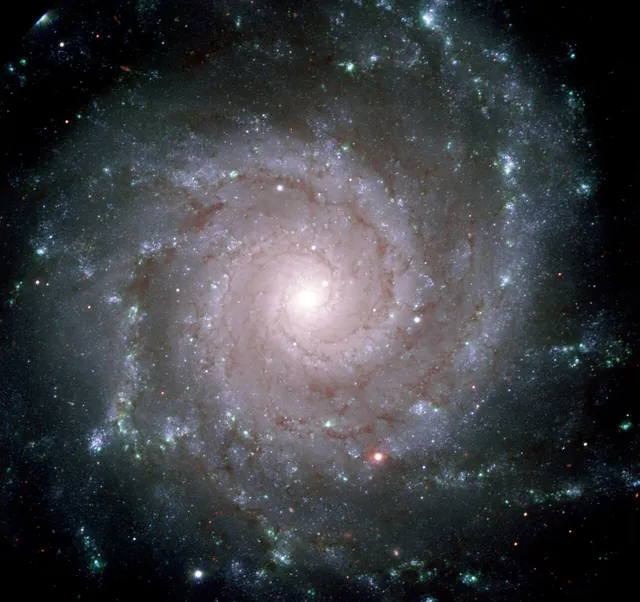
M74 is the prototype of a grand-design spiral, classed as SA(s)c: a barless spiral without a ring. Seen almost face-on, its two symmetrical arms reach out from a small, bright nucleus and are traced by winding dust lanes. Its spiral pattern spans more than 10′ of sky, which the SEDS catalogue converts to roughly 95,000 light-years, similar to our own Galaxy.134
Hubble measurements of its red giant stars place M74 9.77 megaparsecs away, about 32 million light-years; another study by the same method found 10.19 megaparsecs. Its striking symmetry is probably the work of density waves sweeping round the disc. M74 seems to lead a small group of galaxies that includes the peculiar barred spiral NGC 660 and several smaller irregular galaxies.239
Its atomic hydrogen extends well beyond the visible disc. One lopsided extension of hydrogen gas reaches 55 kiloparsecs off-centre and holds 7.5 per cent of M74’s atomic gas, interpreted as gas falling in from outside. It may come from tidally disrupted companions or from a gas cloud captured from intergalactic space.10
- Distance (tip of the red giant branch)
- 9.77 ± 0.17 ± 0.32 Mpc29a 2014 study found 10.19 ± 0.14 ± 0.56 Mpc
- Earlier distance estimates
- 6.7–10.2 Mpc2
- Width of the spiral arms
- about 1,000 light-years3
- Hydrogen extension
- 55 kpc long, 7.5% of the atomic gas10
- Group members
- NGC 660, UGC 891, UGC 1176, UGC 1195, UGCA 203
What makes it shine
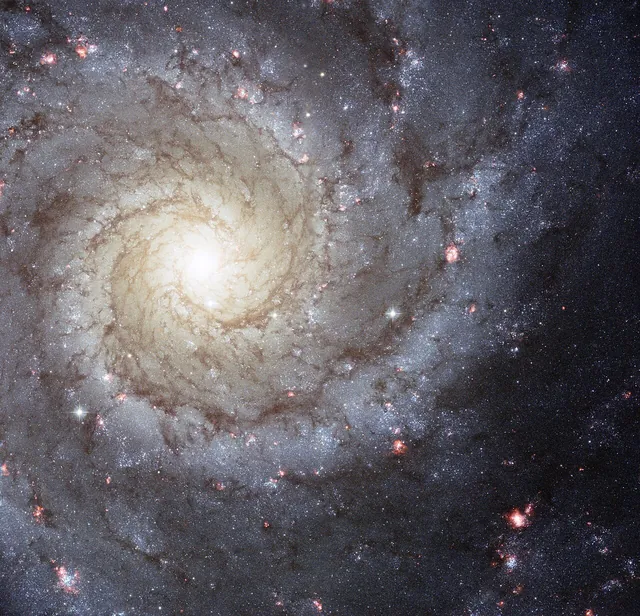
M74’s arms are dotted with clusters of young blue stars and pink H II regions, huge clouds of hydrogen glowing under the ultraviolet light of the hot young stars inside them. An observer’s handbook counts 193 known H II regions. Their number and the strong spiral pattern show that M74’s disc is forming stars vigorously, and they shine brightly in ultraviolet images too.34
In mid-infrared light, Webb sees warm dust instead. Its images revealed filaments of dust emission throughout the galaxy. Mapped at a filament width of 25 parsecs, this dust filament network carries about 30 per cent of the mid-infrared light and contains 75–80 per cent of the H II regions and 60 per cent of star clusters younger than five million years.15
Stars that exploded
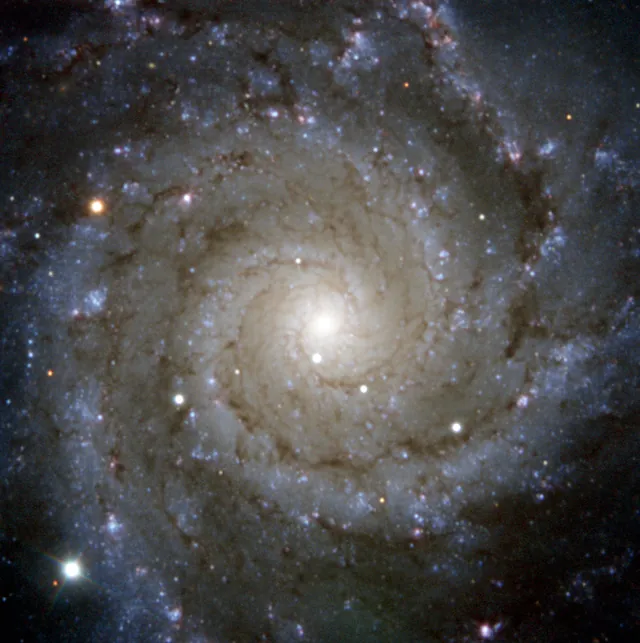
Webb’s infrared view shows the galaxy’s nucleus without obscuring gas, giving a clear look at the nuclear star cluster at its centre. Farther out, M74’s massive stars have made it a rich hunting ground for supernovae. Hubble images taken before Supernova 2003gd exploded show a likely progenitor: a red supergiant of only about 8–9 solar masses.111
Supernova 2013ej came from a star of about 15 solar masses, and its plateau of steady brightness lasted about 94 days. SN 2003gd, SN 2013ej and AT 2019krl lie at the outside edge of a spiral arm, while the unusual Supernova 2002ap exploded at the end of the long hydrogen extension, a possible sign of gas accretion.1012
Notable features
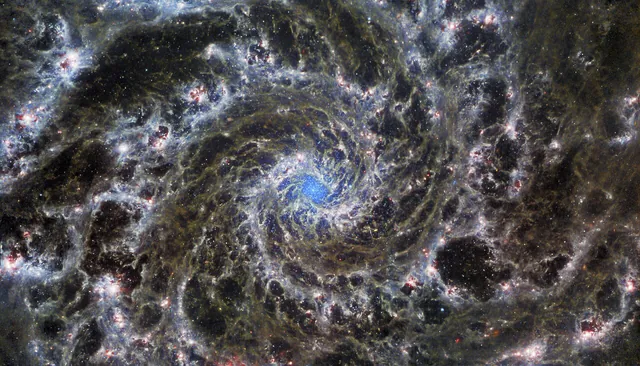
Dust filament network
Webb’s mid-infrared images show delicate filaments of gas and dust winding through the spiral arms, surrounding dark cavities and bright knots. Comparison with Hubble shows that filaments seen glowing and filaments seen blocking light coincide along 40 per cent of sight lines.1513
Supernova 2002ap
Found on 29 January 2002 by the Japanese amateur Yoji Hirose at magnitude 13.7, it brightened to 12.3 in early February. It was a broad-lined Type Ic supernova, unusually energetic enough to be called a hypernova, and it exploded near the end of a long tail of hydrogen gas.310
Supernova 2003gd
Spotted visually by Bob Evans in Australia on 12 June 2003, already fading at magnitude 13.2. A Type II-plateau supernova, it had a likely progenitor star visible in earlier Hubble images; if confirmed, that star would be only the sixth supernova progenitor ever identified directly.311
Supernova 2013ej
First reported on 25 July 2013 by the KAIT telescope team in California, with an earlier image taken by the amateur astronomer Christina Feliciano on the public Slooh camera. It was the third supernova seen in M74 since 2000, and a Type II-plateau explosion.69
AT 2019krl
An intermediate-luminosity outburst in 2019, listed in one study as SN 2019krl but described by others as a supernova impostor. Archive images reveal its progenitor star, probably a blue supergiant or a dust-obscured luminous blue variable of more than 20 solar masses.710
Discovery and history
Pierre Méchain discovered M74 at the end of September 1780 and told his friend Charles Messier, who measured its position and added it to his catalogue on 18 October 1780. Lord Rosse later listed it among 14 “spiral or curvilinear nebulae” discovered before 1850. Its almost star-like nucleus was even catalogued as a star, BD +15° 238, in Friedrich Argelander’s Bonner Durchmusterung in 1860.34
Seeing it for yourself
Because its light is spread thinly across a large face-on disc, M74 is one of the most difficult Messier objects to see, and in small telescopes it is only a faint patch. It is easiest to find from Hamal in Aries, following a line through Beta Arietis to Eta Piscium; M74 lies about half a degree north and one and a half degrees east of Eta Piscium.34
Very good skies are needed to see more than the nucleus. From about 10 cm (4 inches) aperture hints of spiral arms appear, and large amateur telescopes of 40 cm and more show knots in and between the arms. NASA’s observing guide names November as the best month. Its brightness is quoted as magnitude 9.4 by the SEDS catalogue and about 10 by NASA.34
Telescopes on M74
Gemini North imaged M74 with its new multi-object spectrograph in August 2001. Hubble’s Advanced Camera for Surveys observed it in 2003 and 2005, and the combined image was released on 29 November 2007. Archival Hubble images have also been used to find the stars that later exploded, and to measure the galaxy’s distance from its red giants.29111415
M74 is one of 19 nearby spiral galaxies imaged by the James Webb Space Telescope’s PHANGS survey in eight bands from 2 to 21 microns, complementing data from ALMA, the VLT’s MUSE instrument and Hubble. ESA launched its Webb Picture of the Month series with M74 in August 2022, and revisited it in 2024 with new data from the FEAST programme.11316
- Gemini North image
- 13–14 August 200114
Quick answers
- What kind of object is the Phantom Galaxy (M74)?
- The Phantom Galaxy (M74) is a grand-design spiral galaxy, type SA(s)c.34
- Which constellation is the Phantom Galaxy (M74) in?
- The Phantom Galaxy (M74) lies in the constellation Pisces.34
- How far away is the Phantom Galaxy (M74)?
- The Phantom Galaxy (M74) is about 32 million light-years (9.77 ± 0.17 ± 0.32 Mpc) from Earth, from the tip of the red giant branch.124
- How big is the Phantom Galaxy (M74)?
- The Phantom Galaxy (M74) is about 95,000 light-years across (from its arms’ 10′ extent at the SEDS distance of 35 million light-years).3
- How bright is the Phantom Galaxy (M74) in the night sky?
- The Phantom Galaxy (M74) has an apparent magnitude of 9.4 (visual; NASA quotes 10).348
- How big does the Phantom Galaxy (M74) look in the sky?
- The Phantom Galaxy (M74) covers 10.2′ × 9.5′ of sky.3
Sources
- Webb Inspects the Heart of the Phantom Galaxy (potm2208a) — ESA/Webb, 2022
- Accurate Distances to Important Spiral Galaxies: M63, M74, NGC 1291, NGC 4559, NGC 4625, NGC 5398 (McQuinn et al.) — arXiv:1706.06586, 2017
- Messier 74 (H. Frommert & C. Kronberg) — SEDS Messier Database (Observatoire de Paris mirror), 2007
- Messier 74 — NASA Science, Hubble’s Messier Catalog
- PHANGS-JWST First Results: The Dust Filament Network of NGC 628 and its Relation to Star Formation Activity (Thilker et al.) — Astrophysical Journal Letters (arXiv:2301.00881), 2023
- PESSTO snaps Supernova in Messier 74 (potw1335a) — European Southern Observatory, 2013
- The Blue Supergiant Progenitor of the Supernova Imposter AT 2019krl (Andrews et al.) — Astrophysical Journal 917, 63 (arXiv:2009.13541), 2021
- SIMBAD astronomical database: M 74 — Centre de Données astronomiques de Strasbourg (CDS)
- The Tip of the Red Giant Branch Distance to the Perfect Spiral Galaxy M74 Hosting Three Core-Collapse Supernovae (Jang & Lee) — Astrophysical Journal 792, 52 (arXiv:1407.2246), 2014
- Connection of supernovae 2002ap, 2003gd, 2013ej, and 2019krl in M74 with atomic gas accretion and spiral structure (Michałowski et al.) — Astronomy & Astrophysics 638, A47 (arXiv:2004.11391), 2020
- On the Progenitor of the Type II-Plateau Supernova 2003gd in Messier 74 (Van Dyk, Li & Filippenko) — Publications of the Astronomical Society of the Pacific 115, 1289 (arXiv:astro-ph/0307226), 2003
- Extensive Spectroscopy and Photometry of the Type IIP Supernova 2013ej (Dhungana et al.) — Astrophysical Journal 822, 6 (arXiv:1509.01721), 2016
- Catching the edge of the Phantom Galaxy (potm2410a) — ESA/Webb, 2024
- Perfect Spiral M74 (gemini0607a) — NOIRLab / International Gemini Observatory, 2006
- Holiday Wishes from the Hubble Space Telescope — NASA Science (Hubble news release), 2007
- The PHANGS-JWST Treasury Survey: Star Formation, Feedback, and Dust Physics at High Angular Resolution in Nearby GalaxieS (Lee et al.) — Astrophysical Journal Letters (arXiv:2212.02667), 2023
Figures checked against these sources in November 2026. Where a quantity is not known, it is left out rather than estimated.

