moon
Hyperion
Hyperion is the strangest-looking of Saturn’s moons: a lumpy, potato-shaped body about 360 km long, pitted all over with deep, sharp-edged craters that give it the look of a giant sponge. It is the largest of Saturn’s irregularly shaped moons and orbits about 1.5 million km from the planet, a little beyond Titan, taking just over 21 days to go round.1234
Hyperion is also the only moon known to tumble chaotically, its spin changing unpredictably from one orbit to the next instead of settling into the steady lock most moons fall into. Its density is only about half that of water, so more than 40 per cent of its interior may be empty space, which helps explain why its craters have survived so sharp.135
A light, lumpy moon
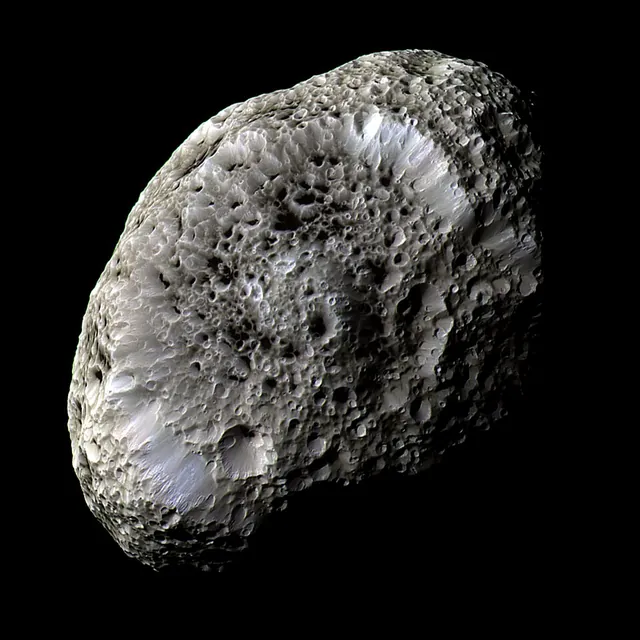
Hyperion is far from round. NASA’s fact sheet gives its three radii as 180, 133 and 103 km, making it roughly 360 km long but only about 206 km through its shortest axis; NASA’s moon page quotes 410 × 260 × 220 km. Its mean radius is 135 km, and its odd shape suggests to NASA scientists that it may be a remnant of a larger moon broken up by a major impact.126
Cassini measured both the size and the mass, giving a density of 544 ± 50 kg/m³, little more than half that of water. If Hyperion is mostly water ice, that means more than 40 per cent of its volume is empty space. It may be a loose pile of smaller icy and rocky pieces that never had enough gravity to squeeze together, perhaps with lighter ices such as frozen methane or carbon dioxide mixed in.13
- Radii (three axes)
- 180 × 133 × 103 km2
- Dimensions quoted by NASA
- 410 × 260 × 220 km1
- Mean radius
- 135 ± 4 km6
- Mass
- 5.6 × 10¹⁸ kg2
- Gravitational parameter (GM)
- 0.37049 km³/s²6
- Porosity
- more than 40%3
- Surface gravity
- about 0.02 m/s²6derived from GM and mean radius; it varies greatly over such an irregular body
- Visual geometric albedo
- 0.32
A chaotic tumble
Hyperion orbits Saturn every 21.28 days at an average distance of 1,500,930 km, in a noticeably stretched orbit with an eccentricity of about 0.1. It shares a resonance with Titan, Saturn’s largest moon, which orbits at about 1,221,850 km. As the two pass each other, Titan’s pull keeps Hyperion’s orbit eccentric instead of letting it become more circular over time.127
Most moons end up tidally locked, always showing their planet the same face. Hyperion has escaped that fate. Its distance from Saturn and the tugging of Titan leave it tumbling unpredictably, and it is the only moon observed to rotate chaotically, a behaviour analysed by Wisdom, Peale and Mignard in 1984. NASA’s moon page says it turns roughly once every 13 days.12310
- Orbital period
- 21.276609 days2
Discovery
William Cranch Bond and his son George Phillips Bond spotted it from Cambridge, Massachusetts, on 16 September 1848, and William Lassell found it independently from Liverpool on 18 September. All three are jointly credited. A ridge on the moon, Bond-Lassell Dorsum, is named after the discoverers.181112
Lassell named the moon after one of the Titans, following John Herschel’s suggestion that Saturn’s moons take the names of the brothers and sisters of Kronos. In Greek myth Hyperion, ‘he who watches over’, was a son of Uranus and Gaia and the father of Helios, the Sun, Eos, the dawn, and Selene, the Moon.18
A sponge in space
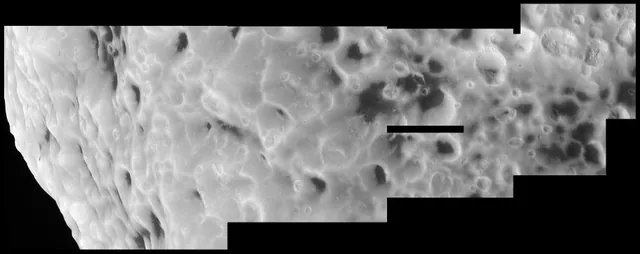
Cassini’s close-up images show a surface unlike any other in the Saturn system, densely packed with well-preserved craters two to ten kilometres across. They are unusually deep and lack bright rays of ejecta, giving a punched-in look like a sponge or a wasp nest. Because Hyperion is so porous, impacts seem to compress the surface rather than blast material out, and its weak gravity lets much of the little ejecta escape altogether.1345
Bright, icy material covers most of the surface, while a unit about four times darker lies mostly in crater floors. Two Cassini instruments found that this dark material resembles the surfaces of Phoebe and the dark side of Iapetus. It may be only tens of metres thick, with brighter ground beneath, and landslides have partly filled many craters on steeper slopes.1913
Hyperion also gave Cassini a jolt. During the flyby of 26 September 2005 the spacecraft passed through a stream of electrons leaving the moon’s surface, which carried a strongly negative electric charge. Tom Nordheim, who led the 2014 study, likened it to Cassini receiving a 200-volt electric shock, although the two were more than 2,000 km apart.1415
Exploration
Cassini made its closest pass on 26 September 2005, flying about 505 km from the surface, and returned the sharp images and spectra that revealed Hyperion’s sponge-like surface and low density. The imaging team used the flyby to measure the moon’s size and mass, and its results, with the instrument teams’ maps of surface composition, were published in Nature in July 2007.391316
Cassini’s last close look came on 31 May 2015, from about 34,000 km. NASA described the processed views as Cassini’s final close look at this moon, which it called quite porous, with weak surface gravity. The mission’s grand finale, a series of dives between Saturn and its rings, was then set for 2017.16
Quick answers
- How massive is Hyperion?
- Hyperion has a mass of 5.6 × 10¹⁸ kg.2
- How dense is Hyperion?
- Hyperion has a mean density of 0.54 g/cm³ (about half the density of water).36
- How long is a day on Hyperion?
- A day on Hyperion lasts Chaotic (tumbles unpredictably; NASA puts one turn at roughly 13 days).123
- How far is Hyperion from Saturn?
- Hyperion is 1,500,930 km from Saturn (semi-major axis, about 25 Saturn radii).2
- What is the temperature on Hyperion?
- The temperature on Hyperion is about −180 °C (average).1
Sources
- Hyperion — NASA Science, 2024
- Saturnian Satellite Fact Sheet — NASA Space Science Data Coordinated Archive, 2025
- Thomas et al., Hyperion’s sponge-like appearance — Nature, 2007
- Odd World (PIA07740) — NASA Photojournal, 2005
- Cosmic Blasting Zone (PIA07761) — NASA Photojournal, 2005
- Planetary Satellite Physical Parameters — NASA/JPL Solar System Dynamics
- Planetary Satellite Mean Elements — NASA/JPL Solar System Dynamics
- Planet and Satellite Names and Discoverers — IAU/USGS Gazetteer of Planetary Nomenclature
- Cruikshank et al., Surface composition of Hyperion — Nature, 2007
- Wisdom, Peale and Mignard, The chaotic rotation of Hyperion — Icarus, 1984
- Bond-Lassell Dorsum (Hyperion) — IAU/USGS Gazetteer of Planetary Nomenclature
- Planetary Satellite Discovery Circumstances — NASA/JPL Solar System Dynamics
- Hyperion’s Unusual Craters (PIA07741) — NASA Photojournal, 2005
- Cassini Caught in Hyperion’s Particle Beam — NASA Jet Propulsion Laboratory, 2014
- Nordheim et al., Detection of a strongly negative surface potential at Saturn’s moon Hyperion — Geophysical Research Letters, 2014
- Cassini Sends Final Close Views of Odd Moon Hyperion — NASA Jet Propulsion Laboratory, 2015
Figures checked against these sources in November 2026. Where a quantity is not known, it is left out rather than estimated.

